
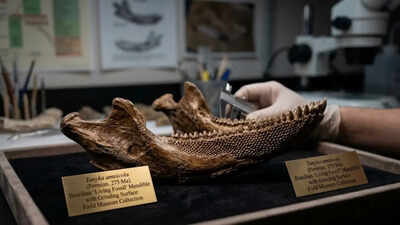
Researchers working on fossils from Brazil found a new kind of tetrapod fossil from 275-million years ago called Tanyka amnicola. This creature is believed to be a living fossil for its time because of its bizarre jaw structure.
Tanyka had lower jaws that twisted in such a way that the teeth would point out at odd angles. The inside of its lower jaw was covered with tiny teeth (called denticles) arranged like cheese grater teeth. The creature belonged to a lineage that lived for a much longer period than its closest relatives. Tanyka, which measured about three feet long, gives scientists a rare glimpse into what the unique, isolated ecosystems of Gondwana looked like during the Permian period.
Scientists baffled by 275-million-year-old fossil in Brazil
The discovery of Tanyka amnicola adds to our understanding of what a relict lineage is, according to the Field Museum, as it’s an animal that existed roughly 60 million years after its closest known relatives had vanished from the fossil record. Lead researcher Jason Pardo, Tanyka can be compared to the platypus, as it was able to live in a time when many other vertebrates were more evolutionarily advanced than it.
How Tanyka processed tough vegetation
According to the book Proceedings of the Royal Society B, one of the most interesting parts of this specimen is the mandible (lower jaw).
The lower jaw is twisted, which made the primary teeth point outward towards the cheeks, instead of upward. The bone had a dense area of small, sharp denticles covering the upper surface, which likely caused the denticles to rub against the upper jaw and help grind down tough plant material, indicating that Tanyka is one of the earliest known herbivorous vertebrates.
The story of the ‘Guaraní Jaw’
Most of what we know about the Permian period has been documented from the Northern Hemisphere (Laurussia); the discovery of Tanyka amnicola will provide important information about Gondwana (the supercontinent located in the southern hemisphere), as noted in the National Science Foundation.
This discovery suggests that the ecosystems found in South America had unique evolutionary experiments and lineages that survived within them, and these lineages did not exist elsewhere in the world.Both aspects reflect the characteristics of the fossil find and the area where it was discovered. According to the Field Museum, the genus name Tanyka comes from the Guaraní language, which is the indigenous language of the area in Brazil where it was discovered, and means ‘jaw.’
The species name amnicola is Latin and means ‘of the river,’ referring to the aquatic lifestyle within the high-stability lacustrine (lake) systems of the Parnaíba Basin.
How a ‘living fossil’ survived the ages
The geology of the Pedra de Fogo Formation shows that Tanyka lived in a complex freshwater ecological setting with numerous lakes and rivers as its primary ecosystems, as published in the scientific journal ‘Proceedings of the Royal Society B’. Many other relatives of Tanyka had been extinct for millions of years before the existence of Tanyka in this part of Gondwana, but the unique ecological conditions of this area allowed Tanyka to be a ‘living fossil.
’ It occupied a unique herbivorous ecological niche via its specialised jaw structure, which allowed it to process a wide variety of aquatic plants that other Permian-period herbivores were unable to easily process.