
The accused were nabbed from different locations, including Gurgaon, Kasganj, Ahmedabad and Jalgaon
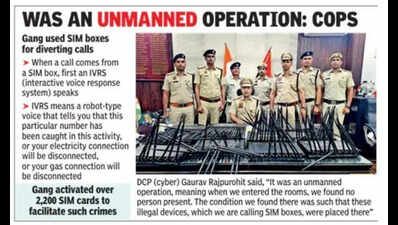
Gurgaon: A cyber fraud module operating an illegal SIM box network — with links to the Philippines and Cambodia — has been busted in the city.Five people have been arrested during the last two weeks, police said on Wednesday, adding that the accused were nabbed from different locations, including Gurgaon, Kasganj, Ahmedabad and Jalgaon.Investigators said the equipment — SIM boxes (GSM gateways) — was used for routing and diverting calls over the internet, masking the origin of calls and enabling cyber fraud, including so-called “digital arrest” scams. The gang activated over 2,200 SIM cards to facilitate such crimes, officials said.A large cache of equipment has been seized, police said, adding that five FIRs were registered based on complaints received at Cyber Crime West and Cyber South police stations.An SIT, led by ACP (cyber crime) Priyanshu Dewan, conducted raids in U-Block and Chakkarpur and seized 15 SIM boxes, seven Wi-Fi TAPO cameras with human detection, seven Wi-Fi routers, seven inverters, 42 batteries, 29 TAPO Wi-Fi switches, 28 ethernet wires, 504 SIM cards, a railway ticket and packaging material.DCP (cyber) Gaurav Rajpurohit said, “It was a manless operation, meaning when we entered the rooms, we found no person present.
The condition we found there was such that these illegal devices, which we are calling SIM boxes, were placed there.”The DCP said when a call comes from a SIM box, first an IVRS (interactive voice response system) speaks. IVRS means a robot-type voice that tells you that this particular number has been caught in this activity, or your electricity connection will be disconnected, or your gas connection will be disconnected.
The robot speaks — the IVRS speaks — and tempts you to press some button so that your call gets transferred somewhere outside.
The SIM box was connected to batteries and UPS so that it does not shut off during a power cut.A senior police officer said, “The devices were sourced from the Philippines, routed through Nepal to Bihar and then distributed across cities in India. The network also facilitated trafficking of individuals to Cambodia, where they were coerced into carrying out cyber fraud operations.”Police have seized mobile phones and digital evidence, including chats and transaction details. Investigation is underway to trace other members of the network and establish the full scale of operations along with the number of scams happening through this mode.Complainants, mostly landlords, flagged suspicious activities by tenants who had installed SIM boxes (GSM gateways) inside rented accommodations, enabling unauthorised telecom operations, a police officer said.
GSM gateways are hardware devices that allow businesses to make direct calls and send SMS using SIM cards.The accused have been identified as Rahul Kumar from Kasganj in Uttar Pradesh, Yash Amrit Singh Dugar from Ahmedabad, Bhavika Ramesh Bhagchandani from Kutch in Gujarat, and Litesh and Sagar from Jalgaon in Maharashtra.Rahul Kumar told police that he came in contact with a handler based in the Philippines through an associate.
“The handler supplied SIM boxes and other equipment and guided the installation through video calls. Kumar installed the devices at multiple locations in Gurgaon and received payments for the work. The rented premises and internet connections were arranged in the name of co-accused Sagar,” a senior officer said.Bhavika was in touch with an associate in Cambodia and handled conversion of cryptocurrency (USDT) into Indian currency and vice versa with the help of Yash.“On an average, around 200 calls are made in a day through a single SIM box. This equipment is necessary for the scamsters to break the gateway of being called from a foreign number, which the victim could easily decline, fearing it to be a scam call. Through this medium, the calls are diverted through this box and the SIM installed in these boxes were of Indian origin,” another officer said.A single SIM box has a slot of 32 SIM cards and the calls are randomly connected.
“It is an automatic process, as one phone is disconnected or is shown busy in the box, it automatically connects to another. The operation is handled from outside the country,” an officer said, adding, “Through WhatsApp calling, or calling through Instagram, or calling through Telegram, people sitting abroad were making VoIP calls (Voice over Internet Protocol).
”“These are internet calls made from one app to another app. So this type of VoIP call was also being converted into our routine calls,” DCP added.The box gave them two advantages — first, they would bypass the gateway for international calls and land them in India, and second, they would convert them into routine calls so that the person they were calling would trust them. “This SIM box network bust has given us a major breakthrough. Cyber crime has two verticals — one is the financial vertical and the second is the telecom vertical in which they use fake SIM cards.
So we have made a very big attack on the telecom vertical.”

