

New insights from medical professionals highlight an alarming correlation: inadequate sleep combined with high stress significantly increases the likelihood of seizures by affecting how the brain operates. These frequently underestimated factors are a part of everyday life, disturbing the delicate equilibrium in our neural processes.
Sleep feels negotiable. Stress feels unavoidable. But for many people living with seizures, both can quietly shift the brain toward danger.Doctors now point to a clear pattern. Missed sleep and rising stress do not just affect mood.
They change how the brain fires, how neurons behave, and how easily a seizure can begin.
The link is not always obvious, which is why it gets ignored.As Dr Praveen Gupta explains, “Stress and sleep problems are two of the most common but least recognized causes of seizures in people with epilepsy.” That single line captures a gap in how people manage their condition.This is where awareness matters. Because the triggers are often part of everyday life.
The night the brain becomes vulnerable
Sleep is not passive rest. It is active repair. During deep sleep, the brain resets electrical activity and balances chemicals that keep signals steady.When sleep falls short, that balance weakens.Dr Vivek Barun puts it simply, “When a person does not get enough rest the brain becomes more excitable making it easier for seizures to occur.”This is not just theory. Research supported by the National Institutes of Health shows that sleep deprivation lowers the seizure threshold, meaning the brain needs less stimulation to trigger abnormal electrical bursts.
Even a single night of poor sleep can tilt the balance. That is why some patients report seizures after late nights, travel, or irregular schedules.Conditions like Juvenile Myoclonic Epilepsy show this link even more strongly. Morning seizures often follow disrupted sleep.
Stress: the trigger people underestimate
Stress does not stay in the mind. It moves through the body.When pressure builds, cortisol levels rise. Heart rate changes. Sleep gets lighter and more broken.
And inside the brain, chemical signals shift.“Stress makes things even worse,” says Dr Gupta. “It works in several ways such as raising cortisol levels, messing up sleep cycles and changing the balance of neurotransmitters in the brain.”This creates a chain reaction. Neurons become more reactive. Signals misfire more easily. The brain moves closer to a seizure state.A review published in the NIH also notes that stress is among the commonly reported seizure triggers in people with epilepsy.Yet stress often goes unnoticed because it builds slowly. Work pressure, emotional strain, lack of rest, and constant screen exposure all add up.

Together, they create a cycle that increases seizure risk.
The cycle that quietly worsens seizures
Here is the part many miss. Sleep loss and stress do not act alone. They feed each other.Poor sleep raises stress levels the next day. High stress makes it harder to sleep the following night. The cycle repeats.Dr Barun explains it clearly: “Stress and sleep are closely related.
Not getting enough sleep raises stress levels and being stressed makes it harder to sleep. This makes the cycle worse.”Over time, this loop can reduce seizure control, even when medication stays the same.That is why some patients feel confused. They follow prescriptions, yet episodes increase. The missing piece often lies in lifestyle patterns, not dosage.
The hidden risks people don’t notice
Not all triggers look dramatic.
Many hide in daily habits.Late-night scrolling may seem harmless, but blue light delays sleep hormones. Skipped meals or excess caffeine can increase restlessness. Emotional burnout often shows up as fatigue, not stress.There is also a timing factor. Dr Gupta points out that “not only the amount but also the timing of sleep is important.” Irregular sleep hours can disturb the brain’s internal clock, making seizures more likely.Then there is accumulated fatigue. People may function through it, but the brain keeps score.The risk builds quietly, then shows up suddenly.
Small changes that make a real difference
Managing seizures is not only about medication. It is also about creating stability for the brain. The good news is that small changes can shift risk in a meaningful way.Start with sleep. Aim for 7 to 9 hours each night, at consistent times. The brain responds well to rhythm.Reduce screen exposure at least one hour before bed.
This helps natural sleep signals return.Build simple stress breaks into the day. Slow breathing, short walks, or quiet time can lower cortisol levels.Dr Barun advises, “Using relaxation techniques like meditation and dealing with stress every day can all help a lot.”Limit caffeine, especially in the evening. And notice patterns. If seizures follow certain routines, those routines may need adjustment.These are not dramatic fixes.
But they are steady ones.
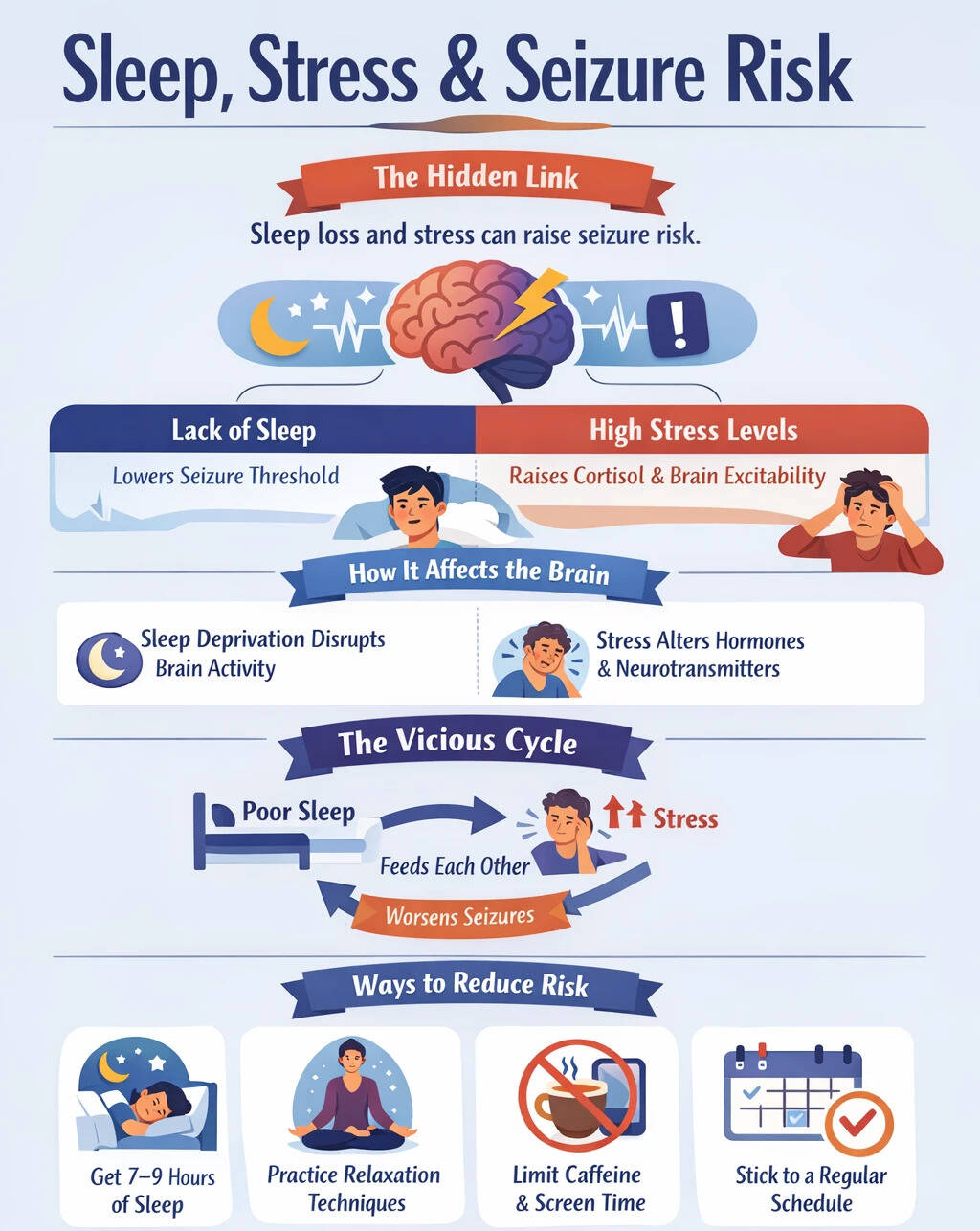
Simple habits like consistent sleep, stress management, and reduced screen time can improve control alongside medication.
A more complete way to think about control
There is a tendency to see seizures as sudden and unpredictable. But in many cases, the brain gives signals through patterns.Sleep loss. Rising stress. Irregular routines.These are not side notes. They are part of the condition.As Dr Gupta notes, “You need more than just medicine to control epilepsy well. You also need to get enough sleep, deal with stress, and keep your life in balance.”That shift in thinking can change outcomes. It brings control back into daily life, where it often belongs.Medical experts consultedThis article includes expert inputs shared with TOI Health by:Dr Praveen Gupta, Chairman – Marengo Asia International Institute of Neuro & Spine (MAIINS), Marengo Asia Hospitals, Gurugram.Dr Vivek Barun, Sr Consultant, Epilepsy & Neurology, Artemis Hospitals.Inputs were used to highlight how poor sleep and high stress levels may increase seizure risk, along with practical steps to manage these triggers effectively.




