
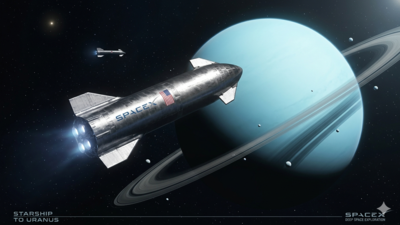
Getting to Uranus had always been a fascination for many scientists. However, because of its immense distance from Earth, any mission there was always seen as one that took decades to complete.
However, the advent of Starship, the next-generation rocket that SpaceX is currently working on, might put an end to this age-old story. According to recent studies, this revolutionary rocket can potentially shave off almost half of the travel time to the planet, making it a lot easier to reach than ever before.
Uranus in half the time: How SpaceX Starship could make it possible
This is due to the special characteristics of Starship. Unlike the normal rocket, the Starship was manufactured to refuel in space orbit. This implies that Starship will have its fuel tank fully loaded once it exits Earth into outer space. As such, it will be faster and more direct when travelling to distant worlds.According to research, ‘Starship as an Enabling Option for a Uranus Flagship Mission’ conducted by MIT scientists, a starship can be used to fly straight to Uranus within six years, less than half the time of other existing missions.In the same vein, Chloe Gentgen, a research scientist at MIT, stated that “if refuelled in orbit, Starship can launch a spacecraft straight to Uranus”.
One more advantage is in its weight capacity. Since it is large and powerful, it has the capacity to transport bigger loads to other planets.
Why does travelling to Uranus take so long
Uranus lies at a tremendous distance from Earth, 19 times further than our planet from the Sun. Such great distances have always posed the most significant challenge for interplanetary missions. The Voyager 2 probe launched by NASA was the only craft to reach Uranus, spending over nine and a half years just for a flyby manoeuvre.Proposed contemporary solutions have not brought much difference either. Previous designs employing rocket boosters such as Falcon Heavy projected a voyage period of about 13 years, with extensive use of gravity assists from other celestial bodies to save energy.Such prolonged periods not only present practical problems but also raise the cost of missions, pose a risk of losing experienced personnel, and hinder scientific discoveries.
As some scientists note, minimising flight duration is crucial for future success.
Why a faster mission to Uranus matters
The planet of Uranus has been one of the most under-researched planets in the Solar System up until now. We have gathered only a little information through a fleeting flyover of the planet made almost four decades ago. However, this planet is scientifically very interesting with its sideways orientation, peculiar magnetic fields, and even possible subsurface water oceans on some of its moons.
This makes it worth investigating from the point of view of discovering alien worlds.Accordingly, as the debriefed 2022 Planetary Science Decadal Survey via The Planetary Society, a Uranus mission was stated as a top priority for exploration.Reducing the flight time by half can be beneficial in numerous ways. It will speed up scientific discoveries, minimise risks, provide better conditions of observation during particular planetary alignments, and change the way humans explore faraway planets like Neptune and beyond.In many aspects, Starship means more than just a new rocket. If this prediction becomes reality, travelling to Uranus will become much easier.