
ETimes.in / Mar 29, 2026, 18:15 IST
AA
Text Size
- Small
- Medium
- Large
1/6
Losing hair every day? Here’s how to tell if it’s just stress or your genes
Waking up to a pillow covered in loose strands is enough to send anyone into a panic. You immediately start wondering if you’re going bald. But before you spend a fortune on miracle oils or start wearing hats indoors, take a deep breath.
Not all hair loss is created equal. In fact, figuring out exactly why your hair is falling out is half the battle. Our bodies are pretty smart, and they usually leave some very obvious clues that point to either an external trigger (like stress or a bad diet) or good old-fashioned genetics. Here is a breakdown of how to decode what your hair is trying to tell you.
by TOI Lifestyle Desk

2/6
The ‘slow fade’ vs the ‘sudden shed’
The biggest giveaway is how fast it happens. Genetic hair loss, clinically known as androgenetic alopecia, is basically a sneak thief. It’s caused by an inherited sensitivity to DHT—a hormone that slowly shrinks your hair follicles over time. This doesn’t happen overnight. It takes years, sometimes decades, for the thinning to become truly noticeable.
On the flip side, non-genetic hair loss is dramatic. It’s reactionary. If you’re suddenly pulling out massive clumps of hair in the shower or finding your brush full after just a few strokes, genetics probably aren’t to blame. This sudden shedding is often your body reacting to a major systemic shock.

3/6
Where exactly are you losing it?
Take a good look in the mirror. Where is the hair actually disappearing from?
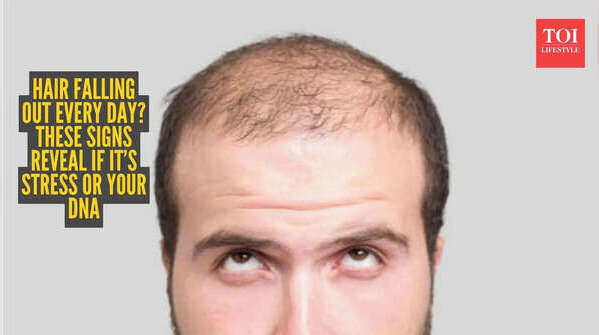
If it’s genetic, it follows a strict set of rules. For men, it almost always starts at the temples, pushing back to create a distinct “M” shape, while the crown of the head starts to empty out. Women usually keep their frontal hairline completely intact. Instead, they’ll notice a general thinning all over and a noticeable widening of their natural hair part.
If your hair loss isn’t genetic, the pattern is entirely random. You’ll likely experience diffuse thinning, meaning the hair is falling out evenly from all over your scalp. Or, you might find smooth, completely bald patches the size of a coin, which is a hallmark of an autoimmune condition called alopecia areata.

4/6
Look closely at the strands
Here’s a trick most people don’t know. Look closely at the hairs that are still on your head. In genetic hair loss, the strands undergo something called “miniaturization.”
Because the follicles are shrinking, the hairs they produce become finer, shorter, and much weaker before they finally give up and stop growing altogether. With non-genetic hair loss, the hairs that fall out are usually full-length, normal-thickness strands. They just fell out before their time.

5/6
Is your body screaming for help?
Think back to what was happening in your life about two or three months ago. Did you go through a terrible period of anxiety? Have a severe illness or surgery? Give birth? Go on an extreme diet?
Non-genetic hair loss usually hits a few months after a major physical or emotional stressor. It can also be accompanied by other red flags. A healthy, normal-looking scalp usually points to genetics. But if your scalp is burning, itching, or flaking, or if you’re also losing your eyelashes and eyebrow hairs, you are definitely dealing with a non-genetic health issue.

6/6
What should you do?
You can play detective at home all you want, but the only way to know for absolute certain is to see a professional.
A dermatologist or a trichologist has the tools to give you a real answer. They might use a microscopic evaluation (trichoscopy) to check your scalp for miniaturization – a dead giveaway for genetic loss. They might also do a “pull test” to see how easily your hair comes out, or order blood work to check your thyroid, iron levels, and vitamin D to rule out any hidden nutritional or hormonal problems.
Follow Us On Social Media