
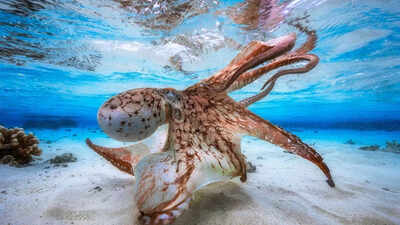
Octopuses are perhaps the most unusual creatures to have ever inhabited the ocean. Their soft body, eight arms, and high level of intelligence make them a fascinating subject of interest to many scientists and lovers of the ocean.
Octopuses are marine animals classified as cephalopods, which include squids and cuttlefish.One of the most unexpected facts about octopuses is the fact that they have three hearts. While humans and most other animals rely on one heart to pump blood throughout their bodies, the octopus has a more complicated system. This has enabled it to survive in the harsh environment of the ocean.Another unusual feature about the octopus is the fact that it has blue blood.
In addition to the blue-colored blood, the octopus has a sophisticated body. This has enabled it to survive in the harsh environment where there may be a low level of oxygen. The three hearts, blue-colored blood, and sophisticated body make the octopus a fascinating subject of interest to many.
Why does an octopus have three hearts
One of the most amazing aspects of the octopus’s anatomy is the fact that it has a three-heart circulatory system. Two of these hearts are branchial hearts, whereas the third one is the systemic heart.
Each of these hearts has a specific role to play, enabling the octopus to live in its aquatic environment.The two branchial hearts are used for the circulation of blood through the gills, where oxygen from the water gets mixed with the blood. This oxygen, after being mixed with the blood, is then circulated to the systemic heart.The systemic heart, after receiving oxygenated blood, circulates it through the octopus’s body, enabling the octopus’s muscles, brain, and other organs to function correctly.
How the three hearts work together
Although it may seem unusual to have three hearts, the system is efficient. The branchial hearts are like pumps specifically meant to pump blood through the gills. They make sure that the oxygen from the water is pumped into the blood.After the blood has passed through the gills, where it has picked up oxygen, it is pumped by the systemic heart to the rest of the body.One interesting thing about the system is that the systemic heart slows down when the octopus swims.
This implies that it takes a lot of energy to swim. It is because of this reason that most octopuses crawl on the floor of the sea instead of swimming.
Octopus blood and oxygen transport
Another unusual aspect of the octopus’s anatomy is the colour of its blood. Instead of having the usual red blood that humans have, the octopus has blue blood. This can be explained by the composition of the octopus’s blood that carries oxygen through its system.Humans and other animals have the iron-based protein called haemoglobin that gives the blood its red colour.
The octopus has the copper-based protein called hemocyanin in its blood.Hemocyanin reacts with oxygen and has the characteristic blue colour when oxygen is present in the blood. This protein reacts best in cold water and low oxygen concentration.However, hemocyanin does not transport oxygen as well as haemoglobin. This is one of the reasons why an octopus needs a more powerful system to transport its oxygen with the aid of three hearts.
Other remarkable features of octopus biology
The three hearts are just one of the many unusual characteristics of the octopus. Octopuses have eight arms, which are all flexible and have suckers on their skin. These arms help the octopus to catch food and explore the environment.Each of the arms has a large number of nerve cells. As a result, the arms have the ability to move in a complex manner and react to their environment in a manner that seems to be independent of the brain.Octopuses are believed to have a high level of intelligence compared to other invertebrates. For instance, it has been noticed that octopuses have the ability to solve puzzles, open containers, and even escape from aquariums.Another ability of the octopus is the ability to change the colour of its skin to enable it to hide from predators or sneak up on the prey without being noticed. It does this by changing the colour of the skin to the colour of the rocks, coral, or sand on the floor of the ocean.
Habitat and lifestyle of octopuses
Octopuses can be found in the world’s oceans, ranging from shallow water to deep-sea environments. Most octopuses prefer rocky areas in the ocean where they can hide in small crevices or caves.They are usually found alone and spend most of their time looking for food. The main source of food for octopuses comprises crabs, shrimp, small fish, and other sea creatures.If the octopus senses danger, it releases dark ink into the water, which confuses the predator and helps the octopus flee the scene in no time. The soft body of the octopus also helps it pass through extremely small spaces, making it hard for the predator to catch the octopus.The octopus remains one of the most fascinating creatures in the ocean and continues to attract the attention of many scientists studying the life of the creatures in the ocean.