
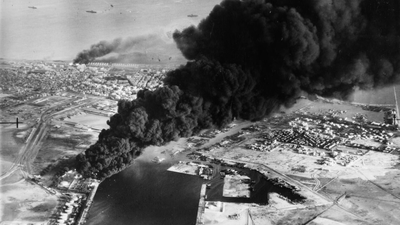
Iranian blockade of Strait of Hormuz and the heavy price that global economy is paying these days bring back dark memories of a similar crisis that had enveloped the world nearly a decade after World War II had ended: the shutdown of the Suez Canal in the wake of a battle in which Egypt was pitted against Israel, the UK and France.
The crisis in Suez — which serves as a lifeline for global trade by facilitating the shortest shipping route between Asia and Europe and America — hogged front-page headlines of newspapers worldwide for months.The Suez conflict was triggered by then Egyptian President Gamal Abdel Nasser’s decision to nationalise the Anglo-French company operating the Canal, which falls in Egyptian territory. However, the power equations in West Asia in the autumn of 1956 were starkly different from those that were to play out in the theatre of war in the same region seventy years later — in the spring of 2026.
On Nov 1 that year, Iran joined hands with the US and the Soviet Union in the UN Security Council over a resolution demanding that an emergency General Assembly meeting be convened to stop the aggression of Israel, the UK and France in Egypt.Then a monarchy, Iran was ruled by Mohammad Reza Pahlavi, who was overthrown in 1979 in the Islamic Revolution led by Ayatollah Ruhollah Khomeini. Israel was governed by David Ben-Gurion.
Ship sunk, canal blockedTOI reported in its edition on Nov 2, 1956, that by supporting the Security Council resolution, which was moved by Yugoslavia, the US had “split from its Western partners (the UK and France) in disagreement over their policy of using force in Egypt”.The other signatories to the Security Council resolution, which was moved by Yugoslavia, were Cuba, Peru and China. France and the UK opposed it, but they were in a minority, resulting in the Yugoslav motion being passed by a 7–2 vote.
Belgium and Australia abstained. The fast-paced drama in the UN coincided with Britain paralysing shipping in the Suez Canal after RAF sank Egyptian warship Akka. The ship was destroyed in Timsah Lake, the canal’s midway point, on Nov 1. Next day, Anglo-French planes sank another Egyptian ship near the entrance to the canal. The destruction of the second ship came on a day when the Gaza Strip, which was then under Egyptian control, surrendered to Israel.
TOI’s front-page headline on Nov 3 read: “Gaza falls: Entire strip now in Israeli hands.” The Suez battle ensured that the canal remained closed for more than five months. It was only by late April the following year that it became operational. Nasser pledged to “fight till the last drop of my blood”. Responding to the sinking of Akka, Nasser said in a 20-minute message broadcast to his nation: “We will fight from village to village, from place to place, until Egypt wins victory.”Eisenhower’s roleContrary to Donald Trump’s aggressive stand and his threat to obliterate Iran’s Kharg Island in Strait of Hormuz, then US President Dwight D Eisenhower is known for his role as a peacemaker during the Suez crisis. He was instrumental in preparing a resolution moved by the US in UN General Assembly which called for an immediate ceasefire in Egypt. Introducing the resolution in the UN on Nov 2, then Secretary of State John Foster Dulles said the conflict over Suez “might develop into World War III”.The resolution asked Israel to “immediately withdraw behind the armistice lines” and called for opening the Suez Canal for shipping after the ceasefire. It also asked the UK and France to refrain from moving war material in the region.The US-sponsored resolution was passed by a 64–5 vote, with the Soviet Union, Iran, China and several other nations backing it. Apart from Israel, France and the UK, the two other nations that opposed the move were Australia and New Zealand.
Among the nations that abstained were Belgium, Canada, Laos, the Netherlands, Portugal and South Africa.India wholeheartedly backed the UN resolution. Then Prime Minister Jawaharlal Nehru wrote to the UN secretary general Dag Hammarskjold, saying: “It is clear and admitted that Israel has committed large-scale aggression against Egypt. Instead of trying to stop this aggression, the UK and France are themselves invading Egyptian territory.”Genesis of Suez crisisThe war-like situation was triggered by Nasser’s decision to nationalise the Anglo-French-owned Suez Canal Company, which operated the manmade channel. Nasser’s move to seize control of the canal followed the US and the UK backing down from their earlier promise to finance the Aswan Dam project, which was aimed at controlling the Nile’s floodwaters. Nasser nationalised the company so that he could use the revenue generated through tolls paid by ships passing through the canal for constructing the Aswan Dam.Though indirectly affected by the Suez crisis, with two of its Cold War allies — France and the UK — being directly involved, the US favoured a diplomatic solution to the problem. However, the UK and France opted for an aggressive approach and collaborated with Israel, which readily agreed, as the move gave it an opportunity to gain control of the Gaza Strip and the Sinai Peninsula.As part of a joint strategy, Israeli army attacked Sinai in Egypt in the last week of Oct.
TOI headlined a front-page report on Nov 2, 1956 — the day it reported RAF paralysing the Suez Canal — that French aircraft had joined the Israeli strike in Sinai.Britain dividedUK’s Parliament was divided on the Suez crisis. There were uproarious scenes in the House of Commons, with opposition Labour MPs demanding the resignation of then British premier Anthony Eden, claiming that “millions of Britons were ashamed of UK aircraft bombing Egypt”.Leader of the Opposition Hugh Gaitskell demanded an announcement from Eden in the House that Britain accepted the resolution passed by UN General Assembly. “Only an unqualified statement of that kind will be sufficient to restore in any way the reputation of this country,” Gaitskell said in the House of Commons, adding that the opposition expected that Britain would not take any further military action in Egypt.End of blockadeAutumn of 1956 was in sharp contrast to spring of 2026, as the UN held considerable influence as an international body then.
After the resolution was passed in General Assembly, a UN peacekeeping force arrived in Egypt in mid-Nov to oversee the withdrawal of forces from the battle zone. By the last week of Dec 1956, French and British forces had withdrawn from Egyptian territory. However, Israel kept its troops in Gaza until March 1957, when the UN compelled it to withdraw from the occupied territory.The crisis finally ended in 1957, with the first British ship passing through the canal on April 19 after paying toll to Egyptian authorities. Days later, a US ship followed suit. France continued the boycott for some time but eventually relented due to high shipping costs.


