
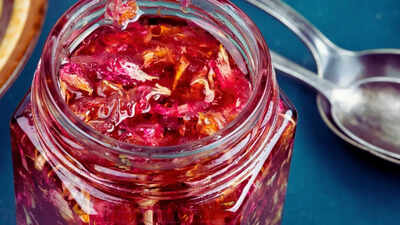
In Ayurveda, Gulkand is not spoken of as a “cooling food.” It is spoken of as a seasonal correction. Summer sharpens Agni. Digestion becomes intense, you feel more thirsty, sleep becomes lighter, emotions rise quicker, and the blood itself begins to carry more heat.
When this heat is not guided out gently, it tries to come out as acidity, rashes, ulcers, irritability, or hormonal disturbance. Ayurveda does not respond to this with extremes. It responds with balance.Gulkand exists for this reason. The rose, by nature, moves upward and outward. When infused slowly under the sun, its cooling rasa becomes refined, not raw. Gulkand does not suddenly drop body temperature. It teaches the body how to release excess heat naturally, especially from the gut and the blood, where Pitta quietly accumulates during summer. At an Ayurvedic level, Gulkand is described as a Pitta-shamak dravya, traditionally used in heat-driven states like amlapitta, burning sensations, and excess sweating—where cooling is needed without suppression.This is why Gulkand has always been advised in small quantities, taken consistently, and paired thoughtfully. Its sweetness nourishes, but more importantly, it stabilises. Its sheeta virya helps reduce internal heat, while its madhura rasa and vipaka pacify the sharp and fluid qualities of aggravated Pitta.
It calms the dryness that follows heat, supports rakta dhatu, and softens the nervous system without dulling awareness. Ayurveda values it because it cools without weakening digestion, something very few summer remedies are able to do. This is also why Gulkand is known to support gentle bowel regulation (mridu virechana) in summer, easing constipation and abdominal heat without irritation.When Gulkand is taken with warm milk, it becomes restorative rather than stimulating.
Warm milk allows the rose to travel deeper, easing heat that shows up as fatigue, disturbed sleep, or hormonal sensitivity. This is especially relevant in summer, when people feel tired despite eating well, or restless despite being physically exhausted. The body is not lacking energy, it is overheated. Gulkand corrects this gently.
The same cooling and stabilising action is why Gulkand is used in Pittaja yoni vyapad, especially when heat expresses as burning, irritability, or heat-associated discharge. Taken with fennel, Gulkand works closer to the digestive fire. Fennel guides excess heat downward, preventing it from rising as acidity, bloating, or mouth ulcers. This pairing was traditionally used when digestion felt irritated rather than weak. When meals were being digested too fast, not too slow. Ayurveda recognises this nuance, and Gulkand fits into it beautifully.In traditional paan, Gulkand was never decorative. It was functional.
Betel leaf activates digestion, increases circulation, and generates warmth. Gulkand was added to ensure this warmth did not tip into excess. The pairing allowed digestion to stay active while keeping the system cool and composed. When prepared correctly and used occasionally, it refreshed the body without overstimulation.Even in buttermilk, Gulkand has a role, not as a flavouring, but as a stabiliser. Summer often creates irregular digestion: loose stools, burning sensations, or intestinal heat.
Buttermilk steadies Agni, gulkand cools the intestinal lining. Together, they restore rhythm rather than suppress symptoms. This combination is traditionally chosen when digestive disturbance is driven by heat and irritation, not heaviness or coldness.
In Ayurveda, Gulkand was never understood merely as something sweet. It was understood as a quiet response to the body’s seasonal needs. Gulkand is naturally most suited to Pitta-dominant constitutions, where excess heat, sharp digestion, burning sensations, and irritability are present.
For Pitta-dominant individuals, Gulkand is traditionally taken in a quantity of 1-2 teaspoons (5 – 10 g), with cold or room-temperature milk or plain water, either in the morning or at bedtime.In Vata dosha, a smaller quantity of about 1 teaspoon is advised, taken with warm milk, preferably at night, with the optional addition of a pinch of shunthi (dry ginger) when Agni is weak For Kapha dosha, Gulkand is used sparingly, about ½ teaspoon only, taken with warm water in the morning, and traditionally avoided at night.The article has been authored by Stuti Ashok Gupta, Co-Founder, Amrutam