
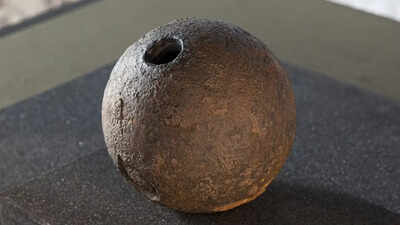
PC: National Trust for Scotland
A team of archaeologists has discovered an undetonated mortar shell from the 1746 Culloden battlefield in Scotland. The find comes as part of an excavation led by both the National Trust for Scotland and the University of Glasgow and provides an excellent insight into the final Jacobite rising through the preservation of this 18th-century shell.
The provenance of the shell being from the government Coehorn mortar, that did not explode after landing in the boggy ground of the battlefield, has allowed archaeologists to use this as an important piece of evidence to help heart of the Culloden battlefield as well as provide site-specific data to help historians understand where artillery was positioned before this pivotal and brutal battle occurred in the Great Britain.
Mortar shell recovered from Scotland’s Culloden battlefield
The recovery of the explosive shell was a team effort between Derek Alexander of the National Trust for Scotland and Professor Tony Pollard of the University of Glasgow. As noted in the report in Archaeology Magazine, this artefact is believed to be a projectile from a Coehorn mortar, a small-calibre ordnance used extensively by the government during the 1746 battle. Experts believe the shell was not detonated because it plunged into soft marshy ground, snuffing out its fuse before igniting the powder charge inside.
How the mortar shell locates the Jacobite artillery
According to archaeologists working on this site, the shell serves as a ‘tactical marker’ enabling them to better understand the trajectory of government fire toward the Jacobite artillery they were targeting based on the approximate location of where the shell landed, as noted in the National Trust for Scotland. Archaeologists believe the shell provides evidence that the area they are currently excavating was a high-intensity zone and could alter the historical understanding of troop formations at this location during this brief but very intense battle.
How archaeologists rendered the shell inert
The shell underwent extensive conservation before being studied and displayed to ensure its safety. It was X-rayed to verify the condition of its contents, then carefully cleaned to stabilise the metal before conservation. The preservation of live historical ordnance recovered from a battlefield typically requires special handling as a combination of forensic science and historic preservation.
April 16, 1746, and the death of the Jacobite Rebellion
On April 16, 1746, the Jacobite Rebellion’s last battle was fought at the Battle of Culloden. Following the loss of Bonnie Prince Charlie’s troops against the government forces led by the Duke of Cumberland, the Highland Clan system was effectively eradicated throughout Scotland. This mortar shell and others like it are direct examples of the devastating technological gap and the enormous firepower the government ‘Redcoats’ relied on in defeating the Jacobites and finally putting an end to the Jacobite Rebellion.