
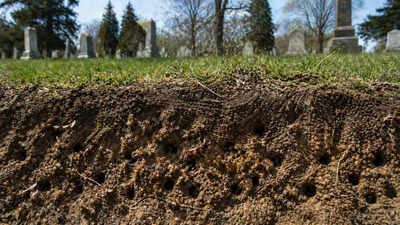
Scientists made an extremely surprising discovery in recent times during an observation carried out as part of the day-to-day routine research work conducted by researcher Rachel Fordyce, where researchers discovered a huge number of bees living underground in what was initially considered an average landscape.
Scientists found about 5.5 million ground-nesting bees in a cemetery in Ithaca, New York.It is important to note that the discovery was not facilitated by any new technologies or major expeditions. In fact, it started with the collection of bees in a jar by Rachel Fordyce from the cemetery. This triggered further research activities using emergence traps by scientists.
A hidden underground city of bees beneath a cemetery
The reason why this discovery is so impressive, however, is due to the fact that not only is the number of bees impressive, but their location as well.
There is an extensive underground city of bees under the seemingly peaceful cemetery, where a vast number of solitary ground-nesting bees create their nests individually but in great numbers all at once.The region covers about 6,000 to 6,500 square meters of land, and the number of bees living there is equivalent to hundreds of bee colonies together.
Why were scientists surprised by the scale of the bees
Ground-dwelling bees are fairly common; however, their numbers are often understated because they reside beneath the ground level.
In this particular instance, the scientists were astounded at the sheer number involved, as the largest colonies recorded before rarely went beyond a few hundred thousand.The type of bee found, namely Andrena regularis, has been part of the ecosystem in the region for several decades without its full colony having been recorded until now.
Why the largest-known underground colony of bees discovery matters for science
It has tremendous ecological significance. Ground-nesting bees are important pollinators, mainly when it comes to flowers and food crops.
They have, however, been neglected in terms of research in comparison to honey bees.According to scientific findings by the study “Massive aggregation of ground-nesting bees (Andrena regularis) in an urban cemetery”, this congregation is highly significant ecologically speaking since they are rarely found.According to a study conducted at Cornell University, areas such as cemeteries are great biodiversity reservoirs due to the minimal disturbances and absence of pesticides.
What this reveals about the hidden natural world of the bees
This finding goes against the notion that discoveries of great ecological significance happen only in areas far away from civilisation.
The discovery illustrates how sophisticated biological systems can thrive beneath our noses without being noticed for decades.Scientists believe that there could be other such occurrences happening in different places that are yet to be reported, indicating deficiencies in our understanding of pollination and underground ecology.
A discovery that changes how we see bees
This discovery shows how the underground colony changes the perspective on bees. This is because not only can bees be found in smaller colonies, but the ground-dwelling bees are able to build large-scale colonies that have a considerable effect on ecology.It shows that there is still much to discover in nature since one is able to uncover the entire hidden bee colony.