
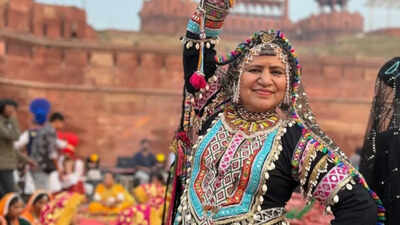
When the music turns on and the heart matches the beats, a dancer begins the enchanting movement of dance passed down through generations and societies. This language of the beats and steps allows one to leap high in the sky and spread freely on the floor, entranced in the feeling of unboundedness.However, in a country with rich historical heritage like India, nothing comes that simply. The land of Bharat, has a journey of fighting for its freedom from the Britishers, those who not only captured land but also culture. Numerous fighters reside in the pages of history with a war of their own. Gulabo Sapera, is one such rebel who revived a dance once banned by the Britishers and placed it on the global stage.
A fight for life
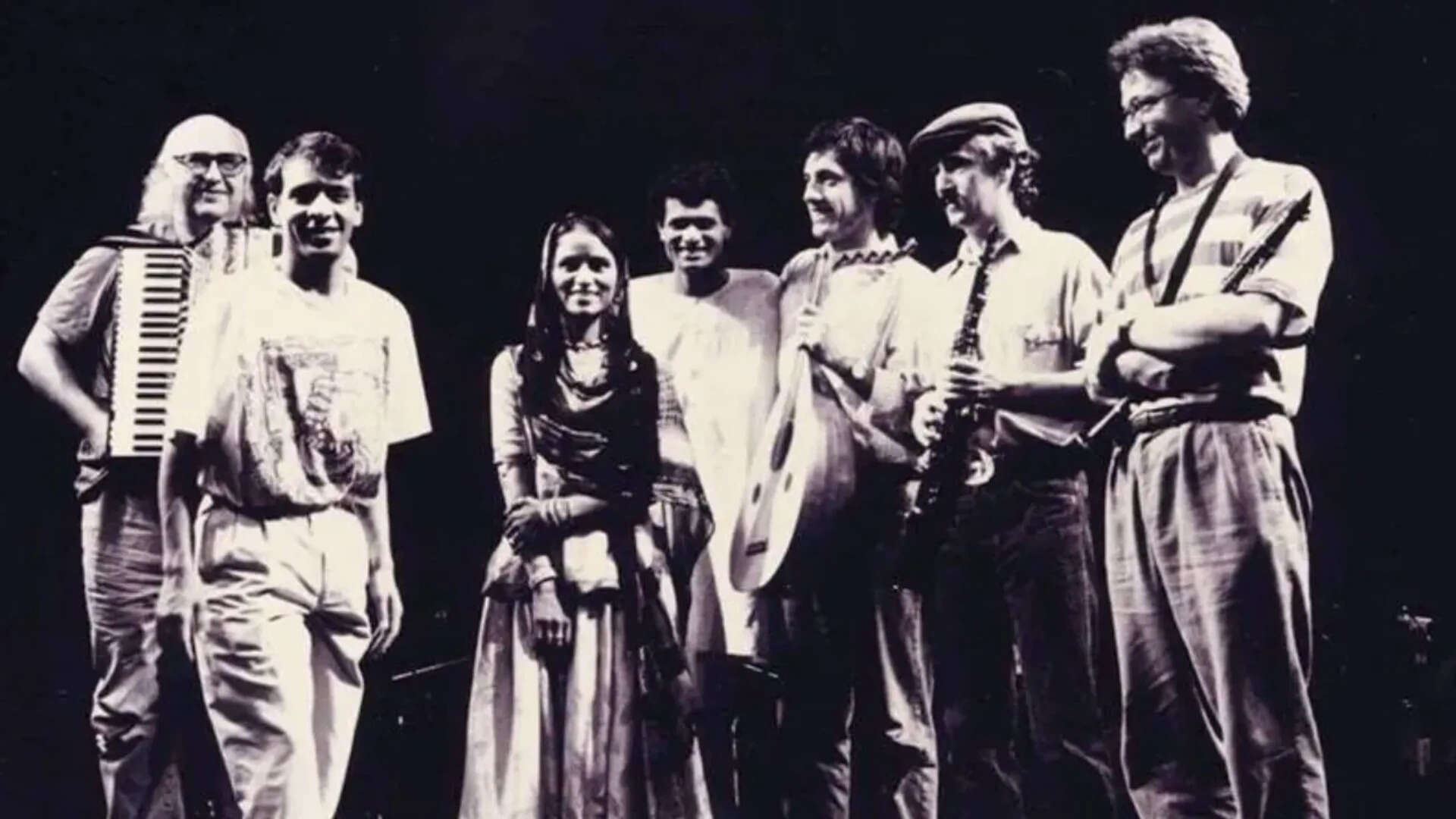
Gulabo Sapera has collaborated with French musician Titi Robin multiple times.
Gulabo Sapera was born in 1973 in Ajmer, Rajasthan in the Kalbeliya community as Dhanvantri.
As the seventh child of her parents, born when female infanticide was common and girls were considered a “burden,” her family buried her when she was just one day old.She survived five hours under the earth before her mother and her aunt dug her out, shared Gulabo with Brut in 2021. “My mother and aunt brought me back from there. I stayed in my mother’s womb for nine months and in the earth’s womb for five hours. So, I have two moms, my mother as well as Mother Earth.”
Her father, a snake charmer, fought for his daughter’s life and was abandoned by the community. Her father named her Gulabo due to her rosy cheeks and her surname Sapera came from the community’s profession.
The steps towards dancing
Hailing from the nomadic Kalbelia community, who traditionally worked as snake charmers and venom traders, she accompanied her father on rounds around villages with snakes when she was barely a few months old.
What began as a childhood fascination soon turned into an unmatched and exemplary talent.In 1985, she travelled to Washington D.C. as a teenager because the Indian government was promoting cultural dances in the US at the ‘Festival of India’ taking place at the Kennedy Centre. At 5 years old, she was performing at a local event at the Pushkar Mela when members of the Rajasthan Tourism department spotted her and helped her get programs.
Soon, Gulabo was leading the dance form she officially created, performing it on TV, in Bollywood and even abroad.In 1991, she lived on the roadside in a tent and was unable to afford housing. Later, Maharani Gayatri Devi adopted her and helped advance her career. She even designed her own costume consisting of a black-flowing ghagra-choli with dupatta and multi-coloured piping which became the hallmark for the dance.
In 2016, she was awarded the Padma Shri for bringing global recognition to Kalbelia folk dance.
Kalbelia: A banned beat of culture
Kalbelia community is one of the oldest tribal communities in Rajasthan. They once worked as snake handlers, which also signifies the name of the tribe: ‘Kal’ meaning snake and ‘Belia’ meaning friend. Another understanding of the tribe’s name is ‘Kal’ meaning death and ‘Belia’ meaning shell, thus meaning a bowl of death.
In this context, the devotees of the sage Kanifnath, who drank the poisonous bowl are known as Kalbelia.The tribe has two subgroups called Dhaliwal and Mewara and uses a language called Sapera. According to Polish poet Jan Kochanowski, the 12th and 13th centuries were the community’s golden age. But as soon as King Prithviraj Chauhan was defeated by Muhammad Ghori, the tribe left Rajasthan to move to Madhya Pradesh and Gujarat.During the British colonial rule in India, the British introduced the Criminal Tribes Act (1871) which restricted and criminalised tribes in India to enforce administrative control. Thus, the movement of the tribe, which practised a profession the British did not understand was restricted and their culture suppressed. In the early 1900s, reports described Kalbeliya performances as “sensual” and “dangerous,” linking them to folk rituals that involved fire and alcohol.
In 1972, the Wildlife Preservation Act passed by the Indian government outlawed wild animal capture and domestication, further limiting the tribe’s livelihood.It was only a year later, that the bearer of their rise was born, one who took the tribe’s culture from a banned profession to a stage of global admiration.
The Kalbelia dance
While not much is written about Kalbelia as a dance form, the art is unique. While the males play instruments like the pungi, the cag and the aphl, the females perform a fast-paced dance with sharp turns and acrobatic steps mimicking the movement of the snake.The costume is uniform: female dancers wear an angrakhi on the upper body, cover their head with an odhani and wear a ghagra on the lower body. They also wear a lot of jewellery.Today, Kalbelia is not just a dance form. It is an art that has kept the existence of a tribe alive and the culture of a nation preserved, against all odds.They say a woman can helm the universe, and in the case of Kalbelia, Gulabo Sapera turned out to be the warrior who fought for her tribe. Today, she is a well-known dancer who has shown the Sapera dance in more than 165 nations. She has attended reality TV shows like Bigg Boss and is in charge of a school in Denmark and another in Pushkar.
In 2010, Kalbelia was added to UNESCO’s representative list of Intangible Cultural Heritage of Humanity. “My community made me a leader and asked me to teach their daughters. ‘But you don’t even save the girl children, you kill them,’ I said to them. They said we won’t kill girl children from hereon, we also want a Gulabo.”Through her life, Gulabo Sapera has revived a dance form, kept a tribe alive, represented her culture on a global stage and saved the lives of numerous girls who aspire to be just like her. All because as Nicole Herbert Dean wrote in his book, Gulabo ‘dances on her grave’.

