
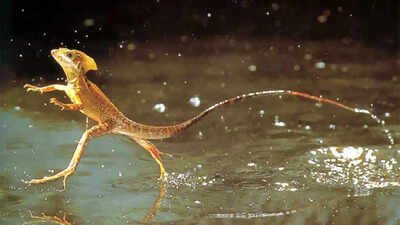
The Basilisk lizard is an amphibious reptile that hails from the tropical areas of Central and South America and has earned the reputation of being able to walk on water. It has also been known as the “Jesus Christ lizard.
” It is usually spotted near bodies of water like rivers and streams because water is crucial to its survival tactics. There are many different species within the basilisk family; they all have distinct habitats that they have adapted to live in. Their body structures make it possible for them to move quickly.
Basilisk lizards’ physical characteristics and appearance
The Basilisk lizards are medium-sized lizards with elongated bodies and tails that constitute a large part of their total body length.
The biggest basilisk reaches 0.9 meters long when the tail is considered. In most cases, male basilisks are bigger than female basilisks.Several species of this reptile have crests that resemble those of cockatoos. The male basilisks have elaborate crests, which they use to attract females in courtship dances. Basilisk lizards vary from one type to another in terms of colouration; some of them have very bright colouration, whereas others are plain with colouration ranging from brown to olive.
How basilisk lizards move across water
The capacity of these animals to travel on water is made possible by specialized hind legs. In the case of Basilisk lizards, the toes are elongated with fringes of skin running around the sides. While traveling through water at a relatively fast pace, the lizard uses its feet to make repeated impacts on the water surface, thereby creating pockets of air to support its body.This form of locomotion takes place through frequent strikes to the water surface, thus making it impossible for the body to sink.
This action depends on the factors of speed, coordination, and force applied to the water surface.
Basilisk lizards’ species diversity
The genus includes four recognised species, each with distinct characteristics and geographic distribution.The green basilisk, scientifically known as Basiliscus plumifrons, is commonly found in rainforest regions from Honduras to Costa Rica and is noted for its bright colouration and crests.The common basilisk, or Basiliscus basiliscus, has a wider distribution and occupies a variety of habitats, including dry forests and wetlands.The brown basilisk, Basiliscus vittatus, is smaller in size and is frequently observed in both natural and urban environments.Each species shares similar locomotion abilities but differs in appearance and habitat preference.
Basilisk lizards’ behaviour and social structure
Basilisk lizards are generally solitary. Individuals may be observed in proximity to water sources, but social interaction is limited. Males establish territories and may display aggressive behaviour, including head movements and pursuit of intruders.During breeding periods, males exhibit visual displays to attract females. These behaviours contribute to reproduction and territorial maintenance within their environment.
Reproduction and growth of basilisk lizards
The reproductive process starts with egg-laying in shallow nests, usually found in sandy grounds close to water sources. One nest may have up to 20 eggs. The incubation period takes around two to three months before the young emerge.The newly born can fend for themselves from the time they come out of their shells without any parental guidance.
Their growth rate is quite fast, and they become adults within a year. The average life span in nature is seven years.
Basilisk lizards’ diet and feeding habits
Basilisk lizards are omnivorous. Their diet includes insects, fruits, plant material, and small vertebrates such as fish and amphibians. Juveniles consume primarily insects due to their nutritional requirements for growth, while adults incorporate a broader range of food sources.Feeding behaviour varies depending on availability within their habitat.
Basilisk lizards’ habitat
The habitats where these lizards can be found include the tropical rainforests, marshes, and riverbanks in Central and South America. Countries like Costa Rica offer the right environment for them because of the abundant plants and availability of water.The presence of these lizards in the ecosystem ensures that there is equilibrium since they help regulate insects and assist in seed dispersion.
Conservation status and threats
Most species of basilisks do not fall into the endangered category at present. Yet, the destruction of their habitats due to deforestation and urbanization poses a great threat to them. Habitat loss is directly linked to population isolation and resource deprivation.In places like Costa Rica, conservation measures involve the preservation of rainforest environments. This becomes an important element for ensuring the sustainability of their populations.

