
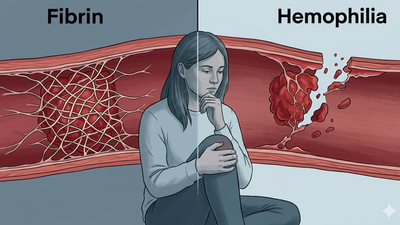
This disorder doesn’t announce itself. There’s no visible mark, no obvious sign, just blood that refuses to stop when it should. For the millions living with hemophilia worldwide, this invisible reality shapes everything from childhood play to the menstrual cycle, from a minor cut to the prospect of surgery.Every year on April 17, World Hemophilia Day puts a spotlight on this often-overlooked condition. The date was chosen by the World Federation of Haemophilia (WFH) to push governments and policymakers toward something deceptively simple: better treatment, better access, better care. The fact that this push is still necessary, decades after the day was established, tells you something about how quietly hemophilia gets sidelined.At its core, hemophilia is a disorder of clotting. The body is missing or low on specific proteins known as Factor VIII or Factor IX, which tell blood to stop flowing after an injury. Without them, even internal bleeding into joints or muscles can become life-threatening. It is rare, inherited, and above all, widely misunderstood.The condition is also deeply tied to genetics. Because hemophilia is linked to the X chromosome, men are far more likely to be diagnosed with it.
A boy born to a carrier mother has a 50 per cent chance of having it. But the idea that hemophilia “only affects men” is a myth that quietly erases millions of women who carry the gene, and who face their own set of risks like heavy periods, complications during childbirth, and unexpected bleeds.That erasure is part of what World Hemophilia Day is trying to fix, not just in policy, but in perception.
The daily reality: Pain, precautions, and the constant risk of bleeding episodes
Most people picture hemophilia as a problem with cuts. Someone bleeds, and it refuses to stop; that’s the image.
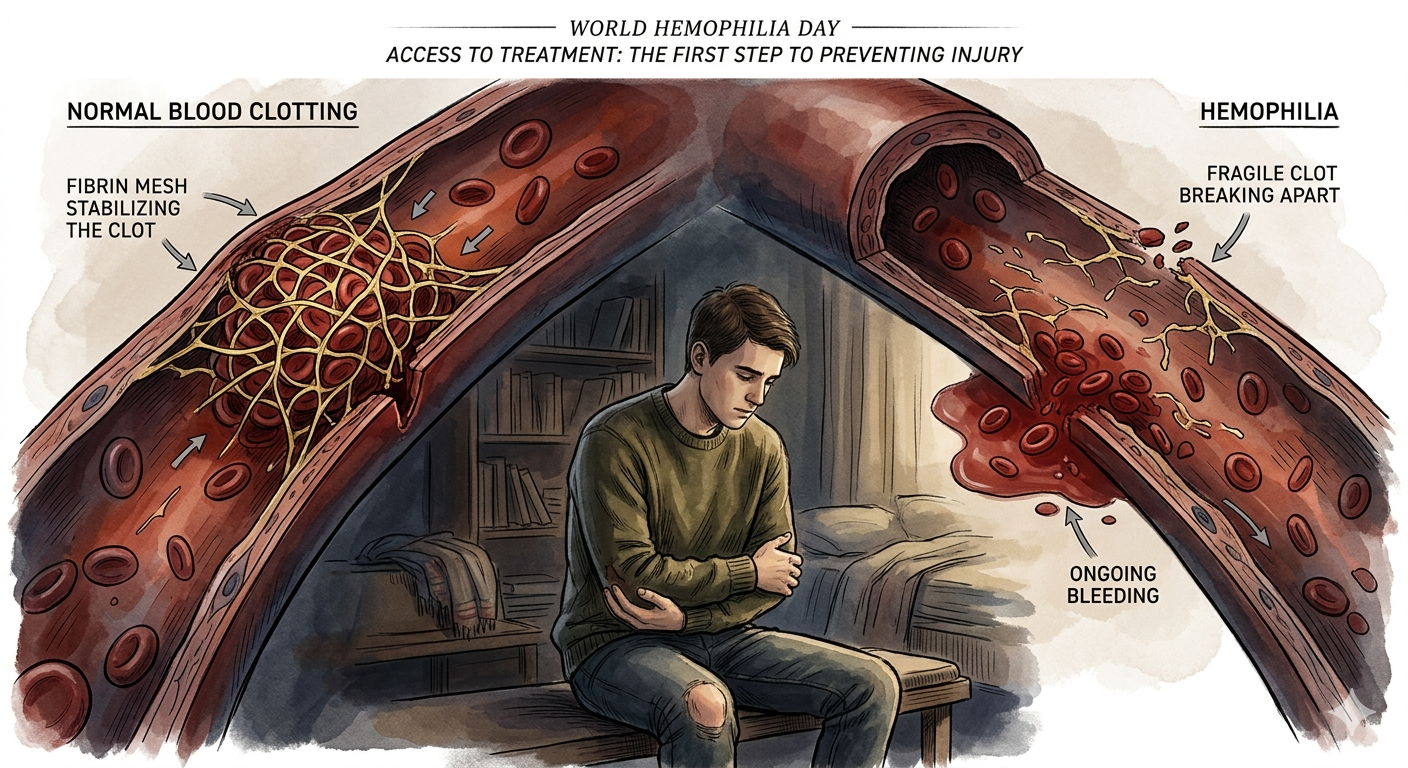
The reality is both less dramatic and way more serious than that.Here’s what actually happens when the body tries to stop bleeding: first, the injured blood vessel contracts, narrowing itself to slow the flow. Then platelets swarm the area, clumping together to form a temporary plug. Finally, clotting proteins in the blood weave a mesh of fibrin over that plug, a tight, strong seal that holds the wound closed while the body heals underneath.
AI generated image
For someone with hemophilia, the first two steps usually work fine. The vessel contracts. The platelets show up. But the third step, which involves the fibrin clot, either doesn’t form or forms so thin and fragile that it gives way. The bleeding doesn’t stop. Or it stops briefly and starts again.This is why the common assumption, that a person with hemophilia will bleed to death from a paper cut, is largely wrong, but not entirely reassuring.
Small surface cuts are rarely the danger. The danger lives deeper.
When the body bleeds into itself
Internal bleeding is where hemophilia becomes life-altering. Blood has nowhere to go inside a joint or a muscle except to pool, press, and damage. The knees, elbows, and ankles are the most common areas that are targets. Over time, repeated bleeding into a joint, even when treated, breaks down cartilage, stiffens tissue, and causes a kind of arthritis that arrives decades too early.What makes this harder to manage is how ordinary the triggers are. A bumped knee during a morning commute. An elbow knocked against a doorframe. Injuries so minor that a person without hemophilia wouldn’t register them. For some, there is no trigger at all; bleeding begins mid-stride, in the middle of an otherwise unremarkable day. These are called “spontaneous bleeds”, and they are exactly what they sound like: unpredictable, uninvited, and urgent.The clock matters here. Unlike a cut that a bandage can address, an internal bleed has to be treated very fast with clotting factor infusions, before the pressure and damage compound. Waiting, or not recognising the bleed in time, means more pain, more joint damage, and a prolonged recovery time.This is the daily arithmetic of living with hemophilia: measuring risk against routine, reading the body for early signals, and carrying the knowledge that an ordinary Tuesday can turn very complicated very fast.“Patients suffering from hemophilia face multiple level of daily challenges. One of the primary issues is the constant risk of spontaneous bleeding, especially into joints, which can lead to chronic pain, swelling and reduced mobility over time. Managing the condition required regular infusions of clotting factor, frequent hospital visits, and strict adherence to treatment schedules which can be physically exhausting and a financial burden,” says Dr Geetika Jassal, Medical Spokesperson, Cryoviva Life Sciences.
From Diagnosis to delay: Why early detection still remains a global challenge
For a condition that has been documented for centuries, hemophilia remains very easy to miss.The reasons are layered. Hemophilia exists on a spectrum, severe, moderate, and mild, and each level behaves differently enough that it can look like three separate conditions. Someone with severe hemophilia may show signs early in childhood: unexplained bruising, bleeding after a minor fall, swollen joints that shouldn’t be swollen.
But someone with mild hemophilia may go years, sometimes decades, without a single obvious episode.
Their blood has just enough clotting factor activity to handle everyday scrapes and cuts. It’s only when something bigger happens like a surgery, a tooth extraction, a serious accident, or childbirth, that the body’s quiet insufficiency finally surfaces.By that point, the diagnosis often arrives as a shock.The family history gapMany families request newborn testing when hemophilia runs in their line.
It’s a reasonable precaution, and it catches a significant number of cases early. But roughly one in three babies diagnosed with hemophilia carry a new genetic mutation, one that didn’t exist in either parent. No family history. No reason to look. Just a result that arrives without warning, often after something has already gone wrong.This means that for a substantial portion of people living with hemophilia, the condition was never on anyone’s radar until it announced itself.“Early indications of hemophilia are usually subtle and may be mistaken for normal childhood injuries. These include frequent bruising, prolonged bleeding from minor cuts, recurrent nosebleeds, and excessive bleeding after injections, vaccinations or dental procedures. In infants particularly, swelling in joints presenting as irritability or reduced movement of limb may go untreated. Many parents dismiss these signs as normal or routine problems which may delay the diagnosis.
Since the symptoms are not always dramatic early on, hemophilia is often misdiagnosed or identified only after a major bleeding event or surgical complications,” Dr Jassal added.The women who get missedThen there is the group most consistently overlooked: women.The longstanding assumption that hemophilia is a male disease has quietly shaped how doctors ask questions and how women understand their own symptoms. A woman who carries the hemophilia gene can experience heavy menstrual cycles that go on too long, bleeding complications after childbirth, or wounds that take longer to heal than they should.
These are real symptoms with a real cause. But without the right questions being asked, or the right awareness in the room, they can get misdiagnosed or dismissed entirely.

AI generated image
The diagnosis, when it finally comes, sometimes follows years of being told that nothing is wrong.What detection actually looks likeWhen hemophilia is suspected, the process is straightforward: a blood test checks whether clotting is happening properly, and if not, factor assays identify which protein is missing and how severely.
The tests exist and so does the knowledge. The gap is rarely about medicine, it’s more about whether anyone thought to look in the first place.That gap is widest in low-income countries, where access to specialist care is limited and awareness among general practitioners is uneven. But it exists in well-resourced healthcare systems too, quietly, in the mild cases that never triggered alarm, in the women whose symptoms were explained away, in the newborns whose mutations arrived unannounced.Early detection changes outcomes significantly. It allows families to prepare, doctors to intervene before joint damage sets in, and individuals to understand their own bodies before a crisis forces the conversation. The medicine has moved forward. The awareness, in too many places, is still catching up.“Early diagnosis of hemophilia is crucial to prevent irreversible joint damage, life threatening bleeding episodes and long-term disability.
Identifying the condition early allows for initiation of prophylactic clotting factor therapy, which significantly improves the quality of life and long term outcomes. However significant gaps in awareness still exists and continue to remain a major concern. Early signs such as prolonged bleeding after minor injuries, easy bruising or joint swelling are often overlooked or misdiagnosed, especially by primary healthcare providers,” said Dr Jassal.
From plasma bags to precision medicine: The evolution of Hemophilia treatment
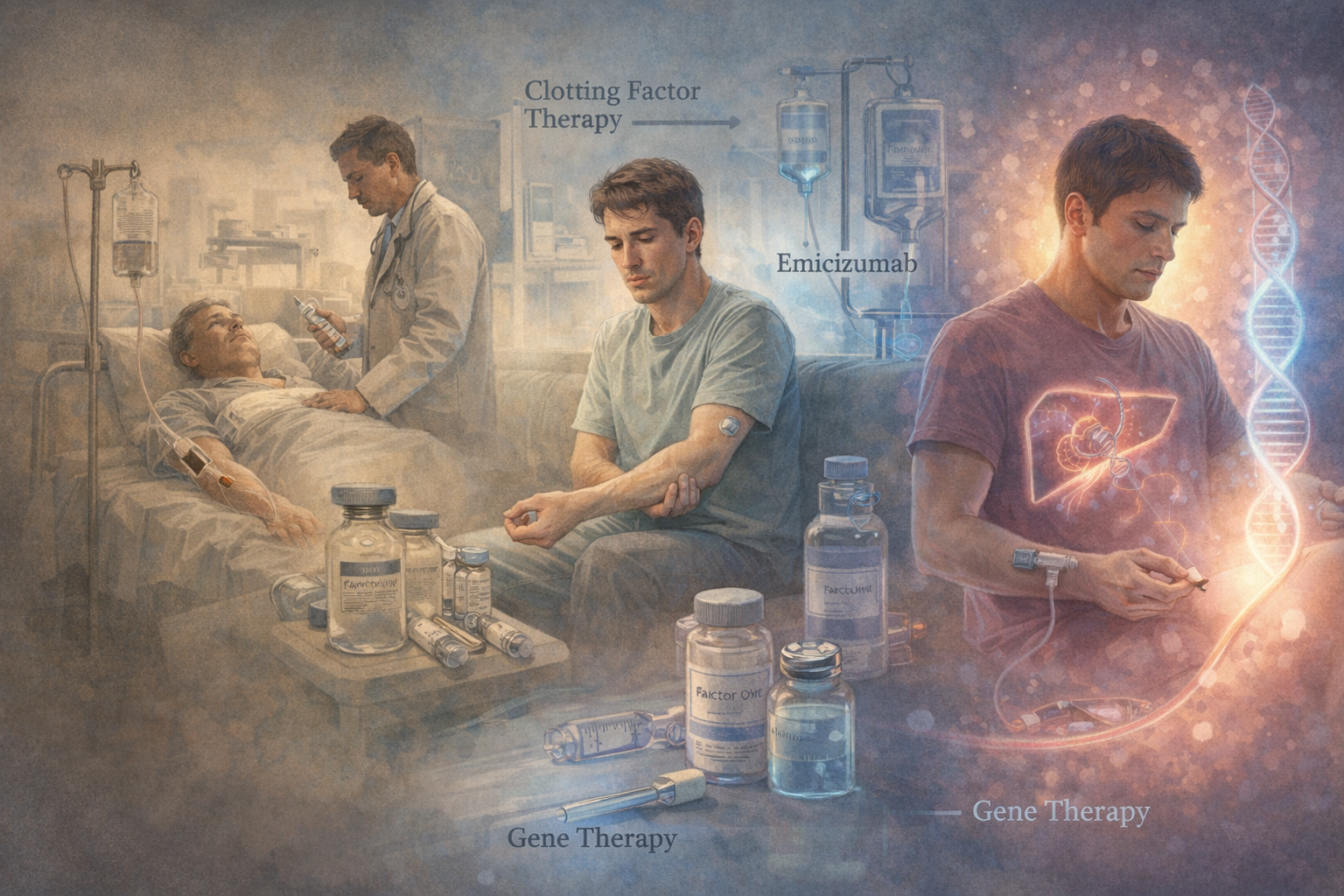
In 1964, when the first effective treatments for haemophilia were taking shape, the options were basic by any measure. Cryoprecipitate which is a frozen concentrate made from plasma, was essentially as good as it got. For most patients, treatment meant getting to one of a handful of cities that had the right equipment, hoping there was supply, and managing everything else through caution and luck.The distance between that world and this one that we currently inhabit is enormous.Treatment for hemophilia has moved from plasma-derived products to recombinant clotting factor concentrates, and more recently to extended half-life therapies that reduce how often patients need infusions. Where patients once injected clotting factors intravenously multiple times a week, newer therapies can be given less frequently. Some can be administered under the skin rather than into a vein, which marks a significant difference for children and for anyone living far from a medical facility.
AI generated image
Then came emicizumab, a bispecific antibody that works differently from traditional factor replacement altogether. It is administered subcutaneously, requires less frequent dosing, and does not trigger the inhibitor development that undermines traditional factor concentrates in some patients the kind of treatment that, a generation ago, would have seemed implausible.And now, at the frontier: gene therapy. Unlike all previous treatments, gene therapy requires only a single administration and works by prompting the liver itself to produce Factor VIII or IX the body doing what it was never able to do before, as cited by Science Direct.
The FDA approved two gene therapies for hemophilia B, Hemgenix in 2022 and Beqvez in 2024, and one for severe hemophilia A. These are not incremental improvements.
They are a different category of medicine.“Recent studies in hemophilia is exploring the well-advanced approaches such as gene therapy, and stem cell-based strategies, mainly aimed at addressing the root cause rather than just managing the symptoms.
Stem cell research is still largely in the experimental stages, with the ongoing studies mainly evaluating its potential to enable sustained production of the clotting factors. While these kinds of developments hold the long-term promise, they are not the part of routine clinical practices,” said Dr Jassal.
Where does India stand?
India carries the world’s second largest burden of hemophilia, with an estimated 136,000 cases, yet the country that recently completed its first in-human gene therapy trial for the condition is also one where most of those patients still manage bleeds with rest, ice, and whatever else they can find. That contradiction sits at the heart of hemophilia care in India today: world-class science at one end, and a vast, underserved majority at the other.The insurance and money problemHemophilia sits in an awkward place in India’s healthcare economy, too rare to attract sustained policy attention, too expensive to treat without it. Private health insurance is largely out of reach for most affected families, and hemophilia’s classification as a low-volume, high-cost disease means insurers have little incentive to cover it well.The result is that economic circumstances dictate treatment in ways they shouldn’t. For a large share of patients, factor replacement therapy remains something they read about rather than receive. Instead, they manage with RICE (rest, ice, compression, elevation), alongside adjunct medications and wet products like fresh frozen plasma or cryoprecipitate whenever available. These aren’t treatments so much as ways of getting through the day.“In India, very much limited access to select research settings and specialized centres as well, with current standard care still centred around clotting factor replacement and new non factor therapies whenever it is available,” Dr Jassal said.The picture overall is of a system still treating a chronic condition as a series of emergencies. The cost of untreated hemophilia, hospitalisations, surgeries, long-term disability, lost productivity, ultimately burdens families and health systems which could be prevented by early care.