
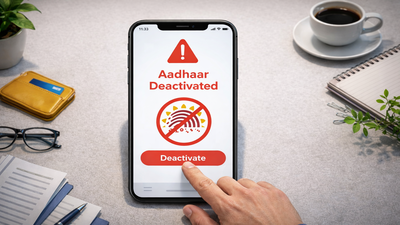
UIDAI regularly updates the Aadhaar database such that any identity records are kept up-to-date and consistent. One of the tasks during the process is the identification of Aadhaar numbers of people who have passed away and updating the status of those numbers to make them inactive after necessary checks.
Aadhaar should serve as an identifier only for living Indians, which would decrease the possibility of any misuse or mistakes in the data stored. In this regard, database cleansing can be performed based on information provided by several government sources.It is crucial to keep the Aadhaar system free from any inconsistencies and maintain consistency since Aadhaar is used for various purposes and schemes throughout India.
Why is the deactivation of a deceased person considered necessary
Aadhaar plays a central role in accessing welfare schemes and verifying identity in many services. If Aadhaar numbers of deceased individuals remain active, there may be risks linked to misuse. It could, in some cases, lead to wrongful access to government benefits or identity-related fraud. UIDAI has stated that deactivation helps reduce such risks and maintain trust in the system.Experts in governance systems often point out that large identity databases need regular updates.
Without continuous correction, outdated records can slowly create inconsistencies in service delivery systems. The principle remains clear. Aadhaar numbers are not reused. They are simply retired once a person’s death is verified.
Reporting deaths through the myAadhaar portal
UIDAI has also introduced a facility on the myAadhaar portal where family members can report the death of a relative.The system currently supports deaths registered in 25 states and Union Territories that use the Civil Registration System.
How to report a death on the myAadhaar portal
- Step 1: Log in to the myAadhaar website
Firstly, the relative should visit the official website for myAadhaar and enter the necessary details to complete the authentication process.
- Step 2: Choose the death reporting option
After logging in, he/she needs to select the option for the death of a family member.
- Step 3: Enter the Aadhaar number of the dead relative
It will be essential to input the correct Aadhaar number in the provided space.
- Step 4: Enter the details related to the death certificate
The user has to provide his/her name, along with other demographic details and the registration number for the same.
- Step 5: Submit the application form
All the above details have to be entered properly and then can be submitted to the site.
- Step 6: Waiting for the verification process
UIDAI will conduct the verification procedure, where the information will be verified with the relevant authorities.
- Step 7: Action taken regarding the Aadhaar number of the dead relative
As per the verification outcome, the number will be deactivated or otherwise processed accordingly.
UIDAI deactivated over 2 crore Aadhaar numbers in a nationwide clean-up drive
UIDAI deactivated over 2 crore Aadhaar numbers linked to deceased individuals across India in 2025 according to UIDAI press release (November).
The exercise is part of a nationwide data correction and validation drive. The intention is to ensure that Aadhaar databases reflect only active, living residents. Each Aadhaar number is permanently assigned to one individual and is never reused or reassigned. Once a person passes away, their Aadhaar is marked for deactivation after proper verification.The scale of the exercise shows how extensive identity systems in India have become.
Aadhaar is widely used for welfare benefits, banking verification, and government services, so keeping records updated is treated as essential for system integrity.
How UIDAI checks Aadhaar data
UIDAI is sourcing information from several official platforms to identify deceased individuals. One of the key sources is the Registrar General of India (RGI), which maintains civil registration records. State governments and Union Territories are also contributing data.
In addition, systems such as the Public Distribution System and the National Social Assistance Programme are being used for cross-verification.These datasets help build a more accurate picture of identity status across regions. UIDAI is also exploring collaboration with financial institutions and other organisations that maintain updated customer records, which may further strengthen verification. The process is based on cross-checking multiple sources before any Aadhaar number is deactivated. This reduces the chances of errors or incorrect deactivation.