
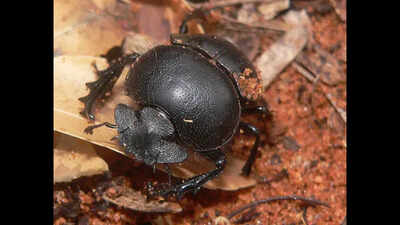
Dung Beetle appearance and behaviour
There are different species of dung beetles that differ in terms of size, colour, and shape. However, all these variations are distinguished by one common feature.
These insects collect and form dung into balls.In the study, ‘Functional leg design in dung beetles: Morphological adaptations to food relocation behaviour,’ it is stated that “many dung beetles form the dung into balls, which they then roll away and bury.”The major classes of dung beetles include rollers, tunnellers, and dwellers. Rollers are characterised by their ability to remove the dung from its source. The tunnelling class buries the dung underground, while the dwellers reside inside the dung.
Habitat and distribution of Dung Beetles
Dung beetles are highly adaptable and can be found on all continents apart from Antarctica.
They survive in grassland, forest, desert, and even farmland environments.As stated by Key Laboratory of Vegetation Ecology, Ministry of Education/Jilin Songnen in ‘Dung beetle communities are jointly mediated by soil properties, herbivore dung types, and habitats in Serengeti savannah’, “Dung beetles are especially common where there are herds of plant-eating animals.” These insects benefit greatly from the constant supply of manure from these herbivores.Dung beetles have become increasingly significant in the maintenance of pastureland in India, Africa, and Australia.
Their presence is sometimes taken to be an indication of a healthy ecosystem.
Ecological role and importance of Dung Beetles
These insects are referred to as the recyclers of nature. Through their role in decomposing animal faeces, these insects ensure that nutrients are returned into the soil and enhance soil fertility.As per the research from the University of Rajasthan, the activities of these insects lead to “nutrient cycling, soil aeration, and parasite reduction in the livestock environment.”Through this process, the number of flies and other parasites is reduced, thereby providing benefits to both wildlife and agricultural practices.
Scientific research and recent findings
Nevertheless, the dung beetle remains an interesting topic in science due to its amazing ability to navigate. Research showed that there are certain species of dung beetles which use the Milky Way as a means of orientation when rolling dung balls.There is research called ‘The role of the sun in the celestial compass of dung beetles’ which states that “dung beetles utilise celestial cues, including the Milky Way, for orientation.”This fact amazed the scientists who discovered how complicated a navigation system could be in such a small insect. The fact also emphasises the great significance of research on insects because of their behavioural and evolutionary features.Despite being unnoticed, dung beetles contribute a lot to keeping our planet healthy and alive. From bettering the quality of the soil to helping scientists make discoveries, the role of these insects cannot be underestimated.

