
The sink’s full of grimy water, it’s not going anywhere, and you’ve got dishes to do. Great timing. Calling a plumber feels like overkill, and honestly, for most kitchen clogs, it is.
The good news is that the majority of blocked kitchen drains are caused by the same stuff: grease, food scraps, and soap buildup that’s slowly narrowed the pipe down to almost nothing. And almost all of them can be fixed at home, without special tools, in under an hour.Here’s how to actually do it.
Start with the simplest thing first
Before you go reaching under the sink or pouring anything down the drain, try boiling water. It sounds too simple to work, but for grease-based clogs, which is most kitchen clogs, it genuinely does.
Boil a full kettle, wait about a minute, then slowly pour it directly down the drain in two or three stages. Give it thirty seconds between each pour. The heat melts the grease, the water flushes it through. Sometimes that’s all it takes.If the water just sits there and doesn’t move at all, you’ve likely got a more solid blockage, food, debris, something physical. Boiling water won’t fix that. Move on.
The baking soda and vinegar method (it actually works)
This one feels like a middle school science project, but don’t dismiss it.
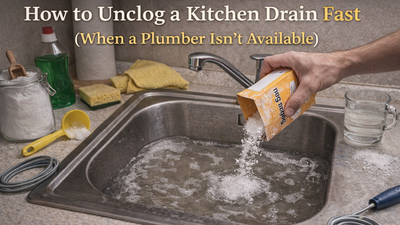
Pour half a cup of baking soda directly into the drain, try to get it past the drain cover and actually into the pipe. Then follow it with half a cup of white vinegar. It’ll bubble and fizz dramatically, which is the point. That reaction is breaking down the gunk lining the inside of your pipe. Put a cloth or a drain stopper over the opening to force the reaction downward rather than back up at you.Leave it for about twenty minutes. Then flush it with hot water not boiling this time, just hot from the tap.
For mild to moderate clogs, this combo does a solid job. And it’s completely safe for your pipes, which can’t always be said for the chemical drain cleaners sitting on supermarket shelves.
Use a plunger
If the water still isn’t moving, it’s time for a plunger. A lot of people don’t realise you can use a standard cup plunger on a kitchen sink, you don’t need the flanged toilet kind. Make sure there’s enough water in the sink to cover the rubber cup, then position the plunger directly over the drain, press down to create a seal, and work it up and down firmly about ten to fifteen times.
Then pull it off sharply.Repeat this a few times. You’re essentially creating pressure that pushes or pulls the blockage loose. It’s not glamorous. But it works more often than people expect, especially on partial clogs where water drains slowly rather than not at all.One thing to watch: if you have a double sink, block the second drain with a wet cloth before you start plunging. Otherwise the pressure just escapes out the other side and you get nowhere.
Check the P-trap if nothing else is working
The P-trap is that curved pipe section directly under your sink, the U-shaped bit. It’s designed to hold a small amount of water at all times to block sewer gases, but it’s also exactly where solid debris likes to collect and sit. If you’ve tried everything above and the drain’s still blocked, the clog is probably right there.Put a bucket under the pipe first. Then unscrew the two slip-joint nuts on either side of the curved section by hand, most come off without tools.
The water and debris will fall into the bucket, so be ready for that. Once it’s off, clean it out, rinse it, and screw it back on. Hand-tight is usually enough, but give it a small extra turn to make sure it won’t leak.Turn the tap on slowly to test it. Nine times out of ten, that’s your problem solved.
A quick word on chemical drain cleaners
Resist the urge. They’re harsh, they can damage older pipes over time, and they’re genuinely unpleasant to work with, especially if the drain is fully blocked and the liquid just sits in your sink. The methods above are slower but safer. And if none of them work, then you call the plumber. But honestly, you probably won’t need to.Disclaimer: The information provided here is for general guidance only. Results may vary depending on your specific plumbing setup. If the clog persists or you notice leaks, consult a licensed plumber.