
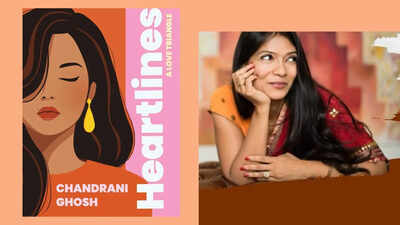
In a world where immigrant stories are often framed through loss and longing, Chandrani Ghosh’s Heartline offers a refreshing shift in perspective. The novel explores a life shaped not by displacement, but by abundance—where cultures blend, identities evolve, and belonging stretches across borders.
Through its central character, the book delves into ambition, relationships and the quiet search for connection in a fast-paced world. In an exclusive interaction with the author, we explored the ideas and experiences that shaped Heartline—from reimagining the immigrant narrative to examining love, belonging and the importance of meaningful human connections in an increasingly fast-paced world.What inspired you to write Heartline?I wanted to tell the “other immigrant story.” Much of immigrant literature centers on loss and a sense of dislocation.
But for some immigrants, the experience is different: it is a story of abundance and the joy of belonging to two cultures. To Diwali and Holi, they added Thanksgiving and Christmas. The book is set in the richness that comes from being able to carry multiple worlds within one life. Through the main character Sharmila, I wanted to portray an immigrant life in which she is successfully assimilated into her new world while remaining deeply rooted in the culture she came from.
Her story is not that of an immigrant struggling to fit in and adapt. The book is set in an affluent Indian American community. I wanted to give readers a peak into that world. Afterall Indian Americans are the top-earning ethnic group in the United States and are leaders in a variety of fields.Your book explores themes of love and connection — how do you define the “heartline” in today’s fast-paced, often disconnected world?I firmly believe that it is possible to live in a fast-paced world and still have love, connection, and a sense of belonging. But to achieve that, you have to seek it actively.
I think many people forget that happiness comes not from the size of your bank account, but from the richness of your relationships and connections. In today’s fast-paced world, you have to prioritize your friendships and relationships. These “heartlines” are what bring joy and meaning to life.
Reams of research support this — in fact, chronic loneliness impacts your health as adversely as smoking fifteen cigarettes a day.Are the characters or situations in Heartline drawn from personal experiences, or are they purely fictional explorations?The backdrop of the book is very much drawn from my personal experiences, but the storyline is pure fiction. The setting – at the intersection of politics, media, and the high-tech world in Washington, D.C. – is based on the world I live in, as is the background of the main character, a journalist who grew up across the world. The story itself comes entirely from my imaginationWhat emotional journey do you hope readers go through while reading this book?I hope it makes readers realize that through difficult times comes growth, and that life can become richer and fuller because we have lived through hardship.
The struggles we endure often shape us in unexpected ways, deepening our resilience, compassion, and understanding of ourselves and others. Even when the path is painful, there can be something meaningful on the other side.In particular, I hope it speaks to Gen Z readers, who are often wary of taking risks in their social lives. After all, it is easier to curl up on the couch with Netflix and order from Uber Eats than to put yourself out there and risk rejection or disappointment.
But while self-protection may feel safer in the moment, I don’t think it ultimately leads to satisfaction or fulfillment – in fact, it often leads to loneliness and isolation.
The richest parts of life – love, friendship, adventure, even heartbreak – require vulnerability and the willingness to take a chance.Did writing Heartline change your own understanding of relationships or human emotions in any way?Writing Heartline made me appreciate the turmoil of the earlier stages of adulthood. It made me realize that that period of life deserves more compassion than we typically give it.
Those are often the years when we make so many of the biggest decisions we’ll ever make: career direction, life partners, whether to have children, identity. There’s so much at stake, and we’re navigating it with so much less experience.In writing this book, I found myself reliving my own twenties and thirties. Scenes and emotions I thought I had forgotten came back with surprising vividness. It was strange to look back with the clarity that only hindsight can offer, while also remembering how hard and complicated everything felt in the moment.How do you balance vulnerability and restraint while writing about deeply personal or emotional themes?Honestly, I’m not sure I consciously balanced them at all and I think that’s precisely what made the process work.The way I wrote Heartline was entirely organic. It was deeply character-driven from the start, and what surprised me was how completely I could lose myself in those characters. I wasn’t standing outside the story making careful, deliberate decisions about how much to reveal or hold back.
I was inside it –following the characters, trusting them, letting the story take me where it wanted to go.The timing mattered too. I began writing during COVID, at a moment when the outside world had effectively stopped. There was a gift in that stillness. With everyday life suspended, I could live with the story almost full time.The vulnerability wasn’t something I had to consciously manage — it emerged naturally because I was deeply immersed.
Looking back, the best writing advice I could draw from my own experience is simply: trust the characters, and let the story unfold organically.Was there a particular chapter or moment in the book that was especially difficult — or meaningful — for you to write?One of the more meaningful sections for me to write was rooted in the question: what happens when a journalist becomes the story? As journalists, we control the narrative.
We ask the questions, we decide what matters, we shape how someone’s life gets told. But what happens when you’re on the other side — when you’re the one being written about, and you no longer control how you’re perceived? And unlike an ordinary person in that situation, you as a journalist know exactly how journalists operate when they are chasing a story.
I lived on the other side of that equation for a long time. I remember working on the Bill Clinton–Monica Lewinsky story and being relentless in tracking down her hairdresser, her housekeeper, anyone who might give me even a small piece of information.
At the time, that felt like good journalism. But looking back with older eyes, I find myself asking: what did it feel like to be Monica Lewinsky? To have dozens of journalists hunting down everyone in your orbit, piecing together your most private life for public consumption? That was a scenario I wanted to explore so I put my character in that position, and let the story unfold.In an age of digital communication, do you think we are losing touch with genuine emotional connections, and does Heartline respond to that idea?I think we are, and we need to actively work to keep emotional connections alive.
We need to invest in friendships and relationships the same way we invest in building a career. Often we treat relationships as something that will simply sustain themselves in the background while we pour our energy into our work. But relationships don’t maintain themselves. They need the same deliberate investment, the same care and attention, that we give to building a professional life.
That parallel feels important to me: just as you nurture a career – being consistent, putting in the hours, taking it seriously – you have to nurture your relationships in the same way.
Friendships, in particular, are so easy to let drift. Life gets busy, digital communication gives us the illusion of staying connected, and before long the depth is gone even if the contact remains.What kind of reader do you think will resonate most with Heartline?I have been pleasantly surprised by the wide range of readers who have loved the book. It has been wonderful to see how many men and older women have enjoyed it, in spite of its very pink jacket! One reviewer described it as “an intellectual’s guilty pleasure.” Many readers are comparing it to Crazy Rich Asians, and that book appealed to a remarkably broad cross-section of readers.If readers could take away just one feeling or insight from Heartline, what would you want it to be?That it is not financial wealth and professional success, but social wealth and meaningful relationships, that make for a truly happy life. Your community and your friendships are treasures to be cherished.