
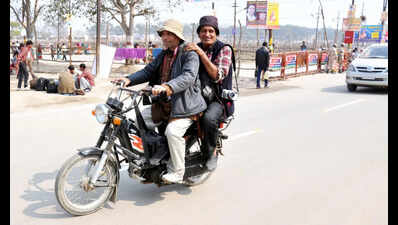
Kamal Kishor Kamal along with Raghu Rai worked in Kumbh Mela in 2000 and 2013 together
Lucknow: Three veteran photojournalists from Uttar Pradesh, each groomed in different ways by the legendary Raghu Rai, shared memories and professional experiences even as India mourned passing away of its most celebrated lensman.
Padma Shri Raghu Rai breathed his last on Sunday, leaving behind a visual legacy that chronicled the nation’s politics, people and turning points.Photojournalist Subir Roy (73), settled in Lucknow, who worked for The Hindu from 1982 to 2013, recalls meeting Raghu Rai four times in the course of his decades long career. Calling him “a Master of Moments”, Roy said Raghu Rai’s photographs were not just images, but a living timeline of India.“Although my father S N Roy was a photojournalist too, who worked for Anand Bazar Patrika, my real inspiration was Raghu Rai,” said Subir Roy. “He was a master of black-and-white photography, an icon, whose images spoke far beyond the frame.”Roy first encountered Rai in 1984, when Rajiv Gandhi visited o Amethi to file his nomination to contest Lok Sabha election from the constituency, following the death of his mother, then prime minister Indira Gandhi, in Oct 1984.
“I was standing right in front of Raghu Rai, trying to capture the moment. He was there with a team of photographers from India Today,” Roy recalled.The second meeting took place during V P Singh’s election campaign in 1988–89 in Fatehpur district. The third, and perhaps the most eventful, was during demolition of Babri Masjid on Dec 6, 1992. “The violent mob did not care how famous a photographer Raghu Rai was; they attacked him and several other cameramen, including me,” said Roy .After the demolition, Roy was stationed in Ayodhya for several months by The Hindu. In late Jan or early Feb 1993, he met Raghu Rai again at the reception area of the Shan-e-Awadh Hotel in Faizabad, one of the few hotels where journalists stayed at the time.“I was preparing to tele-fax my photographs when Raghu ji came and, with a wry smile, asked what kind of machine I was working on. When I replied, ‘Kyu mazak kar rahe hain aap,’ both of us laughed.
That was his way of breaking the ice,” Roy remembered.Certain images by Raghu Rai, Roy said, are etched in his mind forever. “One was taken after Indira Gandhi‘s 1977 defeat, showing a woman sweeper clearing Congress pamphlets next to a poster on a wall that read ‘vote for Congress’. Another iconic image shows a steam engine passing in front of the Taj Mahal, captured using a 500–600 mm telephoto lens, bringing together two distant moments without any superimposition.
“For Prayagraj-based photojournalist Kamal Kishor Kamal, 54, Rai was a personal mentor. “My father, Mohan Lal, was associated with the Congress and photographed Indira Gandhi several times, but it was Raghu Rai who inspired me to become a photographer,” he said.Kamal recalls being captivated in 1989, while reading a book on Indira Gandhi featuring Raghu Rai’s photographs. “Each photograph told a story, something, honestly, I did not see in my father’s pictures,” he said.Kamal owns a personal collection of Raghu Rai’s signed photographs and shared a close bond with him, covering
Kumbh Mela
together in 2001 and 2013. “My father may have introduced me to photography, but it was Raghu Rai who taught me how a single picture can tell multiple stories if captured with the right perspective,” said Kamal, who worked with Hindustan Times for nearly 13 years.Ajay Kumar Singh
(67), former photographer with Lucknow Times, remembered a much earlier connection.
“My father Raghav Singh and Raghu Rai worked together for The Statesman in New Delhi. I was in High School when my father introduced me to Raghu Rai in 1975,” he said. After his father’s death, Singh met Rai again in 1979. “He gave me valuable tips on photography that stayed with me all my life.”As tributes pour in from across the country, these memories underline what Raghu Rai truly was, not just a photographer, but the conscience of the Indian lens, capturing history with an unmatched sense of timing.Picture credit: Kamal Kishor Kamal