
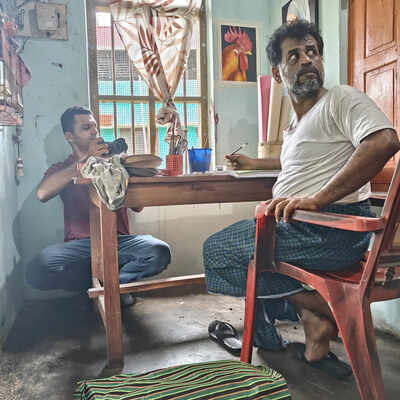
Director Abhilash Babu’s Krishnashtami: The Book Of Dry Leaves will be screened at the Moscow International Film Festival in April. The film, selected in the Out of Competition section, is said to be a modern cinematic interpretation of a poem of the same name by Malayalam poet Vyloppilly Sreedhara Menon.
Filmmaker Jeo Baby plays the central role in the film, which has music by Ouseppachan.Reacting to the selection, Abhilash says, “It’s exciting to be part of the festival, which is one of the oldest in the world. This will be the film’s international premiere, and the rules require a Russian premiere for it to be showcased there.”However, he’s not sure if the team will travel to Moscow. “The mail came at short notice, so we’re unsure if we can make it there — travel, visa and all.
Right now, we are uploading the film in DCP format to their server after receiving the intimation this morning. Our priority is to get the film there first, rather than our own physical presence.”The film is a musical that incorporates other poems by Vyloppilly and is presented as a still-image feature. “It follows an old documentary style made entirely with still images. There’s an age-old method, where archival images are compiled to create a documentary, and we followed a similar approach.
We staged photographs with actors and then built a feature film using those stills,” he says.When asked whether international audiences might connect with it, Abhilash says, “It may appeal as a cultural film. For international audiences, something deeply rooted in another culture can still have its own pull. I don’t know if that influenced the selection. The film explores an Indian myth, but not from a spiritual angle.
There’s also a universality in its theme of power. That said, I wasn’t able to screen it at major festivals in Kerala, including IFFK, where it was rejected.
This invitation comes at a time when we were quite dejected. The cultural space in Kerala wasn’t ready to welcome a film based on a poet who wrote extensively about Malayali identity, which is unfortunate. Maybe that will change now, given our tendency to appreciate things only after international recognition.”