

Artificial Intelligence (AI) is reshaping how we interact with the world. Just as electronic devices in the past made things easier for earlier generations, AI infusion is bringing a greater level of coherence to these very systems we use.
Today, we live at the dawn of a new era: an AI-enabled framework called the Internet of Things (IoT). Under this new paradigm, our AI-driven devices will start talking to each other, making our lives easier in ways we have yet to fully grasp.In the military, AI, still in a nascent phase, has significantly altered how warfare is conducted. From enhancing the capabilities of sensors and shooters, Artificial Intelligence is now revamping how systems interact with each other.IoT has not reached that level in the civilian world, where the moment you lock your door, your car gets signalled to switch on. Still, the US and Israel demonstrated a similar capability during the ongoing conflicts in West Asia. AI-Decision Support Systems (AI-DSS) are now moving up the value chain, becoming a decision-aid tool for military leadership and on their way to becoming indispensable tools in command centres.
The use of AI in combat is a revolution in military affairs. It may not be as glamorous or as obvious as the introduction of missiles, tanks, or bombers, but the nascent technology is already embedded in multiple systems across the battlefield, making warfare practitioners more effective in their trade.
Op Sindoor : The AI story
Although the effect of AI on combat operations has gained currency in the ongoing conflict in Iran, the Indian armed forces utilised this system during Operation Sindoor.
The armed forces used 23 separate types of AI systems to hit targets in Pakistan and in Pakistan Occupied Kashmir with an astonishing accuracy rate of 94%. This figure was brought out by Lieutenant General Rajiv Kumar Sahni, the Director General of Electronics and Mechanical Engineers (DG EME), who was DG Info Systems during the 88-hour conflict.
This level of accuracy was delivered using different types of guns and missile systems.
Lt Gen Sahni spoke about the use of AI during Op Sindoor at an event in October.AI not only improved the Observe, Orient, Decide and Act (OODA) loop but also helped produce predictive intelligence based on data painstakingly acquired for well over two decades during the active phase of Op Sindoor.
Enter Project Maven
Admiral Brad Cooper, head of the US Central Command (CentCom), said early last month that the Americans are using AI in the conflict.
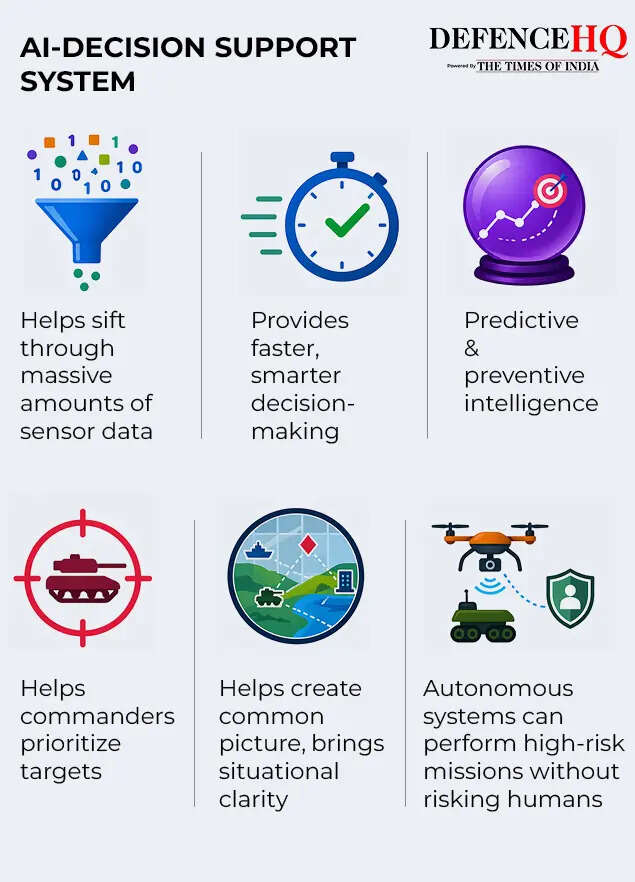
“Our war fighters are leveraging a variety of advanced AI tools. These systems help us sift through vast amounts of data in seconds so our leaders can cut through the noise and make smarter decisions faster than the enemy can react,” Admiral Cooper stated.The top US Central Command officer was alluding to the use of an AI system called Project Maven. It started as the Algorithmic Warfare Cross-Functional Team (AWC-FT) by the then Department of Defence (now Department of War) and a few intelligence agencies.Maven is a Yiddish word that means a dependable expert, similar to how we in India, and now the world, use the word guru.
Removing the fog of war
The task of the AWC-FT was as difficult as the founding document of Project Maven made it look easy. The paper states “(the) objective is to turn the enormous volume of data available to DoD into actionable intelligence and insights at speed.” The initial task was to automate Processing, Exploitation and Dissemination (PED) of videos captured by Unmanned Aerial Systems flying over Iraq and Syria in the fight against the Islamic State. The system collects data from traditional sensors and collates data from social media posts to form a comprehensive picture. This picture helps commanders make decisions in minutes — decisions that would otherwise take hours or days if interpreted through traditional means.
The need for Project Maven
The American military has the best intelligence-gathering capability. The Americans have deployed hundreds of manned and unmanned systems as well as space-based assets, gathering terabytes of data per day.
Despite the best efforts of the Pentagon, most of the thousands of hours of videos were not even seen and could not be translated into actionable intelligence. The system was created to derive actionable intelligence from the incredible amount of data that was not being fully utilised, as it wasn’t correctly going through the PED phase. For example, after an Improvised Explosive Device (IED) blast, an analyst could go through a recording and see when the bomb was planted and where the individual went after planting the bomb.
The project wanted to create a system that could identify the odd activity of planting the bomb and warn forces in the vicinity about the danger.
Kill chains to kill webs: How Maven is reshaping warfare
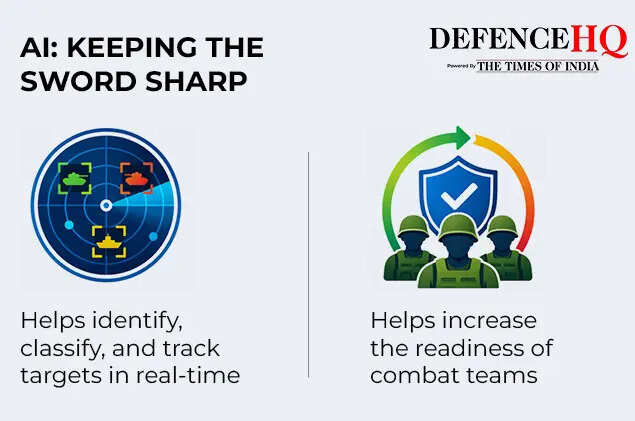
For decades, the mantra taught by military institutions of higher learning was how to shorten the OODA loop. This process, called the kill chain, was taught to be done linearly. This method can be broken down as find the target, get a fix on the target’s location, track, target, engage and finally assess the effect of your action.As the name suggests, kill chains are linear, and the aim of one side in combat will be to break this chain as much as the other side would want to exploit it. With kill webs, as the name suggests, there is a greater amount of linking and cross-linking. Like a web, there are different nodes and information can be passed out from the centre or any one part of the web (either a shooter or a sensor) to another. This gives a lot of flexibility and a lot of redundancy to the commander.
The commander, with the help of AI-DSS, can strike a target with the best weapon system available for the task. More importantly, AI can reduce the OODA loop considerably by sensibly finding a target through the vast amount of information coming to it from different sensors and helping the commander prioritise targets. AI has been critical in helping the Israeli-American coalition hit well over 10,000 targets in Iran.
The Times of Israel has reported that the Americans have hit over 13,000 targets in Iran, while the Israelis have hit over 4,000 targets. AI has likely helped locate many of these targets.
Before Maven, there were Gospel and Lavender
In the aftermath of the October 7, 2023, attack on Israel, the Israeli Defence Force’s (IDF) Unit 8200, a signals-intelligence unit, created two AI systems called Lavender and Gospel systems to counter Hamas. Lavender created a list of 37,000 individuals to be targeted.
Gospel, on the other hand, was used to target Hamas operatives, according to a report of the London-based Institute of International Strategic Studies. Russia and Ukraine, too, are using AI-based systems to fight in the ongoing conflict.
AI and the Indian military
The Indian armed forces are increasingly adopting AI across the forces. The services are not only using AI in combat systems, but also increasingly use AI in support functions. These vital systems help the armed forces become more effective. Currently, the armed forces are using AI in roles such as intelligence gathering, logistics, meteorology, human resources, medical services, training, inventory management, war gaming and a host of other systems. In fact, the Visakhapatnam-class stealth guided-missile destroyer INS Surat is India’s first AI-enabled vessel. Systems such as Akashteer, Artillery Combat Command and Control System (ACCCS) and Integrated Air Command and Control System (IACCS) are systems, which too a degree perform a role similar to Project Maven.
These systems bring sensors and shooters to the same interface, helping a commander make decisions and issue commands to prosecute a target most efficiently and effectively.The Indian armed forces are in the middle of a modernisation drive. Two bodies, the Defence AI Project Agency (DAIPA) and the Defence Artificial Intelligence Council (DAIC) have been constituted to help push AI-based processes.
Theaterisation and AI
Jointness and integration are central to both India’s upcoming Integrated Theatre Command on one hand and AI in general on the other.
As future theatre commanders would have a broad frontier, with an innumerable number of sensors locating targets and a wide array of weapons to tackle those threats, the use of AI to be a prominent one.
Peaceful use of military AI systems
The US armed forces have stated that they used Maven AI to form a ‘common picture’ when Typhoon Halong hit the western portions of Alaska in 2024.Although the use of AI has made the task of warfighting easier, there are many ethical questions about the use of AI in combat.
All artificial intelligence systems are designed to keep a human in the loop. In December of last year, the United Nations, taking cognisance of the growing use of AI in combat, adopted a resolution called ‘Artificial Intelligence in the military domain and its implications for international peace and security’.Although AI is providing superhuman speed to conflict, “Trust moves at human speeds,” said Lt Gen Vipul Singhal, Deputy Chief of Army Staff for Information Systems and Training, when speaking about the increasing role of AI in the Indian Army. The armed forces are constantly working and improving these systems with the help of other agencies to come up with a comprehensive system. It is said that ‘no plan survives contact with the enemy’, but when the stakes are so high, it must be ensured that the system is foolproof.