
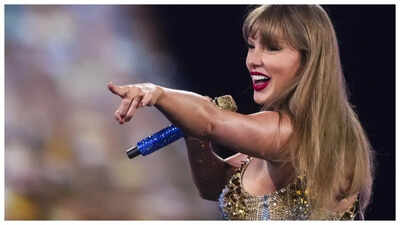
Taylor Swift has filed applications with the US intellectual property office to trademark her voice, a move similar to one made by actor Matthew McConaughey, as AI-generated content surges.
Taylor Swift to trademark her voice
The singer submitted two sound recordings to the United States Patent and Trademark Office (USPTO). Two relate to sound trademarks covering her voice: one is “Hey, it’s Taylor Swift”, and the other is “Hey, it’s Taylor” and announces the release of her latest album, “The Life of a Showgirl,” which was released in early October.This comes shortly after Swift’s likeness had been used without permission in numerous AI fakes, including Meta’s AI chatbots and in pornographic images that have circulated on the internet.
In addition, in the run-up to the 2024 U.S. presidential election, Donald Trump shared AI-generated images of the singer inaccurately suggesting that Swift had endorsed Trump.Another document submitted to the USPTO on Friday was a photo of the artist on stage. The submissions were first spotted by intellectual property attorney Josh Gerben.The filings give no further details about the submission.Taylor Swift’s publicist and representatives and Rebecca Liebowitz, partner at law firm Venable, who is listed on the trademark applications, have offered no comments, so far.
Hollywood actor Matthew McConaughey has in recent years pursued an application with the USPTO, framed as protection against the unauthorized use of his voice by AI models. They include audio of him saying “Alright, alright, alright!” – his memorable line from the 1993 film ‘Dazed and Confused’ – along with audio of him saying “Just keep livin’, right?” followed by additional short phrases.
Indian celebs granted protection from unauthorised AI use
Many artists are increasingly concerned about the unchecked use of their image and voice by AI platforms.Several prominent Indian celebrities have taken legal and preventive steps to safeguard their personality and publicity rights amid growing concerns over misuse, including AI-driven voice cloning.Playback legends Kumar Sanu and Asha Bhosle were among those who have sought protection against unauthorised AI voice cloning that mimics their distinctive singing styles.Actor Anil Kapoor secured a “sweeping injunction” in 2023, protecting his voice, likeness, image, and even his popular catchphrase “Jhakaas” from unauthorised commercial use.Similarly, Amitabh Bachchan approached the Delhi High Court seeking protection against the unauthorised commercial exploitation of his name, image, and voice. The court ruled that the actor’s name, image, and voice cannot be used without permission and directed the Ministry of Electronics and Information Technology, along with telecom service providers, to remove flagged content. “It cannot seriously be disputed that the plaintiff is a well-known personality and is also represented in various advertisements,” Justice Navin Chawla observed, noting that the actor “is aggrieved” by those using his celebrity status to promote goods and services without authorisation.More recently, the Delhi High Court granted an interim order in favour of Allu Arjun, restraining multiple parties from using his name, image, voice, or likeness without consent, thereby reinforcing the legal recognition of personality rights.Several US states have passed laws prohibiting such use, though many apply primarily to malicious or commercial exploitation.Only a few – notably the ELVIS Act passed by Tennessee’s state legislature in 2024 – offer broader protections.Few performers have turned to the courts to assert their rights. The most notable example is Scarlett Johansson, who sued the app Lisa AI in 2023 for creating, without her consent, an AI avatar in her likeness for use in an advertisement.


