

Bengaluru: Anthropic’s Mythos marks a clear break from the incremental gains typically seen across successive frontier AI systems, particularly in software engineering tasks, with significant implications for the sector.In a recent note, Kotak Securities said that if these improvements translate effectively into real-world enterprise deployments, its earlier estimate of a 3–3.5% annual growth headwind for the IT services industry over the next three years could shift from a cautious projection to a more realistic baseline. It also warned of rising downside risks if future frontier models continue to deliver step-change improvements in capability.The note highlighted that Mythos demonstrates a sharp jump in benchmark performance across software engineering tasks, diverging from the recent trajectory of moderate, incremental progress. Based on qualitative assessments, the model appears to significantly advance agentic software development capabilities. However, Kotak cautioned that the model’s real-world impact remains uncertain, as its capabilities are yet to be proven at scale due to the absence of a public release.
It added that disruption risks could be higher for IT services firms with greater exposure to application services.
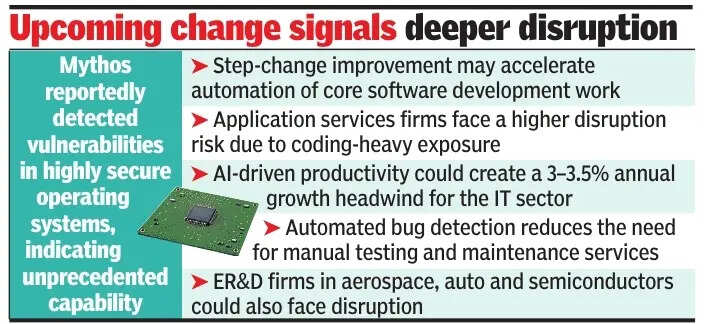
Industry voices suggest the impact could extend beyond traditional IT services. Viral Shah, co-founder and CEO of JuliaHub, said even engineering services firms focused on hardware design, testing and verification of aircraft, automobiles and semiconductors could face disruption. “Anything that is digital is a fair game.
AI represents a shift from labour to capital,” he said. While the short-term impact may be seen in margin pressures, the long-term consequences could be existential.
“I expect a bimodal distribution where a few firms adapt and go from strength to strength while others may vanish,” he added. Shah also described Mythos as a major advancement, noting that it has identified security vulnerabilities in highly secure operating systems that had previously gone undetected.At the same time, some experts see a shift in demand rather than an outright decline. Namratha Dharshan, chief business leader at ISG, said revenue deflation has already occurred in routine, repetitive and low-value work. However, she noted that AI-driven disruption is also creating new opportunities in areas such as integrations, data readiness, governance, cybersecurity and workflow design. ISG is already seeing a 20% year-on-year increase in new scope of work as companies pivot to these segments.
“Labour arbitrage is not a sustainable model going forward,” she said.Analysts also point to a structural shift in service delivery. Biswajeet Mahapatra, principal analyst at Forrester, said services built around repetitive defect discovery, regression testing and low-complexity application maintenance are the most exposed. Mythos-class models can significantly compress the effort required to identify bugs, security flaws and logic errors, particularly in code-heavy environments.However, he does not expect a wholesale revenue collapse. Instead, the bottleneck is likely to shift from detection to areas such as triage, remediation prioritisation, coordinated patching and safe deployment—functions that still require deep system context, governance and accountability. Firms that remain dependent on manual testing models may face risks, while those that pivot to secure-by-design engineering, remediation orchestration and AI-augmented reliability services are likely to see demand evolve rather than disappear.