
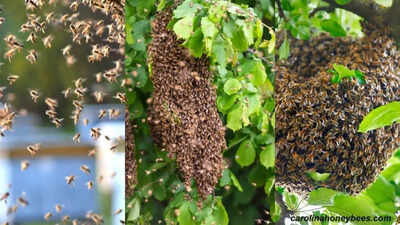
Bees are appearing earlier in the season in several regions, and the shift is being linked with changing climate patterns. A recent study has examined how hibernating bees and wasps respond to rising temperatures before spring even begins.
The findings suggest that timing is shifting in ways that affect survival, body condition, and the relationship between pollinators and plants. In some cases, insects are emerging when food sources are not yet available, creating gaps in the natural cycle. Experts say these changes might seem small at first, but they can build up across ecosystems. Gardens, farms, and wild habitats could all feel the impact as seasonal rhythms continue to shift under warmer conditions globally.
Why bees and wasps are emerging earlier than expected
According to the Federal Ministry of Research, Technology, and Space, seasonal timing for insects is closely tied to global warming. Even small changes can change internal development in hibernating bees and wasps. The result is an earlier emergence in spring.In controlled experiments, researchers have seen that warmer conditions change how long insects remain dormant. The biological “clock” seems to move faster when temperatures stay higher than usual for extended periods.
It is not a uniform effect across all species. Some respond strongly, others less so, depending on their natural habitats. This shift does not always align with plant life cycles. Flowers still depend on sunlight patterns and soil conditions, which do not always move at the same pace as temperature changes.
What the study observed about bees hibernating earlier
The study published in the Functional Ecology journal, titled, ‘Climatic origin and plasticity shape emergence timing and fitness in bees and wasps under experimental climate regimes’ raised other questions regarding extreme warming, pollination efficiency, and insect adaptation.
Most wild bees remain dormant throughout the winter period, typically in the form of pupae in cocoons buried beneath the soil or in wood, among other locations. Some early-season bee species may remain dormant as fully developed adults, while others continue to develop through the spring season to emerge only during summer.The increased temperature associated with climate change is interfering with this process by bringing about changes in timing.
Increased warmth may accelerate the process of emergence such that insects wake up before their sources of nutrition become available. Additionally, increased temperatures result in metabolic activity, accelerating the loss of fat reserves and thereby reducing chances of survival and reproduction.
In investigating this problem, scientists at the University of Würzburg studied five species of wild bees and wasps inhabiting the state of Bavaria.
These five species of wild bees and wasps were collected in large numbers (almost 15,000 individuals), representing more than 160 populations, and subjected to various spring-like temperature conditions.
What this means for gardens and ecosystems
For home gardens, the changes can be subtle at first. Bees may be seen earlier in spring, or in smaller numbers during early flowering periods. In some years, activity may appear uneven. Planting early-blooming flowers can help bridge the gap, especially species that provide nectar at lower temperatures.
This may support early-emerging pollinators during periods when natural forage is limited.On a wider scale, these timing shifts affect more than gardens. Pollination networks support crops, wild plants, and broader ecosystems. If seasonal alignment continues to drift, the effects could build gradually across regions.The timing of nature is becoming less predictable. Bees are adapting in real time, but the pace of environmental change is steady. Gardens sit right inside this shift, quietly reflecting what is happening across the wider landscape.