
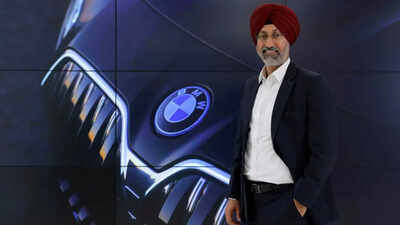
Hardeep Singh Brar, the president and CEO of BMW India, said the company remains hopeful to maintain a “strong double-digit” growth
New Delhi: German giant BMW has said that India “continues to have a very strong consumption story” despite the current geopolitical tensions and negatives such as the Iran war, and added that its leadership in luxury electric vehicles is enabling the company to gain more EV buyers as fears and concerns rise around fuel price hikes.Hardeep Singh Brar, the president and CEO of BMW India, said the company remains hopeful to maintain a “strong double-digit” growth if the geopolitical situation and uncertainties gradually start subsiding.“Coming to the overall situation, yes, there is a lot of uncertainty in the market. There are a lot of customers who are holding on to their purchases, waiting for the situation to get over… However, India continues to have a very strong consumption story.
You have to look at customers who are still not impacted amidst all this turmoil. Also, with crude prices expected to go up and eventually fuel prices likely to rise after elections, many customers are thinking about electric vehicles,” Brar told Times Internet.BMW India sold 4,567 units in the first quarter of 2026, registering a 17% growth.The company CEO said that as per the govt’s Vahan database, BMW has emerged as the Number 1 luxury carmaker in India, ahead of rival Mercedes-Benz.
“Yes, this is based on registration data released recently by FADA (Federation of Automobile Dealers’ Association). We were happy to see this. We were inching close, but did not expect it to happen so soon… We are really looking forward to continuing with this.”Asked if the surge was led by discounting, he said it was earned in the normal course of business. “If you look at our advertisements, we never talk about discounts.
The cars are on waiting. There is no reason why we should be discounting when the demand is so strong… We are making this happen organically. We are not chasing numbers blindly. We want our strategy to be right, we want launches timed well, and customer focus intact.
If that makes us number one, we are happy.”While BMW claims luxury leadership based on Vahan database, officials at Mercedes India say the latter is still Number 1 in the category when it comes to full fiscal numbers (19,363 units), as well as quarterly volumes (5,131 units).
This is based on what it calls “company-declared retail numbers” by both the makers.
Brar said BMW’s growth was aided strongly by its leadership in the luxury EV space. “We had around 60% share in the luxury EV category last year with a 21% EV penetration to our own sales. Now, EV penetration for us is at 26% to us, and we hold about 70% share in the luxury EV market… What has worked for us is a combination of EVs with long wheelbase models.
Customers appreciate that our EVs maintain the same driving dynamics as petrol and diesel cars.
”
A big part of BMW’s EV sales are led by the iX1 luxury entry SUV for the company, which enjoys a waiting period in the market. “Another factor that has brought in more customers is cost. Customers often worry about maintenance and running costs in luxury cars. With EVs, it’s a no-brainer — less moving parts, lower maintenance, and significantly lower running costs.
Whether it’s a Rs 20 lakh EV or a Rs 50 lakh+ EV, the cost of electricity per unit is the same.
So, the driving economics are the same and highly attractive. Also, with ranges exceeding 500 km, strong tech, and cost savings, customers see a complete value proposition. Everything is a plus plus.”
Asked whether fears around fuel price hikes, due to the Iran war, are also benefiting the company’s EV sales, he said it was certainly the case.
“With increasing noise around crude and fuel prices, customers are evaluating EV economics more seriously. If you drive 50,000 kms in three years, you could save around Rs 4.25 lakh. That’s mind blowing. That’s a significant saving, with no compromise on performance or experience.
You also save on overall cost of ownership.”Brar said depreciation of the rupee is a big concern for the European luxury makers. “Forex is our biggest concern, more than commodity prices.
We have already increased prices twice this year. If needed, we may relook pricing again. We are also using hedging, though it has its limits.”He said that while the company has raised prices by about 3–4% this year, the rupee has overall depreciated nearly 18% overall over the past years. “… so, there is still a lot of pricing gap. We cannot pass it on entirely at once, so we are balancing it with internal cost measures.”The company has plans to launch 27 cars this year, which includes all-new models, refreshes, and upgrades. “These will include SUVs, sedans, convertibles, EVs. We also have two motorcycles. Importantly, 10 of these will be MINI models, as we are focusing heavily on growing that brand.”
Brar said that MINI will play a key role in the India strategy this year. The company has plans to launch ten new MINI cars, while looking to double the sales over the 730 units sold last year. “MINI is a lifestyle product. About 90% of MINI buyers are already luxury car owners, and around 50% come from BMW customers… It is also a popular gifting option — for marriage anniversaries, for children after college passing out, or as an additional car in the garage.
It appeals to customers who want something unique and personal.”

