
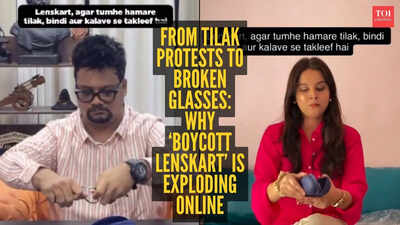
Lenskart faces a major online backlash after a staff grooming guide allegedly discriminated against Hindu religious symbols. Despite the founder’s clarification, employee accounts and viral videos of customers destroying glasses have fueled a boycott movement, highlighting workplace identity and religious expression sensitivities in India.
This whole thing escalated fast.What started as a simple discussion around a company policy has now turned into a full-blown online drama – and Lenskart has found itself right in the middle of it.Over the last few days, the brand has been everywhere – trending, debated, criticised. And not in a good way. It’s not just tweets anymore; it’s videos, reactions, outrage – the works. At this point, it’s way bigger than just “a policy issue.”So, how did it even start?It all began with a document that started doing the rounds online. People claimed it was a staff grooming guide from Lenskart.And honestly, the moment people read it, questions started popping up.The issue? It allegedly suggested that certain Hindu symbols—like tilak, bindi, and kalawa—were being treated differently compared to things like hijabs or turbans.That didn’t sit well with a lot of people.Writer Shefali Vaidya brought more attention to it on X, basically asking the question many were already thinking: why are some forms of religious expression okay, and others not?
And from there… things just took off.
Social media did what it does best—picked sides instantly.
The founder steps in… but it doesn’t cool down
As the conversation got louder, Peyush Bansal finally addressed it.He said the document going viral doesn’t reflect the company’s current policy. According to him, Lenskart doesn’t restrict religious expression at all – employees are free to wear bindi, tilak, or anything else.He also admitted that maybe some older internal documents weren’t worded properly and needed fixing.Fair enough, right? Sounds like a clarification.Except… people weren’t convinced.Then came the employee side of the storyJust when it seemed like things might settle, more voices started coming in – this time from people who’ve actually worked there.Some current and former employees claimed that during store audits, things like kalawa were flagged. One ex-store manager even said their outlet lost points because staff members were wearing it.
Others hinted at internal complaints and pressure around grooming rules.Now, whether this is a widespread issue or just a few isolated cases—no one can say for sure yet. But online, that distinction doesn’t always matter. Once doubt creeps in, it spreads quickly.
And then… the videos took over
This is where things really shifted.
Instagram suddenly got flooded with videos that took the outrage offline and turned it into something visual.In some clips, people are straight-up smashing eyeglasses – said to be from Lenskart – on camera.
One guy even used his slipper to break a pair and posted it with a “Boycott Lenskart” caption.Another video shows a group of men walking into a store, applying tilak on their foreheads while filming, almost like a statement. Even a staff member is seen joining in.
At that point, it stopped being just discussion. It became performance. And that’s exactly what makes content spread like wildfire.
Why this isn’t slowing down
Here’s the thing – online controversies don’t end just because someone explains their side.Once people latch onto a narrative, it grows on its own. Everyone adds their version – screenshots, stories, opinions – and suddenly, the original issue becomes just one part of a much bigger conversation.In this case, it’s a mix of:That original documentThe founder’s statementEmployee claimsAnd now, viral videosPut all that together, and you’ve got a cycle that keeps feeding itself.
It’s not just about one brand anymore
At this point, this isn’t only about Lenskart.It’s touching a much larger nerve – how companies deal with identity, religion, and personal expression at the workplace.And in a country like India, that’s always going to be sensitive. People take it personally, and understandably so.
So where does it stand now?
Even after the clarification, the noise hasn’t died down. Social media is still buzzing, more videos keep popping up, and the boycott calls are very much alive.Right now, Lenskart isn’t just facing criticism – it’s dealing with something trickier: perception.And once that shifts, it’s not easy to fix.One thing’s pretty clear though – in today’s internet culture, controversies don’t stay small. They grow, they evolve, and sometimes… they take on a life of their own.

