
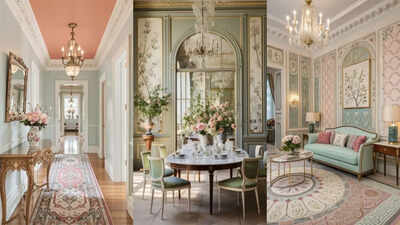
From Bridgerton to the living room: Interior expert explains the rise of Regencycore, the romantic, period-inspired design trend finding its way into modern homes globally
There is something about sweeping drapes, ornate detailing and candlelit grandeur that has always stirred something in people. Now that something has a name, Regencycore. Rooted in the aesthetics of early 19th-century Regency-era Britain, the trend draws on historical romanticism and theatrical elegance, reimagined for the modern home.Its recent surge in popularity owes much to cultural touchstones like the Netflix series Bridgertonbut this is more than a TV-inspired fad. Regencycore speaks to something deeper, a longing for beauty, warmth and a sense of story within the home.According to a 2026 study in the journal Current Opinion in Psychology, “Nostalgia enhances feelings of social connectedness, meaning in life and psychological comfort, particularly during periods of uncertainty.” This directly explains why Regencycore’s romantic, historical aesthetic resonates now – it offers comfort, warmth and emotional grounding.
Geoff Brand, Founder of Australian-owned brand Bean Bags R Us, has been watching the trend take hold and he revealed why it resonates so strongly right now. In an interview with the Times of India, he shared, “What we’re seeing is an appetite for interiors that feel considered and personal. People want their homes to reflect a sense of character.”Read on as we decode the trend and highlight practical advice on bringing Regencycore into any home.
Why romantic nostalgia is trending in interiors
Modern interiors have long favoured the clean, the minimal and the understated but there are signs that appetite is changing. After years of pared-back living, many homeowners are looking for something that feels warmer, richer and more emotionally resonant and Regencycore delivers exactly that.Part of its appeal lies in escapism. Ornate, historically inspired design offers a visual retreat from the functional monotony that minimalism can sometimes produce.
Where stark white walls and bare surfaces keep things simple, Regencycore invites you to linger.
There is also an element of storytelling. Well-chosen period details like an arched mirror, a tufted chaise or a ceiling rose give a room a sense of history and personality that contemporary design often strips away.A 2026 study in Journal of Environmental Psychology revealed, “Interiors perceived as layered, personalised and visually rich were consistently associated with higher emotional attachment and perceived comfort than minimalist environments.”
This validates that people are moving away from minimalism toward more expressive, layered interiors – exactly what Regencycore delivers through ornamentation, textiles and symmetry.“Romantic aesthetics tap into something psychological,” said Brand. “A room with layers and ornamentation feels lived-in and intentional. It tells a story about the person who inhabits it and that emotional connection is something people are actively seeking in their homes right now.”
A 2026 Frontiers in Psychology study found, “Moderate visual complexity and ornamentation increase engagement and perceived ‘atmosphere,’ contributing to a stronger sense of narrative within a space.” This backs the idea of “storytelling” in interiors, showing that decorative elements like moldings, layered fabrics and curated objects make spaces feel more immersive and meaningful, not just visually appealing.
The core elements of Regencycore design
At its heart, Regencycore is about considered abundance. Every element is chosen for how it contributes to an overall sense of grandeur without tipping into clutter.
- Symmetry: Regency-era interiors were built around balance – matching sconces on either side of a fireplace, paired armchairs and centered artwork. This architectural approach gives rooms a composed, formal elegance that feels inherently classical.
- Ornamentation: Ceiling cornicing, decorative moldings and carved furniture legs are all hallmarks of the style. If your home lacks original period features, modern reproductions and carefully sourced antique pieces can achieve a similar effect.
- Fabric choices: Think velvet, silk and heavy linen in deep jewel tones or softer blush and ivory palettes for a more delicate interpretation. Curtains should be full and floor-length. Upholstery should feel substantial.
- Layering: Regencycore rooms are built up gradually with rugs over rugs, cushions over cushions, art arranged in salon-style groupings rather than placed in isolation.
“It’s about creating depth,” said Brand. “Each layer adds to the overall feeling of the room. When it’s done well, it feels opulent but also comfortable, the kind of space you actually want to spend time in.”
How to add Regencycore without turning your home into a film set
The most common concern people have about this kind of design is going too far. The good news is that Regencycore works just as well as an accent as it does as a full commitment.
- Starting with one statement piece: A velvet sofa in a rich jewel tone, an ornate gilded mirror, or a dramatic pendant light can anchor a room in the aesthetic without requiring a complete overhaul. Let that piece lead and build around it selectively.
- Mixing eras keeps things grounded: Regencycore details sit well alongside contemporary furniture, a modern, clean-lined sofa paired with antique side tables or a minimalist kitchen offset by a heavily framed botanical print. The contrast prevents the space from feeling theatrical or dated.
- Textiles are perhaps the lowest-commitment: Swap out plain cushion covers for something in velvet or brocade. Add a fringed throw. Layer a richly patterned rug over a neutral floor. Small changes in texture and fabric can shift the entire mood of a room.
“You don’t need to redesign everything,” said Brand. “Some of the most effective Regencycore interiors I’ve seen have been achieved through a handful of well-placed choices. A room can feel entirely different with the right mirror, the right fabric, the right light. It’s about intention, not volume.”

