
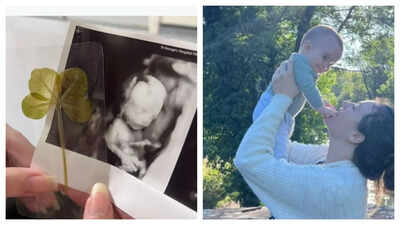
Ever heard of a blood transfusion in a womb? This probably is one of the rarest of rare miracles medical history has ever witnessed. When an unborn baby’s life was saved after receiving a transfusion while he was still the size of an apple in the womb, which made him Britain’s youngest blood donor recipient.Why the transfusion?According to a report published in a leading digital daily, it was mentioned that the unborn baby Arthur Ransom’s organs were failing after contracting a virus, and to save his life, the doctors performed an intricate infusion using a tiny needle inside the womb when his mother Maisie was just 16 weeks into the pregnancy. The “50/50” procedure worked, so Arthur recovered in the womb and was born in January 2025.
Here’s more about this complex transfusion.What exactly is this rare transfusion?Baby Arthur Ransom became Britain’s youngest blood donor recipient, but it is not the first time this condition has arisen. As per the experts of medical science, such procedures on babies in the womb are known as intrauterine transfusions (IUT). Sharing her views with the leading daily, Arthur’s mother, Maisie, expressed her gratitude to the donors and doctors who saved her baby.
She said, “There are no words to express the gratitude I feel.
The experience was absolutely terrifying. ” The doctor said it was 50/50 whether he would make it or not. He was so small the doctors were working within millimeters. Without that blood he would not have made it. “His organs were failing, his heart was completely enveloped in fluid and it was struggling to pump. If nothing was done, he would not have made it much longer.” Here’s what actually happened. Read on The rare virus complicationAccording to the report, during the 16-week pregnancy, in the womb Arthur had developed Parvovirus which is a common childhood illness also known as “Slapped cheek syndrome”, which was life-threatening because his immune system had not yet developed enough to fight off the bug, making him severely anemic and causing a dangerous build-up of fluid, which in turn caused heart failure.
However, to treat this, the doctors performed an intricate transfusion using the needle guided by ultrasound through which oxygen was delivered to Arthur’s body so the fluid around his heart and organs could be reabsorbed.
The complex and complicated procedure was performed by the experts and doctors at St. George’s Hospital in London, which further reduced the strain on his body and heart, allowing normal function to return.Ransom’s mother further expressed that “The doctor said to the best of her knowledge there was no-one younger to get an intrauterine transfusion. Arthur’s doing great now, he’s a really chirpy little boy, reaching all the milestones. He keeps us on our toes. I think every day about how lucky I am.”I don’t think there are words to describe how thankful I am to blood donors. To have the life I am now living, with my family, there are no words to express the gratitude I feel and how fortunate I was to be able to access that care and blood promptly.
I do often wonder who the person to donate was as I would love to tell them that their decision to give blood gave my boy the chance to be here.”What makes this transfusion so complex?According to the experts, IUTs are some of the most complex yet rarest transfusions, which require a very specific blood type that can only be provided by a small number of donors. Donors need to be men, have type O blood which is “Kell negative” and also be negative for cytomegalovirus. Only around 180 IUT units are issued each year by the NHS. Their blood is made into small packs of extremely concentrated red cells, which are then transfused into anemic fetuses to save lives.Image courtesy: Mirror.Uk