
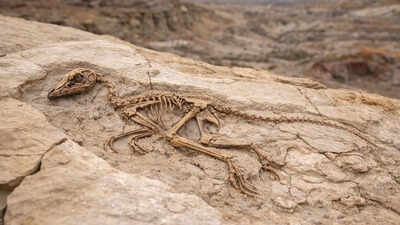
One of the most fascinating fossils discovered in Argentina includes a chicken-sized dinosaur whose existence challenges our understanding of the prehistoric world. The newly discovered dinosaur is named Alnashetri cerropoliciensis, and it was discovered in Patagonia.
In addition, this fossilised specimen represents one of the smallest non-avian dinosaurs discovered to date.Interestingly, what makes this fossil even more fascinating is the era in which it existed, as this small dinosaur coexisted with other massive dinosaurs on the planet. This fascinating study conducted by scientists at the Natural History Museum in Los Angeles was recently featured in the prestigious journal Nature.
Alnashetri dinosaur discovery in Argentina: Location, age and fossil details
The fossil was discovered at the La Buitrera location in the north of Patagonia, an area that is famous for its abundant fossil discoveries. The experts say that the new dinosaur species called Alnashetri lived roughly 95 million years ago in the Late Cretaceous era.Another important feature of this find is the state in which the fossil was preserved. The skeletal remains of the new dinosaur were well preserved in a natural position of rest, which makes it possible to study its morphology in unprecedented detail.
Such good preservation of the skeleton gives information about the way this dinosaur behaved and looked.According to the study titled “Argentine fossil rewrites evolutionary history of a baffling dinosaur clade,” published in the journal Nature, this fossil provides key evidence about the evolution and diversity of small-bodied dinosaurs in South America.
Size and features of the chicken-sized dinosaur Alnashetri
Unlike the common large reptiles believed to inhabit the prehistoric period, the Alnashetri was very small. It is estimated that its body length was approximately 70 cm and its body weight was less than a kilogram.
Consequently, the dinosaur was smaller than most bird species in existence. Such information challenges the general idea that all dinosaurs were large-sized.It possessed efficient and effective body features meant to facilitate its activities. For instance, the animal possessed long legs, indicating that it was a very fast-running dinosaur with high mobility. In addition, despite its relatively shorter forelimbs compared to others, it possessed strong limbs and could have been adapted for specific functions like digging and capturing prey.
Besides, the dinosaur possessed a very light head.
What type of dinosaur was Alnashetri: Theropod and Alvarezsaur evolution
The Alnashetri was among the theropods, which are a group of dinosaurs that include famous meat-eating species such as the Tyrannosaurus rex. This dinosaur belongs to the family of Alvarezsaur, which are small, quick dinosaurs characterised by specific physical traits.This family is especially notable among palaeontologists for its unique evolution from other large dinosaurs, which is one of the many reasons why they continue to fascinate many researchers.
It is also believed that these dinosaurs might have possessed feathers, a trait that may indicate their evolutionary relationship with birds.
Diet and survival of the chicken-sized dinosaur in Patagonia
Though small in size, this organism would have made a very efficient and fast-moving hunter. It most likely hunted for insects, small reptiles, and early mammals living within its surroundings. Such features as its agility and speed would have helped it successfully hunt and defend itself against other organisms.Its habitat was a semi-arid climate, which would have meant that the organism had to be very adaptable and resilient in order to cope with its surroundings. The lightweight construction of the organism, along with its ability to move rapidly, indicates that it was adapted to the environment.
Cretaceous Patagonia ecosystem: Coexistence of small and giant dinosaurs
Finding Alnashetri gives us information regarding the ecology of Patagonia during the Cretaceous period. Alongside such a small animal, at that very time in Patagonia, there existed gargantuan creatures such as the Argentinosaurus, among the biggest dinosaurs ever discovered, as well as the Giganotosaurus, a fierce predator.The simultaneous existence of such creatures is indicative of the complexity of ancient ecosystems, where even the smallest dinosaurs found their place within specific ecological niches.
Why the Alnashetri discovery is important for dinosaur evolution
Such discoveries refute old theories of the development of dinosaurs. It proves that such characteristics as small body size may have been independently acquired by other dinosaurs.It will also shed light on how dinosaurs managed to adjust to various habitats.
Using information about the discovered dinosaur Alnashetri, the researchers will be able to study the variety of fauna that existed during that era.
Final insight on the chicken-sized dinosaur discovery in Argentina
The existence of Alnashetri is evidence that dinosaurs were much more varied in their form and shape than was previously thought possible. Whereas large dinosaurs tend to be popular subjects, it is those small dinosaurs that tell us about the finer points of the prehistoric period.Its small size, specialised body parts, and capacity for survival in difficult conditions give this small chicken-like dinosaur a whole new angle from which to view the process of evolution.