
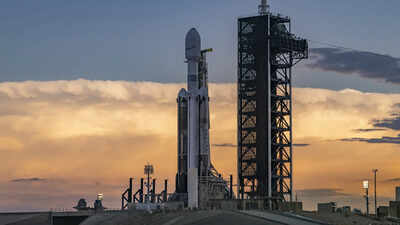
Elon Musk’s SpaceX is all set to launch the @viasat-3 F3 mission. SpaceX has confirmed that its powerful Falcon Heavy rocket will launch for the first time in 18 months, lifting off from NASA’s Kennedy Space Center in Florida.
The 85-minute launch window opens at 10:21 a.m. ET (8 PM IST). If needed, a backup opportunity is available Tuesday, April 28 during an 85-minute window that opens at 10:17 a.m. ET (8 PM IST). A live webcast of this mission will begin about 15 minutes prior to liftoff, which you can watch here and on X @SpaceX. You can also watch the webcast on the X TV app.“One of the side boosters on this mission previously supported SDA-0A, SARah-2, Transporter-11, and 18 Starlink missions, and the second previously supported launch of the GOES-U mission.
Following stage separation, Falcon Heavy’s two side boosters will land on SpaceX’s Landing Zones 2 and 40 (LZ-2 and LZ-40) at Cape Canaveral Space Force Station in Florida,” said SpaceX.
Falcon Heavy one of the most capable rockets
The Falcon Heavy is one of the most capable rockets in operation today, combining three Falcon 9 boosters to generate more than 5 million pounds of thrust. This immense power allows it to carry large payloads to geostationary orbit and beyond, making it a critical asset for both commercial and government missions.
The April 27 launch was the rocket’s first since October 2024, highlighting the significance of its return to service.In line with SpaceX’s reusability strategy, the rocket’s two side boosters executed a synchronized landing at Cape Canaveral, a visually striking maneuver that has become a hallmark of Falcon Heavy missions. The center core, however, was expended due to the demanding trajectory required for the satellite deployment.The payload, Viasat-3 F3, is designed to expand broadband coverage across the Americas, Europe, and Africa. Its deployment will support growing demand for high-speed internet services, particularly in underserved regions. SpaceX confirmed the satellite was successfully placed into orbit, ensuring the mission’s objectives were met.