
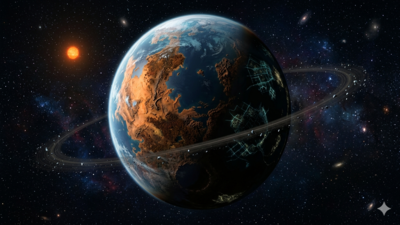
Not only is water necessary for sustaining life, but it is also an important factor in maintaining the climate of a planet. The study of exoplanets reveals that without enough water, there is no way for a planet to establish a stable carbon cycle, which is necessary for the regulation of the planet’s carbon dioxide levels.
In the case of our planet, it is called the “carbonate-silicate cycle,” which functions like a thermostat for Earth.
How carbon cycling on exoplanets work
These processes rely heavily on interaction between the atmosphere, surface, and interior of a planet. Precipitation takes up carbon dioxide, which turns into weak carbonic acid and weathers the rocks. In this way, carbon becomes embedded in the minerals, which are then carried inside the planet through tectonic movements.
The volcanic eruptions will give out carbon dioxide into the atmosphere.The paper ‘Carbon cycling and habitability of massive Earth-like exoplanets’ underscores the interdependence, declaring that “limited surface water decreases silicate weathering rates, limiting the strength of the feedback mechanism that maintains climate stability.” Without sufficient amounts of water, this process becomes difficult, ceasing to function completely and turning the planet into a frozen or overheated one.
The scientists point out that even planets located in the so-called habitable zone might not be habitable if they do not have enough water. As said in the paper cited above, “habitat zones for rocky planets should take into account active geochemical cycles, rather than just distance from their star.”
What this means for the search for habitable worlds
Implications for the search for extraterrestrial planets and life are profound. Many scientists usually consider only those exoplanets whose orbits fall within what is known as the habitable zone, the area around a star that allows liquid water to exist.
These results demonstrate that merely falling within this range is not enough; exoplanets must also possess enough water for the geological cycles that help stabilise their atmospheres.As NASA scientists have noted, “long-term climate stability depends on balancing carbon inputs and outputs.” Clearly, water is an essential ingredient that maintains this balance; without it, planets experience drastic fluctuations in climate.Astronomers will now pay attention to other criteria in addition to the position of exoplanets when studying them. Future expeditions will concentrate on the detection of atmospheres and geology capable of sustaining a stable carbon cycle.
The bigger picture: Water as a marker of habitability
After all, water is proving to be essential not only for life, but also for planet stability. Worlds without enough water might seem to be very attractive indeed; however, without carbon cycle processes, such planets cannot be inhabited for an extended period of time.With ongoing investigations, new criteria for defining the potential habitability of worlds have been developed, going beyond elementary models of water availability and taking into account complex interactions on chemical, geological, and climate levels. This opens up exciting possibilities for solving one of the major problems of our civilisation: are we alone in the universe?