
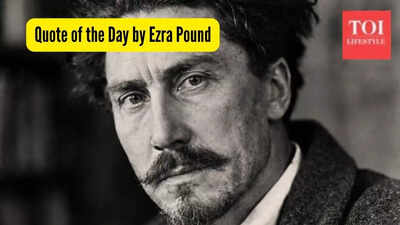
Ezra Pound was one of the most important and controversial writers of the 20th century. He was a poet, a critic, an editor, and a cultural force, leaving a significant mark on modernist literature and championing several key writers.
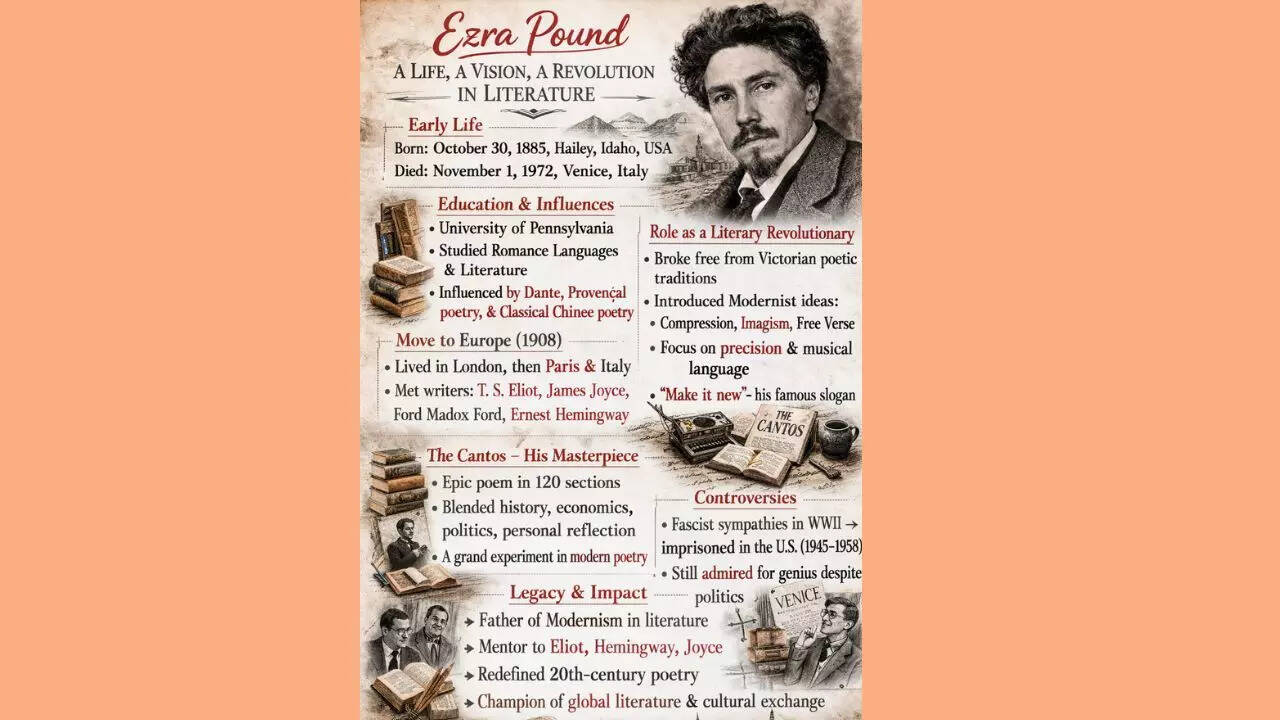
Pound’s reputation extended beyond his own verse; he was also renowned for his ability to recognize and nurture literary talent. Ezra Pound entered the world on October 30, 1885, in Hailey, Idaho, a town in the United States.Ezra Pound was born on October 30, 1885, in Hailey, Idaho, which is in the United States. His dad worked at the U.S. Mint, and the family soon moved to Pennsylvania, where Pound spent most of his childhood.
He was very interested in books and languages from a young age. He attended the University of Pennsylvania and Hamilton College, where he developed a strong interest in poetry, classical literature, and Romance languages.
Pound was a dedicated student, and he had a strong belief that he would become a great poet. His love of literature, combined with his drive, would greatly influence the direction of his life. After he graduated, Pound worked as a teacher for a short time, but he quickly grew tired of school life.
At that time, Europe was thought to be the cultural center of the literary world, so he decided to move there in 1908. He moved to London first, where he quickly got involved in literary circles. In the early 1900s, many experimental writers met in London to try to break away from the Victorian styles of poetry and fiction that were popular at the time. Pound got very involved in these new movements and quickly became one of their most active supporters.Pound made friends with a number of important writers while he was in London. These writers would later become important figures in modern literature. T. S. Eliot, James Joyce, and W. B. Yeats were some of them. Pound was not only a writer, but he also taught and promoted their work. He helped get T. S. Eliot’s work in front of more people, and he was a key editor of Eliot’s famous poem The Waste Land, which later became one of the most important works of modernist poetry.
Pound’s suggestions for editing the poem helped shape the final version and showed how well he understood literary style and structure. Pound’s most important contribution to literature was his work on Imagism, a movement that stressed clarity, accuracy, and strong visual imagery in poetry. Imagist poets thought that poems should show clear and vivid pictures instead of long, flowery descriptions or emotional over-the-topness.
Pound advocated for poetry to be concise and direct, devoid of unnecessary words. His imagist style is well-known in his short poem “In a Station of the Metro,” which captures a fleeting moment in just two lines. The poem compares the faces of people in a subway station to petals on a wet black branch. This shows how powerful images can convey meaning in very few words.
Pound had an impact on more than just Imagism. He also helped spread another modernist movement called Vorticism, which tried to show the modern world’s dynamic energy.
Pound thought that literature should show how the world was changing in the 20th century, with new technologies and social structures that were always changing. His ideas pushed writers to try out new styles, break the rules, and find new ways to talk about life today.Pound’s most ambitious literary work was probably The Cantos, a long and complicated poem. People know that the Cantos are hard and complicated, but they also show how smart and curious Pound was.
Pound tried to connect old civilizations, famous people from history, and modern society through this work, making a kind of poetic history of human culture.Ezra Pound’s legacy is not just in the poems he wrote, but also in the literary movement he helped start. He was a key figure in the development of modernist writing because he encouraged new ideas, helped other writers, and pushed literature in new directionsQuote of the DayOne of the very famous lines of Ezra Pound is, “If a man isn’t willing to commit to risking his opinions, either his opinions are no good or he’s no good.”
One way to make sense of this quote is to contemplate how belief and action are connected. Many people have opinions about politics, social issues, or moral values, but they might not say them out loud if they think someone will disagree with them. This idea says that real belief needs bravery.
If someone really thinks something is right or important, they should be ready to defend that belief, even if it means getting criticized, disagreeing with others, or facing personal consequences. Otherwise, they might not really believe what they say. The quote also shows how important honesty is. If someone won’t take any risks for their beliefs, it could mean that they care more about comfort or approval than about truth or principle. In that way, the quote says that a person’s character is shown by how much they are willing to give up for what they believe. Standing up for what you believe in, even when things are hard, shows that you are strong and dedicated.This quote also talks about how risk is a part of making meaningful changes.


