
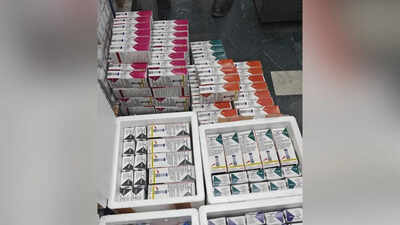
Authorities have uncovered a dual operation in Gurgaon where a man manufactured fake Mounjaro injections.
GURGAON: The man accused of manufacturing fake Mounjaro injections from a Sector 62 flat was running two parallel operations, police have found – producing counterfeit vials designed to pass off as the weight-loss drug, while also developing and selling an unapproved tirzepatide-based injection under his own brand name, ‘Toneup’.Officials said Avi Sharma was using 3D printing to make cartons, labels and instruction leaflets that closely mimicked original Mounjaro packaging. At the same time, he had prepared 15-16 vials labelled Toneup, which he allegedly sold online as a separate weight-loss product.It is these Toneup vials that have now been traced to buyers in Delhi, Hyderabad and other cities.“He had prepared 15-16 vials under this brand name and sold them through an online platform to buyers in Delhi and other parts of the country.
We have retrieved the injections from Delhi. The others are being traced. Six injections sold in Hyderabad have also been traced,” said Amandeep Chauhan, the district drug controller.The department has sought details from IndiaMART, where Sharma allegedly listed the products, and has begun an immediate recall. “This brand has no approval from any authority, and these injections were never tested. Anyone who has them should not use them at all,” Chauhan said.
According to officials, the injections were sold for Rs 11,000 to Rs 18,000. Sharma is in judicial custody till May 8.The racket was busted on April 22, when a joint team of drug inspectors and police intercepted a car near Super Mart-1 and seized 262 vials of suspected spurious injections worth more than Rs 70 lakh. Sharma and his associate, Mujammil Khan, were arrested. The probe found that the operation ran out of a flat in Sector 62 that had been turned into a crude manufacturing and packaging unit.
“His lab was just one room with a refrigerator and a deep freezer.
He used Google, ChatGPT and YouTube to learn how to make injections,” Chauhan said.Sharma, officials said, sourced research-grade tirzepatide, cartridges and injection pens online, then assembled the injections at home. He allegedly used 3D printing to make cartons, labels and instruction leaflets resembling the genuine product. During inspection, officials found visible differences in colour, typography, text alignment and the pen illustration.
“These discrepancies clearly showed that the product was not genuine,” Chauhan said.The authorities invoked provisions of the Drugs and Cosmetics Act, 1940, including Section 17B on spurious drugs and penal sections 27(a) and 27(c).All seized samples have been sent for laboratory testing, including sterility analysis. The results are expected after a 14-day incubation period. A spokesperson for Eli Lilly India, which manufactures Mounjaro, said the company “takes patient safety extremely seriously”, welcomed the crackdown and was “actively supporting the investigation”.