
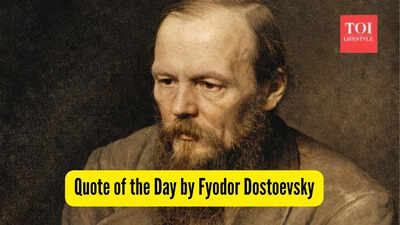
Fyodor Dostoevsky is considered as one of the most loved novelists across the world. His writing goes deep into human psychology, morality, faith, and the problems that people face in their souls.
Dostoevsky changed the novel into a powerful tool for philosophical and psychological exploration through both his troubled life and his innovative writing style. Dostoevsky was born in Moscow, Russia, to a middle-class family. His father was a strict doctor, and his mother was kind and religious. These two things would later show up in his work. Dostoevsky was sent to a military engineering school in St. Petersburg after his mother died, even though it was clear that he loved literature.
His first book, Poor Folk (1846), was a giant hit with critics and showed that he was a talented young writer.But things changed quickly in his life. The Russian government thought Dostoevsky was part of a group that talked about political and social reforms in 1849, so they arrested him. He was sentenced to death and even taken to a firing squad, but the Tsar ordered a fake execution at the last minute. The event had a profound effect on him.
Rather than facing execution, he was sentenced to a Siberian prison camp for several years.
Afterward, he was conscripted into the military. In Serbia, Dostoevsky’s experiences with criminals, his personal hardships, and his deep spiritual reflections greatly influenced his writing. This time in his life sparked a strong interest in human suffering, the possibility of redemption, and the nature of faith, which became the main themes of his later works.
After returning from exile, he slowly rebuilt his writing career. His most popular books, including Crime and Punishment, The Idiot, Demons, and The Brothers Karamazov, garnered worldwide acclaim.Dostoevsky’s literary distinction lies significantly in the profound psychological depth of his characters. He explored the intricacies of the human psyche well before psychology was established as a formal discipline.
His characters often grapple with internal struggles, moral quandaries, and existential challenges. As an illustration, in *Crime and Punishment*, the protagonist Raskolnikov experiences guilt and attempts to rationalize his actions following a murder, thereby demonstrating Dostoevsky’s preoccupation with themes of conscience and the possibility of redemption.
Another thing that makes his style unique is what critics call “polyphony,” a word that literary theorist Mikhail Bakhtin later made popular.
Dostoevsky’s books have more than one voice and point of view, and there is no one right answer. The characters have different ideas about truth, morality, and existence, and the author doesn’t give a clear answer. This gives his works a sense of movement, almost like philosophical arguments happening in a story.Dostoevsky’s stories were also very intense. His writing is often dramatic, full of tension, and full of emotion.
He often puts his characters in very dangerous situations, like crime, poverty, madness, or a spiritual crisis, to show who they really are. Sometimes this intensity can be too much to handle, but it’s what makes his work so powerful and real. Faith and doubt are two themes that run through all of his writing.
Dostoevsky was very interested in questions about God and morality because he had both deep suffering and a religious awakening.
He often wrote about characters who are torn between believing and not believing, which was a reflection of his own inner struggles. Dostoevsky was different from many Western thinkers of his time who stressed rationalism. He was more interested in the emotional and spiritual aspects of life. His work also talks about how radical political ideas grew in Russia in the 1800s. For example, in Demons, he talks about how nihilism and extremism can be dangerous and how ideological fanaticism can cause chaos and destruction.
He was still very worried about social problems like poverty, inequality, and injustice at the same time.Dostoevsky has had a huge effect on literature and ideas. He had an impact on more than just novelists; he also had an impact on philosophers, psychologists, and theologians. Friedrich Nietzsche admired his ability to understand people’s minds, and Sigmund Freud thought he was a deep explorer of the unconscious mind.
Existentialist philosophers like Jean-Paul Sartre and Albert Camus were profoundly impacted by his examination of freedom, responsibility, and significance.
Dostoevsky’s influence can be seen in modern literature’s focus on characters who are hard to understand and morals that are not clear. He helped the novel move away from just telling stories and toward more philosophical and psychological questions.
People still read and study his works a lot, not just because they are great literature but also because they give us insight into what it means to be human.Dostoevsky’s personal life was still hard, even though he was smart. He had trouble with epilepsy, money, and gambling. Fyodor Dostoevsky transcended the role of a mere novelist; he was a profound intellectual who employed fiction as a medium to explore the fundamental aspects of human existence.
His distinctive perspective was shaped by the adversities, periods of exile, and spiritual development he experienced throughout his life.
Through his profound philosophical understanding, psychological acuity, and compelling narrative techniques, he made a significant and enduring impact on both literature and intellectual discourse. His writings continue to resonate in contemporary society, addressing enduring questions: What constitutes the essence of humanity? How should one conduct their life? And how do love, truth, and pain change our lives?Quote of the DayOne of the most iconic quotes of Fyodor Dostoevsky is, “A man who lies to himself, and believes his own lies becomes unable to recognize truth, either in himself or in anyone else, and he ends up losing respect for himself and for others.
When he has no respect for anyone, he can no longer love, and, in order to divert himself, having no love in him, he yields to his impulses, indulges in the lowest forms of pleasure, and behaves in the end like an animal.
And it all comes from lying – lying to others and to yourself.”This strong passage is from Fyodor Dostoevsky’s book The Brothers Karamazov. It talks about how lying to yourself can slowly ruin your moral and emotional life.
The quote is mostly about lying to yourself, which Dostoevsky says is the most dangerous kind of dishonesty. When a person lies to themselves over and over again, like denying uncomfortable truths, justifying wrong actions, or changing reality to fit their needs, they start to lose the ability to tell the difference between what is true and what is false.
It’s not just about lying to others; it’s also about making up a false world inside yourself and then believing in it.When someone loses touch with the truth inside themselves, they can’t see the truth in other people either. People stop trusting each other, and they also stop trusting their own judgement. This has a bigger effect: it makes you lose respect for yourself. You start to feel empty or broken when you know, even if it’s only subconsciously, that you’re lying to yourself. That dishonesty inside you hurts your integrity, and without integrity, you can’t really respect yourself.The quote then shows a chain reaction. When a person doesn’t respect themselves anymore, they also have a hard time respecting other people. Relationships become shallow or manipulative when they aren’t based on honesty or mutual respect anymore. Respect is necessary for a deep connection, and without it, emotional ties become weaker. Dostoevsky then makes an important jump: love can’t happen without respect.
To love someone, you have to be honest, open, and see them for who they really are. If someone can’t accept the truth, even about themselves, they can’t really love other people. Their emotional world is empty. Over time, this pattern makes a person act only on instinct, without any higher morals or self-control. This is why Dostoevsky compared it to acting “like an animal”. The end of this quote is what makes it so powerful: all of this decline starts with something that seems small—lying.
Not serious wrongdoing, but the quiet habit of not telling the truth. Dostoevsky is saying that moral decline often happens slowly. It begins with self-deception and then spreads to affect how you see things, your relationships, and your behaviour.
The passage is basically a reminder that being honest, especially with yourself, is the most important thing for a life that matters. Without it, a person could lose not only their grip on reality, but also their ability to love, respect, and be human.

