
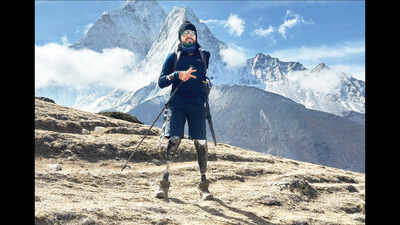
Panaji: Goa-based triple amputee and founder of Tinkesh Ability Foundation, Tinkesh Kaushik, led India’s largest inclusive trek to Everest base camp, which was completed on April 14.Panaji: The Lyrids meteor shower occurring in the constellation Lyra: the Harp, in the northern sky in spring, is expected to be sighted in Goa, on April 22. This year, the moon will be a 30% illuminated waxing crescent.Known for bright, fast meteors, they offer roughly 10-20 “shooting stars” per hour, occasionally producing dramatic fireballs. It is caused by Earth passing through dusty debris from the long-period comet C/1861 G1 (Thatcher).“The annual shower, known for its few but bright, swift meteors, promises a dazzling display across the night sky,” said Satish Nayak, the president of Association of the Friends of Astronomy.The meteor observation is best visible in dark skies with no light interference. However, with the pre-monsoon rain clouds hovering in some parts of the state, the view may have obstructions in some parts of the state.“Ideal viewing spots include open beaches and hilltops away from city lights.
However, since there is a doubt of the recently issued yellow alert for the state, and the cloudy skies these days, astronomy enthusiasts are advised to head for dark areas if interested but stay prepared for sudden weather changes,” Nayak said.Calangute: Following fierce opposition from locals and environmentalists to Calangute MLA Michael Lobo’s plan to cut ‘heritage’ trees for the development of the Calangute-Mapusa road stretch from St Alex church to Bhodkovodh junction, the MLA has now announced that most existing trees will be protected and “only two-three damaged trees will be removed for safety”.The Goa State Infrastructure Development Corporation (GSIDC), of which Lobo is the chairman, had drawn up a plan to develop the road stretch with widening and parking bays etc. As this would result in many ‘heritage’ trees being cut, the plan had been opposed by the Calangute Constituency Forum (CCF) and other activists, including the village panchayat bio-diversity management committee (BMC). However, after discussions it was decided to go ahead with the work in public interest.After a large number of trees were cut some months ago in the first phase of the road widening, locals were dismayed to find that it was being occupied by illegal vendors, sellers and unauthorised parking.“To facilitate infrastructure development and manage overcrowding, a significant number of trees were sacrificed for road widening. However, it is observed that instead of easing traffic flow, the cleared areas are being exploited for illegal parking,” said Benedict Lobo, the BMC chairman, in a letter to Lobo in January.“Unauthorised vendors and sellers have seized the area, benefiting a few individuals at the cost of the environment and public utility. As a committee dedicated to biodiversity conservation, we find this exploitation unacceptable. We urge you to take immediate action to clear these encroachments and ensure the space is used strictly for its intended purpose,” he said.The BMC, CCF and the village panchayat also insisted that the plan be modified for the second phase with minimal cutting of trees.
This led to the GSIDC chairman redrawing the plan without cutting trees as far as possible.Last week after rumours spread that the remaining trees were being cut, environmentalists including Claude Alvares rushed to the spot. Calangute sarpanch Joseph Sequeira clarified that the village panchayat is not involved in cutting the trees.Talking to the media, MLA Lobo also claimed that around 150 new trees will be planted from April 20 to compensate for the cut trees.Six people with disabilities and seven others undertook the eight day trek, navigating steep terrain, low oxygen levels, heavy rain, and snowfall.Ayurvedic medical officer from Ludhiana and polio survivor Dr Rupinder Kaur, who uses a wheelchair, said she is at a loss for words to describe her experience. “From childhood, I have been looking at pictures and videos of the mountains, but I never thought it was possible for me, with my disability,” she told TOI.She met Kaushik at Purple Fest last year, where she tried adventure sports such as scuba diving, parasailing and jet skiing and later signed up for the trek. During the expedition, she covered stretches on foot in her wheelchair, on a pony, was carried by porters, and used a helicopter for the final stretch.“The expedition has still not sunk in, and I get goose bumps talking about it. Today, I can say that anything is possible if you have the right support.
Barriers are only physical and should not be in the mind,” she said.Kaushik, who has a 90% locomotor disability, had scaled Everest base camp in 2024 and earlier led an inclusive expedition to Annapurna base camp. He said this trek was particularly challenging due to rain and snowfall, which made the route slippery. Temperatures dropped to -20°C at the base camp.“Everybody has the right to experience the mountains. With reasonable accommodation, persons with disabilities can participate in adventure sports too,” he told TOI.The group included Syndestrica Gautam, Vishal D’Costa and Cecille Rodrigues from Goa, visually impaired professional Priyanka Agarwal from Bengaluru, Dipendra Singh from Jaipur, who lost his hand at the age of seven, Sameer Deshmukh, who lost his right leg and suffered a brain injury in an accident in 2024, Sai Prasad Vishwanathan, an educator and wheelchair user, and Vikas Thakorbhai Patel, a mechanical engineer who lost his right leg below the knee in a 2006.