
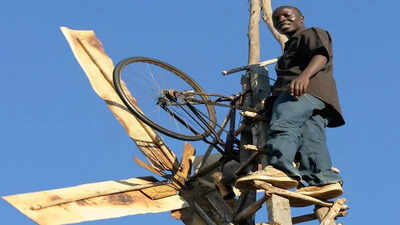
There is something almost cinematic about the first time William Kamkwamba’s story lands: a 14-year-old boy in rural Malawi, unable to stay in school, wandering into a village library and finding a book that seems too ordinary to matter.
Inside it, he sees a wind turbine. He cannot read much of the English text, but the illustrations are enough. They open a door. Out of scrap metal, tractor parts, bicycle pieces, plastic pipes and tree branches, he begins building a machine that should not work, and then does. In a place where hunger had narrowed life to survival, imagination became his way forward. Scroll down to read more…
A famine that closed one path and opened another
Kamkwamba grew up in Masitala, a rural village in Malawi, where his family farmed maize.
In 2001, a famine hit after drought, heavy rains and the government’s sale of the national grain reserve contributed to a devastating food crisis. His family could no longer afford his school fees, so he dropped out at 14. That part matters because the windmill was never just a clever school project. It was an answer to a shortage of money, a shortage of opportunity, and a shortage of light.
When formal education shut its door, Kamkwamba kept learning through a small village library and a borrowed textbook called Using Energy.
Building without a blueprint, except the kind inside his head
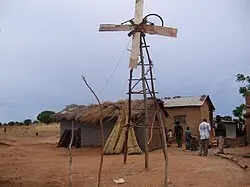
What Kamkwamba made was not polished, and it was never meant to be. He used the book’s drawings as a guide and improvised the rest, shaping a 16-foot windmill from whatever he could find. Britannica describes the materials as tractor and bicycle parts, plastic pipes and tree branches; TED says the windmill powered four lights and two radios in his family home. Soon, neighbours arrived to charge their phones. The scene is irresistible, but the real story is less about miracle than method: he tested, adjusted, failed, tried again, and kept going until the machine held together.
In a world that often treats innovation as something born in labs and funded by institutions, Kamkwamba’s windmill came from persistence and necessity.
When one windmill became a public story

For a while, Kamkwamba was known locally, then nationally, and soon far beyond Malawi. The story first appeared in a local Malawian newspaper, and from there it travelled quickly online, eventually drawing the attention of TED. He was invited to TEDGlobal on a fellowship and later spoke there about his invention and his wish to build a larger windmill for irrigation and to return to school.
That next step is important: the windmill did not end his story, it launched it.
He went back to school, studied at the African Leadership Academy in South Africa and later graduated from Dartmouth College with a degree in environmental studies in 2014. The machine built from scrap became a bridge back to education.
From one home to a wider village
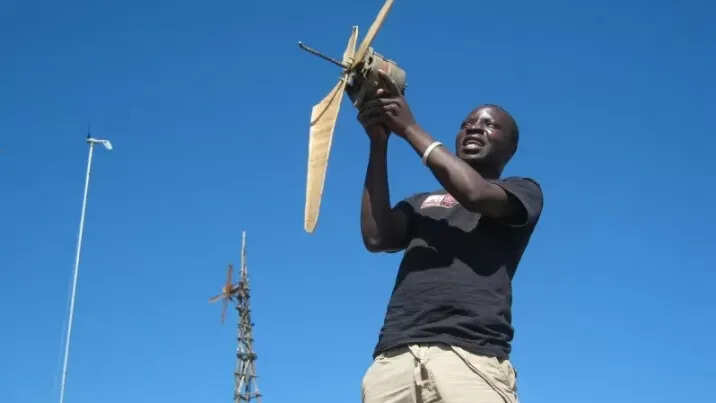
Kamkwamba did not stop at one invention. He went on to build other windmills to generate electricity and pump water in his village.
In 2008, he co-founded the Moving Windmills Project, which works with residents of the Masitala area on clean-water wells, solar panels for schools and community centres, and simple solutions for everyday farming problems. This is where his story shifts from inspiration to infrastructure.
The point was never only that he lit his own home. It was that he began imagining how to make light, water and dignity more dependable for other people too.
That is the quiet power of the story: invention as service, not performance.
What his story still asks of us
It would be easy to flatten William Kamkwamba into a motivational poster: poor boy, big dream, happy ending. But that version misses the harder truth. His achievement happened because a curious mind met a brutally practical problem, and because he kept learning when the system had already decided he was done. The windmill matters not because it was glamorous, but because it was useful.
It gave light, yes, but it also gave back a sense of agency.
That is why the story endures. In Kamkwamba’s hands, scrap became shelter from hopelessness. His example still says something urgent and unfashionably simple: progress often begins when someone decides that what is lying around is enough to start.

