
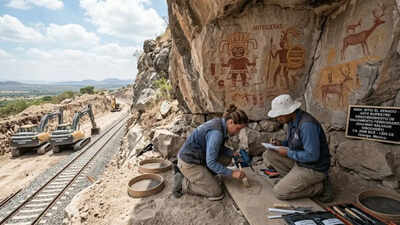
Research conducted on the construction of the passenger railway connecting Mexico City and Querétaro has resulted in an extraordinary archaeological finding: a breakthrough in the study of the Tula region’s cultural evolution.
Archaeologists from the National Institute of Anthropology and History (INAH) recently identified 16 newly discovered rock-art sites at El Venado, Hidalgo. These sites constitute a ceremonial landscape that provides a chronological view of four thousand years of history from the Archaic period hunter-gatherer groups up to the time of the Postclassic Toltec Empire. There are complex petroglyphs and pictographs representing various forms of gods, shields, and the rain god Tlaloc.
The government of Mexico has officially changed the course of the railway so that these culturally significant sites can be saved, creating a unique occasion where cultural preservation won out against the expansion of modern industry.
Railway survey in Mexico uncovers 16 ancient rock art sites at El Venado
The mandatory salvage operation implemented to build the Mexico-Querétaro passenger railway revealed that ongoing archaeological surveys at sites across Mexico that have not yet been excavated can yield valuable new insights into ancient cultures and their histories.
Researchers were able to survey an area that was previously unreachable and found 16 different areas of human-made petroglyphs (rock engravings) and pictographs (use of pigment on a rock) at the El Venado site. This is incredibly valuable in understanding how people lived in this part of the Tula River area, including what they believed spiritually, as early as 2000 BC.
The rock art site had mineral pigments, pointillism, and the sacred geometry of Tlaloc
The rock art sites used two kinds of techniques (pointillism for engraving and pigments made from minerals) and document two important figures as noted in Journal of Archaeological Science: Reports: A warrior with a chimalli (a type of shield) and a figure with ‘goggle-eyes’ (anteojeras), which are diagnostic attributes of Tlaloc (the god of the rain and fertility of all things on earth), indicating that the El Venado site served as a sacred geography, where people used astronomical alignments to codify ritual cycles.
Evidence of long-distance cultural exchange in El Venado
The El Venado discovery’s artistic connection to the Mogollon iconographic tradition of the Southwestern US and Northern Mexico is one of its most unanticipated features. It implies that the Tula region was a centre for long-distance cultural interactions or that common symbolism was transmitted throughout the ‘Northern Frontier’ of Mesoamerica before the emergence of the Aztecs.