
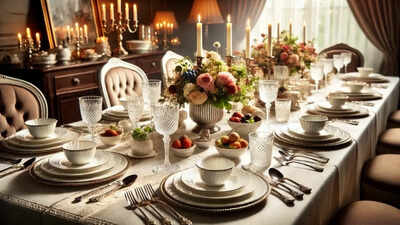
Hosting business sure looks quite jolly, but for those who are tasked with the responsibility, it can be weirdly nerve-wracking as well. And that’s not because of the food itself, but because of the table.
Suddenly, you’re asking yourself, “Does the fork go on the left or right?” “Where does the soup bowl even go?” And honestly, why are there three spoons for one meal? All that second-guessing can zap your confidence quickly.But here’s the truth: Great hosting isn’t about being perfect or acting like you’re in some royal palace. It’s really about making people feel welcome, like you put thought into their experience.
A well-set table does that quietly.The best part? Table setting follows pretty simple logic. Whether you’re keeping things casual or going all-out formal, most setups stick to one main idea: Arrange utensils in the order they’ll be used, from the outside in. Forks on the left, knives and spoons on the right, glasses are above the knives. Once you realize the key logic, it’s easy enough to roll it out.So whether it’s brunch for your friends, Sunday lunch for family, or a fancy dinner with multiple courses, knowing what each plate, bowl, spoon, and fork is for makes everything smoother and makes you look seriously polished without trying too hard.
Here’s your no-nonsense guide to getting it right.Let’s unpack.
The rule of setting the table: Go outside-in
Here’s the classic rule: Use utensils in the “outside-in” order. Start with the fork that’s furthest from the plate for your first course, then move inward as the meal goes on. The same goes for spoons and knives. If you only remember one thing, let it be this simple rule.Moving on to the next phase.
Plates: What goes where
Charger plate: It’s the big, decorative plate that stays on the table as the base during early courses.
You don’t eat straight off it; rather, other plates or bowls go on top. Remove it when the main course arrives. Use it for formal dinners, weddings, holidays, etc.Dinner plate: This is the main plate, sitting right in the center. It’s usually used for the main course. You can use it for pretty much every meal, regardless of the type of event.Salad plate: This one’s a bit smaller than the dinner plate, used for salad or appetizers. It can go on top of the dinner plate or charger.
Use it for casual or fancy meals.Bread plate: This is a small one and sits just above the forks, upper left (think 10 or 11 o’clock). For bread or little extras. You can use it for formal settings and dinner parties.
Bowls: Not all are created equal
Soup bowl: Start by putting it on top of the salad plate or charger, only if the soup is first. Don’t just have it floating out there. You can use it for soup, especially as a starter.Dessert bowl: As the name suggests, this one’s for pudding, fruit, mousse, ice cream, etc.
It’s usually brought out with dessert, not at the start.
Forks: Each has its moment
Dinner fork: This is the big one, closest to the plate on the left. Main course fork. Use it for the main dishes.Salad fork: Just like how we saw in the case of plates, the salad fork is smaller and sits to the left of the dinner fork. It’s used first, since salads usually come before mains. The guests usually use it for salad, starters, etc.Dessert fork: This is where the pattern breaks a little. The dessert fork goes above the plate horizontally, or comes with dessert later.
Keep in mind, the handle of the fork points left. Use it for cakes, tarts, pastries, etc.Seafood/oyster fork: This one’s an oddball, and it might be on the right side instead of left. It’s smaller and designed for shellfish or oysters. Use it for fancy seafood courses.
Knives: Always point toward the plate
Dinner knife: This one sits closest to the plate, on the right side. It’s used for the main course.Butter knife: Blunter for the purpose of it, the butter knife sits on the bread plate, and one can use it only for butter.
Spoons: More than just soup
Soup spoon: This one sits at the far right of the knives, and is rounder (and bigger) than a teaspoon. One can use it for soup.Dessert spoon: It’s usually placed above the plate, horizontally again, handle pointing right, or brought out with dessert. Use it for pudding and other desserts.Teaspoon: The most commonly seen spoon, the teaspoon comes later with tea, coffee, or dessert service, and is used for the same purpose.Apart from all these arrangements, the placement of the glasses matters a great deal.Take note: The water glass goes right above the knife, while the wine glasses go to the right of the water glass, in the order they’ll be used.
Setting the table: Casual vs formal
In case of arranging a casual table, you can keep it simple, adding just a dinner plate, one fork, one knife, one spoon, a napkin, and a water glass.However, when setting a formal table, make sure to add a charger, salad plate, soup bowl, bread plate, extra forks and spoons, dessert cutlery, and wine glasses.However, it’s advisable to avoid putting out utensils people won’t use; unnecessary forks or spoons just make things confusing instead of classy.
Final tip on hosting
This goes in the Holy Grail of hosting: Comfort always beats perfection. Nobody remembers if your salad fork was a smidge too far left. What sticks is how relaxed they felt. A great host makes people comfortable, because ease matters more than silverware.So learn the basics, sure. But remember: Warm food, full glasses, a good laugh, and a candle or two do much more for your guests than perfect knife placement. Hosting isn’t about how many forks you have. It’s about making folks want to stay a little longer at your table.

