India
We have become marksvaadis: Education minister flags marks obsession
By: Hindustan Times
Published: 28 October 2026
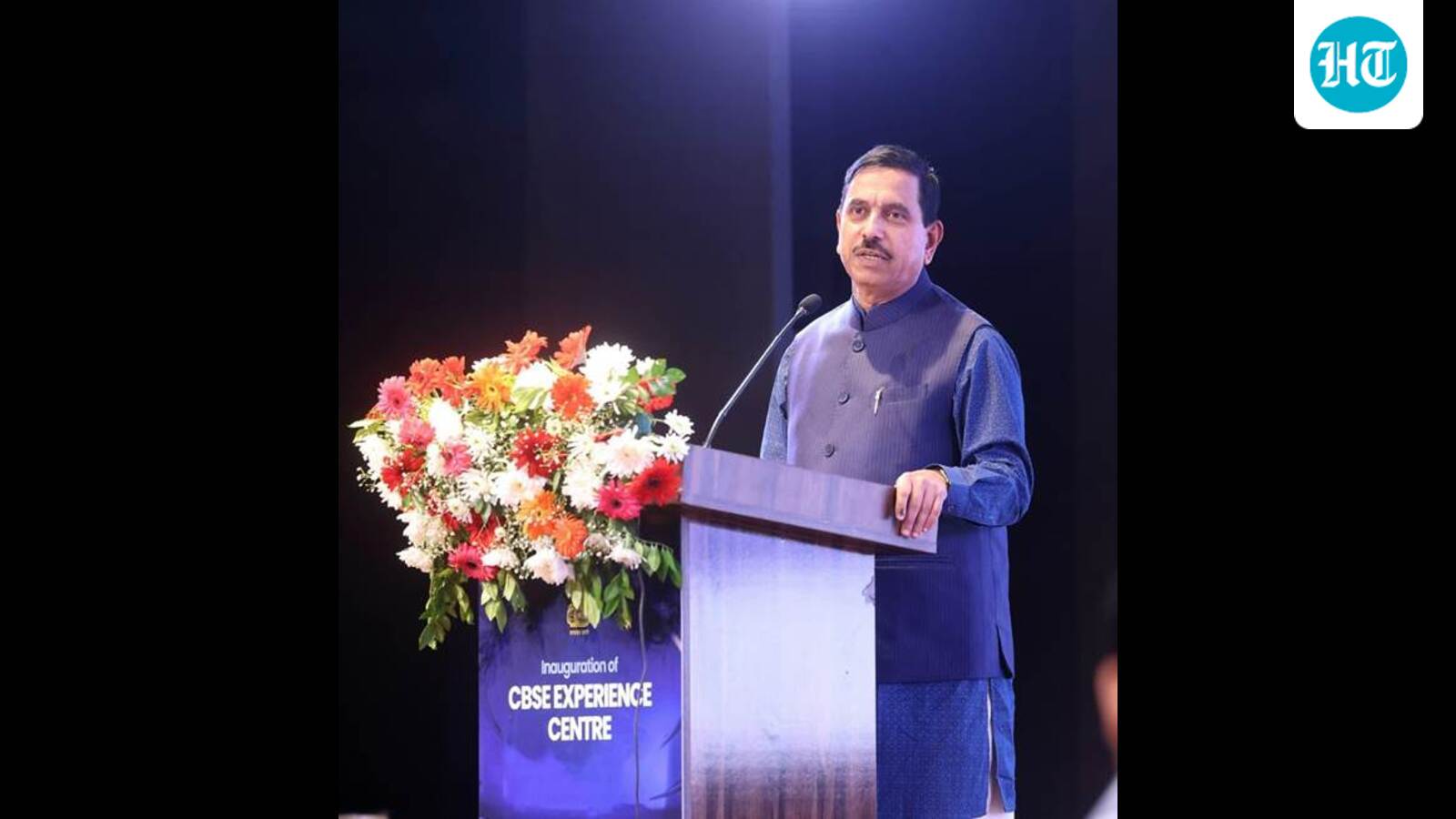
Photo / Illustration: Haldwani Times News Desk
<p>Union education minister Prahlad Joshi on Tuesday used the launch of the Central Board of Secondary Education’s (CBSE) Experience Centre at its New Delhi headquarters to criticise an alleged culture of marksvaadis obsessed with examination scores and rote learning, which he said was hurting the self-confidence of students.</p>
<p>Union education minister addresses the launch event in New Delhi on Tuesday. (PIB)He also linked the associated pressure with student suicides.</p>
<p>“Today, most of our time is spent figuring out how to memorise things and score marks. Parents, too, feel that somehow, by whatever means, children must get marks. I often say that, in a way, we have all become marksvaadis,” Joshi said.</p>
<p>“Whenever the results are announced, there are reports of students taking their own lives. Why has this weak mindset developed among us? Because our entire focus is on somehow filling children’s minds with information and ensuring that they pass competitive examinations,” he said.</p>
<p>Building self-confidence was therefore crucial, Joshi said, adding that he hoped CBSE’s Experience Centre would help students develop curiosity, understand their interests and explore possibilities beyond examinations. “I firmly believe that this Experience Centre will become a major force in building children’s self-confidence,” he said.</p>
<p>Spanning 6,000 square feet, the centre has 12 zones and 21 exhibits designed to introduce students to India’s educational heritage, emerging technologies, career choices and environmental interconnectedness through interactive experiences. According to a CBSE press release, visitors can use radio-frequency identification (RFID)-enabled smart cards to interact with exhibits, participate in activities and access personalised takeaways and game-based leaderboards.</p>
<p>The experience is bookended by Shiksha Ki Kahani, a film narrated by the personified river Saraswati, tracing a journey which begins with the gurukul system and ends with digital classrooms,and ‘Eduverse’— which uses motion-based features and multisensory elements to present an experience of forests, oceans, the Himalayas and the solar system to emphasise the interconnectedness of natural systems.</p>
<p>In addition, the centre features historical photographs and archival records documenting CBSE’s evolution, an interactive geological timeline that introduces visitors to the history of the earth, holograms of eminent personalities such as Dr BR Ambedkar and Dr APJ Abdul Kalam, and multiple exhibits aimed at helping students explore various career paths. It also features a kiosk on Prime Minister Narendra Modi’s book for students, Exam Warriors.</p>
<p>CBSE chairperson Mandeep K Bhandari said the centre reflected the board’s broader efforts to look beyond examination results towards students’ overall development. “Preparing students for the future also means introducing them to new areas of learning and work. Artificial Intelligence is now part of the curriculum. Giving students and opportunity to understand and engage with the technology that will become increasingly relevant in the years to come. The experience centre also reflects this thinking,” he said.</p>
<p>Prachi Pandey, joint secretary in the Union education ministry’s school education department, said exposing children to new subjects, professionals and technologies could help them recognise their interests and consider future opportunities.</p>
<p>Sanjay Maurya is a Principal Correspondent with Hindustan Times, where he covers education, with a focus on school and higher education, competitive examinations, education policy and governance. Working as part of the National Bureau, he is based in New Delhi and reports on the Ministry of Education and covers various statutory bodies like UGC, AICTE and NCTE and autonomous bodies like CBSE and NCERT. His reporting also tracks the implementation of key government reforms and policies from school education to higher education including in IITs, NITs, IIMs, central and state universities, and their impact on students and educational institutions. His reporting on the irregularities and rushed implementation of CBSE's On-Screen Marking (OSM) system for evaluation of Class 12 board exams 2026, triggered administrative action, leading to the transfer of the board's two senior-most officials and the constitution of a committee to probe alleged irregularities in procurement process of the system. He joined Hindustan Times in December 2024. Prior to that, he had a three-year stint at Careers360, where he reported on school and higher education, entrance examinations, admissions, rankings and various education policies involving universities and professional education bodies. Over the years, Maurya has reported extensively on major developments in India's education sector, including the implementation of the National Education Policy (NEP) 2020, reforms in the National Testing Agency (NTA) following the NEET-UG 2024 controversy, changes in school education, higher education regulation, and the evolution of entrance examinations such as NEET, JEE and CUET. He regularly produces data-driven and explanatory stories based on government documents, parliamentary proceedings, court records and official data. His focus remains on helping readers understand how education policies and institutional decisions affect millions of students, teachers and educational institutions across the country.Read More</p>