
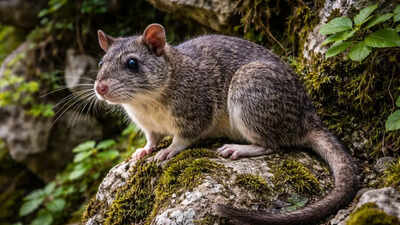
A rodent found in Laos has been determined to belong to a group thought to have gone extinct in the fossil records about 11 million years ago. This rodent is called the Laotian rock rat.
The discovery of this rodent came about when scientists, Mary R. Dawson and colleagues, studied one that had first been observed in local markets. The reason for its newfound interest was due to its likeness to animals belonging to the Diatomyidae group, which were only known to exist in fossil form from the Miocene era. The term Lazarus species is used to refer to such creatures.
Discovery of the Laotian rock rat in Southeast Asia
A description of the Laotian Rock Rat was done at the beginning of the 2000s.
The species had been familiar to the local inhabitants before scientific classification.Upon first description, the animal seemed to belong to an unidentified rodent family based on its anatomy. It possessed distinctive skull and tooth features that were not found among other rodents.
Classification within the Diatomyidae family
Further studies revealed that the species belonged to the family Diatomyidae, which was a type of rodent known solely from fossilised remains.
Fossils of animals belonging to this family showed their existence in the Miocene period and were thought to have become extinct millions of years ago.This identification linked the living species to an ancestral line without any contemporary examples until now.
Scientific confirmation through fossil comparison and analysis
The identification of the rock rat from Laos as a living representative of the family Diatomyidae was established on the basis of morphological similarities with the fossils.As described in “Laonastes and the ‘Lazarus Effect’ in Recent Mammals,” which appeared in the journal Science, morphological similarities were identified in the skeletal and dental structures between the rock rat and the Diatomyidae fossils. In this way, the evolutionary relationship was established.
Evidence from taxonomic and evolutionary research
Evolutionary studies further confirmed the position of the species in the rodent family tree.As reported by Springer Nature in “Using radiotelemetry to identify the home range and daily movement of a ‘living fossil’”, further taxonomic studies helped establish the species as the only living member of a long-extinct rodent family.The above-mentioned research helped shed some light on the evolutionary past of the species.
Habitat and survival in limestone karst regions
The limestone karst habitat in Laos is where the Laotian rock rat can be mainly observed. This habitat comprises rocks, caves, and difficult access, possibly aiding in the existence of the species throughout time.The isolation and ecology of such regions might help explain why the species was not identified despite being around for many years.
Final insight
The discovery of the Laotian rock rat shows an undeniable connection between the living species and the extinct family, which was known only through fossils. This discovery proves that some species have managed to survive for millions of years in certain ecological niches.It also suggests that the lack of evidence in fossil history does not always mean extinction, but rather a lack of opportunity to make observations.

