
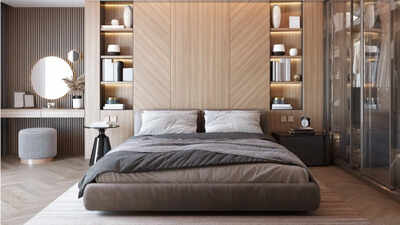
Interior design and home decor experts shares five practical, renter-friendly tricks for making small rooms feel larger and more functional with no renovation required.
Across the UK, Australia and beyond, more people than ever are calling compact spaces home and the pressure to make those spaces liveable, personal and comfortable is real. The challenge is doing it without knocking down walls or losing your deposit.The good news is that a lot can be achieved through smart styling choices alone. From the placement of a mirror to the furniture you choose, small tweaks can impact how spacious and liveable a room feels.Below are five tricks that make the biggest difference in smaller rooms and three styling rules that stop them from feeling cluttered.
5 tricks that make rooms feel bigger
Try these visual and functional strategies that have the most impact on how a compact space feels day-to-day:
- Use Mirrors to Borrow Light and Space – A well-placed mirror can effectively double the perceived size of a room. Position one opposite a window to reflect natural light into the space or lean a large floor mirror against a wall to create the illusion of depth. The key is scale. A small mirror won’t do much, but a full-length or oversized one absolutely will. Geoff Brand, Founder of Bean Bags R Us, an Australian seating and home furnishings brand supplying
homes , schools and commercial spaces worldwide, has spent years helping people find comfort-led solutions for every kind of space. In an interview with the Times of India, he shared, “People underestimate how much mirrors can do in a small room. Place one strategically, and the room immediately feels more open.” According to a recent 2026 study published in the Journal of Environmental Psychology, “Reflective surfaces and daylight amplification significantly increased perceived spatial openness, with participants rating mirrored rooms as up to 35% larger than identical non-mirrored spaces.” This directly validates the mirror and lighting strategy. The study shows that mirrors don’t just decorate a room, they measurably alter how large it feels by redistributing light and depth cues. - Draw the Eye Upward – Vertical lines naturally make a room feel taller. Floor-to-ceiling curtains, tall bookshelves and vertically striped wallpaper all encourage the eye to travel upward. Hang curtain rails close to the ceiling rather than just above the window frame. It’s a small adjustment with a noticeable effect.
- Zone Without Walls – Use rugs to anchor a seating area, or position furniture to divide a sleeping zone from a living area. Lighting also helps. Think of a pendant above a dining spot or a floor lamp beside a reading chair. “Zoning gives a small space purpose,” Geoff explained. “When every corner has a reason to exist, the room feels intentional rather than cluttered.”
- Choose Furniture That Works Twice as Hard – Dual-purpose and modular furniture is a particularly practical approach to small-space living. Think ottomans with storage inside, sofas that convert for guests or flexible seating that can move between rooms without adding bulk. A 2026 Building and Environment study found, “Multi-functional and modular furniture improved both perceived spaciousness and usability scores, particularly in dwellings under 500 square feet.” This backs the recommendation to use dual-purpose and modular furniture. The research shows that flexible furniture reduces visual and physical clutter while improving how efficiently space is used.
- Make Storage Invisible: Built-in storage, under-bed drawers, and furniture with hidden compartments keep surfaces clear and the room feeling organised. When storage blends into the space rather than competing with it, the overall effect is a room that breathes.
3 styling rules that prevent clutter
Getting the furniture right is only half the work. Experts outline the styling disciplines that separate a well-designed small room from one that simply feels busy –
- Respect Negative Space: Leaving areas of a room free, such as a clear corner or an uncluttered shelf, gives the eye somewhere to rest and makes the room feel calm rather than packed. Resist the temptation to fill every surface.
- Stick to a Cohesive
Colour Scheme: Too many colours in a small room create visual noise. A limited palette of two or three complementary tones keeps things feeling cohesive and spacious. Light, neutral walls reflect more light, while a single accent colour adds personality without overwhelming the space. “Colour is one of the most powerful tools in a small room,” said Geoff. “A consistent scheme makes everything feel intentional. The moment you introduce too many competing tones, the room starts to feel smaller.” - Edit Your Surfaces: Styling a small room well is as much about what you remove as what you add. Keep surfaces such as shelves, sideboards and windowsills curated rather than covered. A few considered objects will always look better than a crowded display and they will make the room feel more spacious in the process. A 2026 study in Frontiers in Built Environment established, “Visual clutter and excessive object density were negatively correlated with perceived room size, while controlled negative space improved both aesthetic ratings and psychological comfort.” This strongly supports the “don’t over-decorate” rule. It shows that restraint, through negative space and edited surfaces, directly impacts how spacious and calming a room feels.
Small spaces have more potential than most people give them credit for.
The biggest mistake is treating a compact room as a limitation rather than a starting point. With the right furniture choices, a considered colour palette and a bit of restraint when it comes to decorating, even the smallest room can feel comfortable and well put-together. You don’t need a big budget but a clear idea of what the space needs to do and the discipline to stick to it.

