
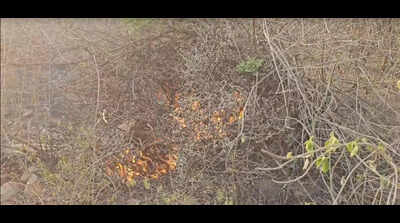
The incident once again exposed chronic fire vulnerability and weak preparedness in one of the region’s most ecologically fragile stretches
Gurgaon: Around five acres of forest land in Mangar village in the Aravalis caught fire on Monday, with flames spreading rapidly through dense lantana undergrowth — the same patch ravaged by a major blaze last year.The incident once again exposed chronic fire vulnerability and weak preparedness in one of the region’s most ecologically fragile stretches.The fire started around 3pm. Forest department officials and a fire brigade team were deployed as flames swept through dry scrub and thorn forest, fuelled by parched vegetation, summer heat and invasive lantana — a species ecologists have repeatedly flagged as a major fire accelerant in the Aravalis.
“It took around two-and-a-half hours to douse the fire,” a forest official said.Containment was difficult due to rugged terrain and poor accessibility. The fire brigade struggled because of insufficient pipe length to reach deep forest pockets where flames continued to spread through thick undergrowth. “We had around four to five forest staff members on the ground to control the fire,” an official said. “Invasive species like lantana create a highly inflammable environment, making it difficult to control fires once they start.
”The affected area falls under Sections 4 and 5 of the Punjab Land Preservation Act.Ecologist Sunil Harsana, who was present at the site, said recurring fires were becoming harder to tackle due to inadequate manpower and delayed response systems. “The department needs dedicated fire protection watchers. We will be able to respond much better,” he said.Harsana also flagged logistical gaps. “When the fire brigade is called, it can take close to an hour.
If the vehicle runs out of water, it has to travel again for refilling.” He recommended installing a borewell near Pali police station to allow firefighting vehicles to refill locally and save crucial time. He also noted that even basic firefighting instruments were unavailable with ground staff.Ecologists said lantana invasion has turned large parts of the Aravalis into a tinderbox during summer by creating dense, dry biomass that ignites easily and allows fire to travel rapidly.
“The problem is not just the fire, but the fuel load created by lantana invasion. Unless invasive species management becomes central to Aravali protection, such fires will keep recurring,” Harsana said.The latest blaze is particularly worrying because it struck the same Mangar patch that witnessed a major fire last year, underlining how vulnerable regenerated zones remain without sustained restoration, firebreak planning and invasive species control.Mangar, along the Gurgaon-Faridabad Aravali belt, is critical for biodiversity, groundwater recharge and wildlife movement. Environmentalists have long warned that recurring fires damage native vegetation, destroy habitats, weaken regeneration and accelerate ecological degradation in the already stressed hill system.Forest officials were monitoring the area till evening, with the full extent of ecological damage still being assessed.TOI reported in Dec 2024 that forest fires are becoming increasingly common across Haryana. According to data from Indian State of Forest Report, the number of fires recorded in the state more than doubled in a year — from 82 in 2022-23 to 166 in 2023-24 — with most blazes reported in Ambala, Faridabad, Panchkula and Yamunanagar. No forest fires were documented in Gurgaon in 2023.