
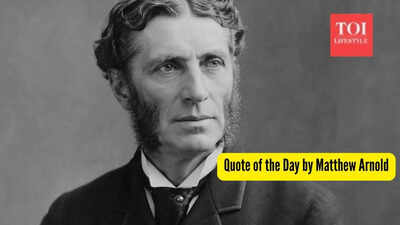
Matthew Arnold was one of the most iconic poets and critics of the Victorian Era.. He was a poet, essayist, critic, and teacher whose work had a big effect on English literature and how people talk about modern literature.
People remember Arnold not only for his sad poems about the problems of modern life, but also for his prose works that talked about religion, culture, society, and education. He was the voice of reason during a time when England was going through a lot of changes in its economy and society. Matthew Arnold was born in Laleham, Middlesex, England in 1822. His father Dr. Thomas Arnold, was a well-known headmaster at Rugby School.
Arnold’s father was a respected teacher who had a big impact on his mind. Matthew Arnold learned how to behave, have good morals, and do well in school by growing up in a place like this.Arnold went to Balliol College at Oxford after Rugby School. He did really well in his literature and classical studies at Oxford. He won the Newdigate Prize for poetry in 1843. This is a very important award. His time at college had a big impact on his love of Greek and Roman classics, which changed the way he wrote and thought about literature later on.
After school, Arnold became Lord Lansdowne’s private secretary. He was an Inspector of Schools from 1851 to 1858, which was a job he kept for a long time. For this job, he had to go to schools all over England. Arnold learned a lot about schools and how people live through this job. His life inspired many essays on culture and education. In 1851, Arnold married Frances Lucy Wightman. They had six children. He had to take care of his family, but he kept writing poems and essays until he died.
Matthew Arnold was a poet.First, Arnold became well-known as a poet. A lot of the time, his poems show sadness, loneliness, doubt, and the search for meaning in a world that is always changing. During the Victorian era, when science and industrialisation made traditional religious faith less strong, Arnold wrote. This is not the same as what Romantic poets like Wordsworth or Shelley wrote. His poems often show this crisis of faith.Some of his most famous poems are:
- Dover Beach
- The Scholar-Gipsy, Thyrsis, Sohrab and Rustum, Rugby Chapel, and the Themes in His Poetry
- Loss of Faith: Many poems talk about how religion is becoming less important in today’s world.
- Isolation: People often feel lonely and emotionally distant from others.
- Nature and Beauty: Nature may look peaceful, but it doesn’t always help people who are hurting.
- Old and New Values Clash: Arnold had trouble with both modern progress and old wisdom.
For example, in Dover Beach, Arnold writes about the “melancholy, long, withdrawing roar” of the Sea of Faith, which stands for the loss of religious certainty.How it affects society and cultureDuring the Industrial Revolution, when Arnold lived in England, a lot of things changed. Cities grew, machines took over old ways of life, and class wars got worse. Arnold was worried that society would get better without moral progress.
He wrote Culture and Anarchy to criticise people who are close-minded and to say that education and culture can make society better. Instead of just money or politics, he thought people should look for beauty, moral balance, and intellectual excellence.
His ideas changed how people talked about changing how schools work, social class, and the role of literature in public life.Effect on Future WritersA lot of poets, critics, and thinkers who came after Matthew Arnold were influenced by him.
Some writers who responded to or built on Arnold’s ideas were T. S. Eliot, F. R. Leavis, and Lionel Trilling. People didn’t always agree with him, but they respected how serious he was about literature and culture. Dover Beach is still one of the most quoted Victorian poems because its themes of doubt and emotional struggle are still important today. Matthew Arnold passed away in Liverpool in 1888. He was buried in Laleham.
Even after he died, his reputation grew.Matthew Arnold was more than just a poet. He was a Victorian thinker who wrote poems and essays to talk about the spiritual and social problems of his time. His poems use beautiful language to show doubt, loneliness, and beauty. His essays, on the other hand, promote culture, reason, and moral growth. Arnold’s poetry and prose had a lasting impact on English literature and critical thought.
People still read his work because it talks about faith, society, and the meaning of art, which will always be important.Quote of the DayThe following lines from Matthew Arnold’s Empedocles On Etna And Other Poems raise some deep questions.“Is it so small a thingTo have enjoy’d the sun,To have liv’d light in the spring,To have lov’d, to have thought, to have done;To have advanc’d true friends, and beat down baffling foes…?”Matthew Arnold’s words show a deep thought about the value of human life. Arnold wonders if living through the joys, struggles, and successes of life is really a “small thing.” The passage says that we shouldn’t judge life only by money, fame, or final success. Instead, we should judge it by the experiences, feelings, relationships, and actions that make life worth living. Arnold praises the richness of life in these lines.
The first part of the sentence, “Is it so small a thing / To have enjoy’d the sun,” talks about how nice it is to be alive in nature. The sun stands for warmth, light, hope, and happiness. Arnold wants to know if it’s really okay to think that enjoying the sun and the beauty of nature is not important. There is no doubt that his answer is no. Feeling the sun on your face is a good thing, even if it’s just a small thing. It reminds people that the simple pleasures in life are often more important than they think.The next line, “To have lived light in the spring,” goes along with this idea. Traditionally, spring stands for youth, new beginnings, and freshness. To have lived happily in spring means to have felt the energy and brightness of youth. Arnold could be talking about both the real spring and the “spring” of life, which are the years of growth, innocence, and hope. He says that even if life gets hard later, the memory of happy times as a child makes life worth living.Arnold then writes, “To have loved, to have thought, to have done.” This line goes from natural pleasures to human accomplishments. Love is one of the best things that can happen to you in life. To love someone means to have made emotional connections and cared deeply about them. Next comes thought, which stands for intelligence, reflection, and the life of the mind. Arnold thought that culture, learning, and reason were very important, so he thought that thinking was a good thing.
Finally, there is action: “to have done.” This means that you have done something, worked on something, made something, or added something to the world. These three verbs—loved, thought, and done—sum up a full and meaningful life. The passage as a whole says that the value of life comes from the experiences we have. It’s not “little things” to feel happy, to know youth, to love, to think, to act, to help friends, and to fight obstacles. They are the real treasures of life.