
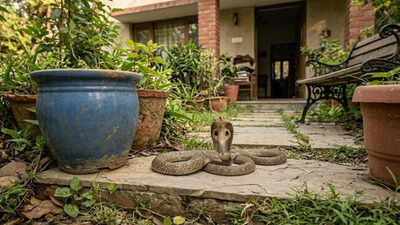
Finding a snake in your home or in the garden can cause anyone to be startled. It’s one of those moments where time stands still. However, the reality is that the vast majority of snakes aren’t looking for a fight; they have simply followed a mouse into your yard, or are seeking a place to cool off by spending the day napping under a flower pot.
As the neighbourhoods grow, we are basically moving into their home territory, so you will experience these types of encounters as you continue to make your neighbourhood grow larger. For the most part, the snake is just as afraid of you as you are of it, but because some are considered to be dangerous, it’s important to know the difference. Having an understanding of the snakes found in your area will help you remain calm and allow you to handle the situation properly.
Snakes that enter homes and gardens
Branded Grass Snake (Natrix helvetica)Branded Grass Snakes are abundant in the wild and common to gardens in much of Europe and the UK. According to The Wildlife Trusts, they are recognised by their yellow/black ‘collar’ behind the head, and like to use garden compost heaps as incubators for their eggs because of the warmth produced from decomposition of matter. If startled or cornered, they will hiss or play dead and pose no threat to you or your pets.Behaviour: If startled or cornered, they will hiss or play dead and pose no threat to you or your pets.
Habitat: Gardens with ponds or compost heaps.Smooth Snake (Coronella austriaca)Smooth Snakes are rare, non-venomous constrictor snakes. They can frequently be confused with an Adder. Although they can be found on the heathland edge in a garden setting, Smooth Snakes like to live in sandy soil, and do not lay eggs; they give live young. They are very secretive and spend their time under cover, such as flat rocks or logs, primarily feeding on lizards, as per The Wildlife Trusts.Habitat: Sandy soil or heathland edges in gardens.Behaviour: Very secretive; they spend their time under cover, like flat rocks or logs.Diet: Primarily feeds on lizards.Adder (Vipera berus)Adders are the only venomous snake in the UK. According to Forestry Journal, they can be recognised by their dark ‘zig-zag’ markings on their back and vertical pupils. They primarily inhabit open heathland, but will venture into gardens bordering wild areas for thermoregulation.
Adders are not aggressive and will only bite if they are attacked, but their venom is medically serious and requires immediate medical attention, especially if bitten by a child or pet.Behaviour: Not aggressive; will only bite if attacked or stepped on.Habitat: Venturing into gardens bordering wild areas for thermoregulation.Risk factor: Venom is medically serious and requires immediate attention for children or pets.Banded Krait (Bungarus fasciatus)The Banded Kraits can be easily recognised due to their obvious black and yellow striped bands and their central ridge (triangular body cross-section). According to iNaturalist, they are also shy animals that are mostly active during the night, while hunting for other snakes, especially venomous snakes, but they will also use gardens/farmsteads in South Asia as places to hunt for food. Banded kraits have strong neurotoxic venom; however, they do not usually bite during daylight hours.Behaviour: Shy and nocturnal; hunts other snakes, including venomous ones.Habitat: Gardens or farmsteads in South Asia.Risk factor: Strong neurotoxic venom, though it rarely bites during the day.Saw-Scaled Viper (Echis carinatus)According to iNaturalist, the Saw-Scaled Viper is one of the ‘Big Four’ venomous snakes found in India. Worldwide, it causes more deaths than any other type of snake. These vipers inhabit dry, rocky areas such as gardens and agricultural fields.
They are known for making a unique sound (stridulation) by rubbing their scales against one another. Their hemotoxic venom can cause large amounts of internal bleeding and cytotoxic tissue damage.Behaviour: Known for stridulation (rubbing scales together to make a sizzling sound).Habitat: Dry, rocky areas like gardens and agricultural fields.Risk factor: Hemotoxic venom causes internal bleeding and cytotoxic tissue damage.Russell’s Viper (Daboia russelii)It is a member of the ‘Big Four’ and is characterised by three dark, round patches running down its body. The iNaturalist classifies it as very defensive and attracts attention by making loud hissing noises to warn potential threats while defending its territory, whether in a garden or grassland.Appearance: Brown body with three rows of oval spots.Behaviour: Slow-moving but aggressive when provoked.Habitat: Grasslands, farmlands, and sometimes gardens.Risk factor: Known for its potent venom and distinctive loud hiss.Indian Rat Snake (Ptyas mucosa)This snake is a fast-moving, non-venomous species often found in suburbs. A study published in Scientific Reports states that they are adaptable to urban areas, hunting for rodents on rooftops and in drains, providing important natural pest control for cities.Appearance: Long, slender body with a yellowish or brown colour.Length: Up to 2–3 meters.Behaviour: Fast-moving and an excellent climber.Habitat: Fields, gardens, rooftops, and even drains.Why it enters homes: Primarily a predator of rats, it finds human settlements to be optimal hunting grounds.Spectacled Cobra (Naja naja)The spectacled cobra, a species of considerable medical significance, is distinguished by its prominent hood. Observations recorded on iNaturalist indicate its presence in domestic woodpiles and gardens, where it forages for rodents. This species exhibits defensive behaviour, deploying its distinctive hood when it perceives a threat.Appearance: The cobra features an expandable hood, marked by a dark, ‘spectacle-shaped’ pattern on its dorsal side. Colours vary from tan to black.Length: Typically 1 to 1.5 meters.Behaviour: Defensive; raises its body and hoods as a warning when threatened.Habitat: Lives in termite mounds, dense gardens, and old buildings.Why it enters homes: Follows rodent scents into quiet, dark corners of houses.

