
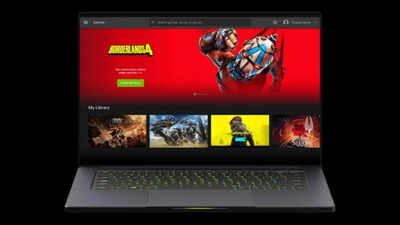
A work laptop that makes Chrome sweat ran Cyberpunk 2077 at 4K. The server was 1,400 kilometres away. The ping was 27 ms. That’s the GeForce NOW pitch, and after a week of testing from a Delhi flat—on that laptop, a Mac, and a phone—it holds up. Performance starts at Rs 999. If you don’t own a gaming PC and have a half-decent connection, nothing else in this market is currently making a stronger case.
The Windows laptop I use for work has a problem. It’s the kind of machine that makes Chrome sweat when I have more than six tabs open, an Intel iGPU doing the heroic job of rendering a spreadsheet.
When I booted up Cyberpunk 2077 on it the other night, it should have laughed at me. Instead, it was running the game at 4K, path tracing on, DLSS 4 doing its thing, somewhere north of 120 frames a second. The fan wasn’t even spinning up.That’s the GeForce NOW pitch in one paragraph. You already know this—it’s the whole point of cloud gaming. But there’s a difference between knowing it and actually watching it happen on the machine you use to file copy.Back in February, I got a wired-ethernet preview of GeForce NOW in Mumbai—same city as the servers, best possible conditions. Everything worked, as it tends to in controlled demos. The real test was always going to be at home. So for the past week, I’ve been testing the Ultimate tier from my flat in Delhi—on that poor work laptop, on a Mac with a, and on an Android phone. None of it were in a controlled environment. All of it worked better than I expected.
The connection held. That was never guaranteed.
Nvidia’s one Indian data centre is in Mumbai. I’m about 1,400 kilometres north on a Wi-Fi connection that is, let’s say, inconsistent. In the built-in network test, my ping to the Mumbai server hovered between 25 and 35 ms throughout the week, most often sitting around 27. Packet loss was zero or near-zero in almost every session. The only time I saw it spike was around 9 pm on a Wednesday, when my entire family seems to decide it’s streaming time—and even then, the game adapted rather than crashed.That adaptive behaviour is the bit that surprised me. GeForce NOW’s encoder quietly scales bitrate and resolution on the fly if your connection wobbles. You notice it as a slight softening of textures for a few seconds, not a stutter or a disconnect. It’s the cloud gaming equivalent of a driver feathering the clutch—you barely register it unless you’re watching the overlay.I did, a lot. Ctrl+N brings up Nvidia’s streaming stats panel, which tells you game FPS, stream FPS, ping, bitrate and packet loss in real time.
It’s a slightly obsessive habit I picked up and didn’t shake.
This is what a good screen was waiting for
The Mac is where I spent most of the week, because its miniLED screen is more or less the best-case scenario for Nvidia’s new Cinematic Quality Streaming mode. This is the Ultimate-tier perk that pushes 10-bit HDR, 4:4:4 chroma subsampling and up to 100 Mbps bitrate—all the things that typically separate cloud gaming from local gaming on a nice screen.Cyberpunk 2077 at 4K/60 with CQS on looked, genuinely, like I was running it locally on a 5080.
Night City’s neon didn’t smear. Text on in-game menus stayed sharp—Nvidia has added a HUD sharpness filter on top of CQS, and it pulls its weight. Black levels held up in dark interiors, which is where cheap cloud streams usually collapse into a grey sludge. Even the chromatic detail on wet pavement, the kind of thing you’d write off as compression on a lesser stream, was intact.A caveat on the bandwidth: at these settings, GeForce NOW eats roughly 30 GB an hour.
If you’re on a metered connection, or you share a flat with anyone who wants to watch something else in 4K at the same time, do the maths before you commit to Cinematic. I dropped to the Balanced preset for most of my general play, which holds 1440p at still-excellent quality for somewhere between 12 and 20 Mbps.The Data Saver mode runs at roughly 12 Mbps for 1080p, which is low enough for a mid-tier 4G connection. The fact that Nvidia has engineered for that floor says something about who it’s aiming for in India.
You already own everything this needs
This is the use case I keep coming back to. You already own an Android phone with a good screen. You own a Bluetooth controller, or you’re willing to buy one for Rs 2,500. You don’t own, and don’t plan to own, a gaming PC.With that setup, I ran Apex Legends and Counter-Strike 2 on my phone this week. Ultimate unlocks competitive modes—1080p at 360 fps, 1440p at 240 fps—but my phone caps at 120 Hz, so that’s what I aimed for. Apex held a locked 120 fps for the duration of a match.
CS2 was similar. Input latency was low enough that I stopped thinking about it, which is the only honest metric for a shooter.The native Android app is genuinely good—not a ported-over web client dressed up for mobile. Controller pairing is one tap. Cloud saves roam. You can alt-tab out of a match to reply to a WhatsApp message and come back to the same lobby. If you already own a decent phone and a controller, this is a quietly excellent portable gaming setup, and nothing else in India currently matches it on price.
The library is suddenly much bigger than it was
This is the meaningful quality-of-life change since my February preview. GeForce NOW’s library has historically been a curated list of supported titles—roughly 2,300 Ready-to-Play games that Nvidia pre-configures on its servers. With the Blackwell update, there’s now a second category called Install-to-Play. You bring your own Steam library and GeForce NOW installs titles into cloud storage on demand, which roughly doubles the total catalogue to about 4,500 games.In practice: I added a Steam game I own that wasn’t on the R2P list. It installed in about three minutes—an actual 100-odd-GB game. Nvidia’s data-centre internet is, predictably, very fast.There’s a catch. Performance and Ultimate each come with 100 GB of single-session cloud storage that wipes when you close out. If the game supports Steam Cloud saves, your progress survives. If it doesn’t, it doesn’t. Nvidia sells 200 GB of persistent storage for Rs 299 every 90 days as a workaround, which stacks neatly on top of the subscription for anyone serious about keeping a few games installed.
Nothing else in this market is even close on price
Here’s the pricing, which is the thing that’ll actually decide this for most people. Performance is Rs 999 for 90 days. Ultimate is Rs 1,999 for 90 days. That works out to Rs 333 a month and Rs 666 a month, respectively. Add persistent storage and Ultimate becomes Rs 766 a month.For context, Xbox Game Pass Ultimate in India is Rs 1,389 a month. That bundle includes a rotating catalogue of games, which GeForce NOW doesn’t—you still pay for Steam titles separately.
But the streaming service undercuts Game Pass by more than half. In a market where gaming cafés in smaller cities do steady business at Rs 30-50 an hour, that gap matters.Nvidia has called these introductory prices, and the service is technically in open beta. Read that as: enjoy it while it lasts. Even at a 50% bump when it exits beta—if that’s where it lands—Ultimate would sit at about Rs 1,000 a month, which is still cheaper than every console gaming subscription in this market.The missing piece, for now, is the free tier Nvidia runs in other countries. It’ll come “in the coming weeks”, according to the company. Worth waiting for if you’re genuinely just curious.
The caveats, which haven’t gone away
The demo in Mumbai was on ethernet in the same city as the server. My week at home was on Wi-Fi 1,400 km away. Both worked well. Neither is representative of everyone’s situation in this country.If you’re on 4G, if you’re in the Northeast or deep South, if your building’s last-mile fibre situation is a crime scene—your experience is going to vary.
Nvidia has built in lower-bandwidth modes, but there’s no way around the basic physics of distance and packet loss. The Low Latency Streaming mode that works in the US relies on an ISP-level protocol called L4S that no Indian ISP supports yet, so that particular optimisation simply isn’t available here at launch.The rest of the usual cloud gaming warnings apply. If your internet goes down, so does your game. If you hit a data cap, you’ll hit it fast—30 GB an hour on Cinematic is not a joke.
And there’s no getting around the fact that this is still a beta. Pricing could move. Features could change. Server capacity in Mumbai will be tested hard once invitations open up and the whole of the country piles on.
You don’t need a gaming PC for this to make sense
If you already own a gaming PC with a recent Nvidia card, don’t overthink this. GeForce NOW isn’t going to replace your rig, and you’re not the target anyway.If you don’t own a gaming PC, don’t want to spend Rs 1.5 lakh on one, and have a reasonable internet connection, this is the most compelling version of cloud gaming India has ever had.
It’s the first time I’ve tested a service here where I stopped thinking about the stream and just played. That’s the bar, and nothing else in this market currently clears it—not Xbox Cloud Gaming, not anything Jio tried before quietly walking away.The real question is how this holds up six months from now, when the open beta has actually filled up and Nvidia isn’t running on mostly empty servers. I’ll revisit it then. For the moment, Rs 999 buys you three months of Performance and Rs 1,999 buys you Ultimate—cheap enough to find out for yourself.