
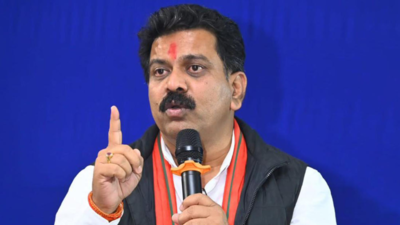
RAIPUR: Declaring March 31 a “historic” and “unforgettable” day for Chhattisgarh, deputy chief minister and home minister Vijay Sharma on Tuesday claimed that armed Naxalism had come to an end in the state, capping what he described as the collapse of a five-decade insurgency in just two years.Addressing the media in Raipur, Sharma said the armed Maoist structure in Chhattisgarh had been dismantled and that only a small number of scattered cadres remained, mostly without weapons. The declaration came on the deadline repeatedly set by Union home minister Amit Shah for ending Naxalism by March 31, 2026. Shah had publicly fixed that target earlier and reiterated it again in Parliament this week. The home minister gave credit to security forces, technology-based intelligence upgrades and local community leaders, transformed the operations. “The advanced tech-based based intel helped in improved surveillance and clearer jungle mapping made strikes more precise, leading to a series of successful operations in which many Maoists were neutralised while security forces escaped without injury in some missions. Amidst allegations of ‘fake encounters’ unfairly cast doubt on the courage of jawans even when Maoist communications themselves had acknowledged cadre losses,” HM said.
“Maoist organisation has now 99% finished, with only a few remnants left in parts of north Bastar around Kanker, while some others in the south had shed weapons and uniforms and blended back into village life. There is no reason for fear now,” Sharma said, adding that even among Chhattisgarh-linked DKSZC-level commanders, the remaining presence was outside the state, including in Telangana, not within Chhattisgarh.Sharma also sought to project the anti-Naxal drive as more than a gun battle. He said the govt softened the language around surrender because many cadres were uncomfortable with the term, and instead pushed “rehabilitation” more aggressively. Rehab centres were linked to vocational training, and he said cadres began staying there in larger numbers and taking up skill programmes.Sharma said the breakthrough was not the result of a change in the ground machinery, but of a change in political will after the BJP came to power in Dec 2023.
“No officer or employee was changed in Bastar. The govt changed, and the resolve changed,” he said, stating that the state moved with a sharper mission once the new dispensation took charge.He traced the shift to a high-level review in January 2024, chaired by Shah, in which Chhattisgarh was identified as the core theatre of the Maoist conflict. According to Sharma, it was assessed that 75% of the country’s Naxal footprint lay in Chhattisgarh and that the overwhelming share of active armed cadres, too, was concentrated in the state. From there, Sharma said, a multi-agency roadmap was drawn up with inputs from CRPF, BSF, state police and other forces on how to uproot armed Maoism. He admitted that even within the govt there had initially been doubts over whether the deadline was realistic, but said Shah laid out a “crystal clear” strategy that combined intelligence, operations, rehabilitation and local outreach. “The decisive turn was social as much as military. Bastar’s people had stopped accepting ‘laal atank’ (red terror) and had begun insisting on roads, schools, hospitals, anganwadis, electricity, water and mobile connectivity instead of fear and isolation,” he said.He said he had even issued a barcode-based public feedback mechanism asking Maoists and intermediaries to suggest what a workable rehabilitation policy should look like. He also offered unconditional talks, including through video calls, to anyone willing to discuss a return to the mainstream.Sharma spread the credit widely: to Bastar’s people, central and state forces, tribal society heads, panchayat representatives, journalists and govt outreach campaigns such as Bastar Olympics, Bastar Pandum and the rehabilitation policy.
Repeated meetings were held with community leaders from Narayanpur, Sukma and Bijapur — among Dorla, Bhatra, Muria, Madia and Gond tribal groups — urging them to open channels with local cadres because “these are also people of our own society”.That local mediation, he said, made many surrenders possible. Sharma cited October 2025 as a turning point, saying the surrender of 210 Maoists triggered a phase of mass returns. He claimed that in the past two years more than 3,000 cadres had been rehabilitated, around 2,000 armed cadres arrested and 536 neutralised. In a striking image meant to capture the moment, Sharma said villagers in Bastar were now “laughing freely” and telling him they felt as though they had only now become truly free.