
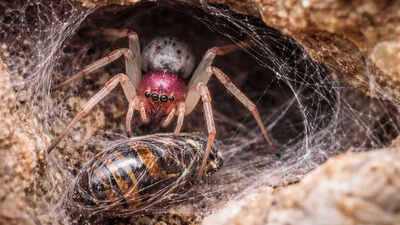
An emerging spider species known by the name of the popular rock band Pink Floyd has garnered international fame for more than just its unique moniker, but also its superior hunting skills.
Researchers have found evidence of a very small spider that is able to catch prey many times its own size, thus proving that small animals can rule their ecosystem as well. This is one of those cases when we realise there are still so many things we have yet to discover regarding biodiversity, particularly in an urban setting. Even in terms of its small body size, this spider is equipped with certain abilities that help it survive in the environment around us.
What is the Pink Floyd spider
The recently discovered spider is called Pikelinia floydmuraria and falls under a family of crevice-inhabiting spiders. This is a spider family whose members have been known to occupy cracks, walls, and other concealed locations, particularly those near human habitations.It was found in Colombia and has evolved to thrive in urban settings. The species name “floydmuraria” is derived from “Floyd,” which is interpreted as a reference to the rock band Pink Floyd, combined with “muraria,” meaning wall, reflecting its habitat.
This find was reported in the paper “Another web in the wall: A new Pikelinia from Colombia” and has offered a lot of information on the taxonomy, natural habitat, and biology of the spider.
How does this spider hunt prey larger than itself
One of the most remarkable features of the spider is that it can catch prey that is six times larger than itself. This is very uncommon for such a tiny creature, which indicates great efficiency in its hunting strategy.Unlike most spiders that rely on agility and physical strength, this one uses strategically placed webs that are usually erected close to artificial lighting sources, which attract insects.
Thus, the likelihood of capturing bigger prey becomes higher without using excessive effort.In other words, the spider maximises its food resources at minimal costs, which makes it quite efficient in the process of survival.
Diet and feeding behaviour
This spider mainly consumes smaller insects like ants, flies, and beetles. The mentioned insects are abundant in cities and towns, hence making the spider appropriate for habitats close to human settlements.Among the most consumed insects are the ants, followed by the flies, among others. The feeding behaviour indicates that the spider is crucial in maintaining population sizes of other insects.Besides, this spider can consume large insects, thus showing adaptability in its food consumption habits.
Why this discovery matters
Despite being very small, this spider plays a role in balancing the ecosystem. Spiders play a very important role in regulating insect populations, which may be detrimental to humans in terms of diseases and agriculture.The discovery of this spider brings to light the fact that urban areas have various kinds of organisms, which are often neglected. Moreover, it also proves that there is still much to discover in well-explored habitats.
Survival and adaptability in urban ecosystems
One of the characteristics of the organism is its ability to adapt to life in human habitats. This spider exists within the walls and structures of homes and makes use of areas that were typically overlooked before.The actions of the spider exhibit a highly adaptive nature. This is because it has adapted to the urban setting by spinning webs around sources of light, using the movements of insects. Adaptation plays a significant role in the survival of different organisms.Interestingly, this finding shows that even in places you wouldn’t expect, biodiversity can flourish. This is because while urban settings have been perceived to be independent of natural settings, they can also accommodate organisms.