
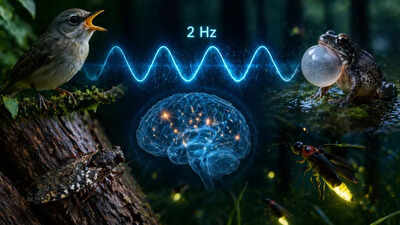
New research, published in the journal PLOS Biology, indicates that the timing used in communication among animals could be universal. It was discovered that animals, from insects to mammals, have a common rhythm in signalling, usually two pulses per second.The universal rhythm can be observed in various modes of communication, such as vocalisations, movements, or light. Even though animals use diverse ways of communicating, like birds chirping, frogs calling out, or flashing by fireflies, the common rhythm is observed within a range of 0.5 to 4 hertz.
A shared rhythm could explain how animals send signals to each other
Many types of creatures signal each other again and again at almost 2 Hz. The findings suggest that this synchronisation can be achieved by any creature from various environments without any similarity in size or nature of habitat, or even the style of communication.Field studies have been vital to this realisation. In their study of fireflies in Thailand, researchers discovered that the flashing rate of fireflies was almost the same as the chirping frequency of crickets in the vicinity. They found that this phenomenon was happening not by design but by chance.
Brain processing limits shape animal communication rhythm
“A widespread animal communication tempo may resonate with the receiver’s brain,” research suggests that this shared rhythm is linked to how animal brains process information. Neurons require time to receive, process, and transmit signals, which creates a natural timing constraint.
Computational models developed during the study showed that neural circuits respond most effectively to signals within the same 0.5 to 4 hertz range. This indicates that communication systems may have evolved to match the optimal processing speed of the brain. Signals delivered too quickly or too slowly may be less effective, while those within this range are more likely to be detected and interpreted accurately.
Cross-species communication patterns show biological consistency
In order to conduct the study, several pre-existing sources concerning animal signalling were reviewed. The data indicated that rhythmic behaviour was common among all types of animals and not restricted to one type. It included visual forms of signalling, like flashes of light in insects; auditory forms of signalling, like bird songs; and behavioural forms of signalling, used for courtship purposes.However, what was notable about animals was that they could change the speed of their signalling when needed.
Fireflies were noted to flash faster when stressed. But during normal communication, animals would stick to a certain tempo and would not deviate too far from their natural rhythm.
Neural resonance theory explains shared communication tempo
The study suggests that the observed rhythm occurs because of what is called neural resonance. Neural resonance is a situation where neural networks react more efficiently to stimuli that match their own timing. If the stimuli coincide with the neural resonance frequency, the information transmission will be more effective.To test the theory, scientists conducted experiments on artificial neural circuits. It was discovered that artificial neural circuits react to stimuli with the highest intensity around 2 hertz.
Universal rhythm in animals linked to human behaviour patterns
Moreover, there is also consistency with human behaviour. Human activities such as locomotion and vocalisations take place at similar frequencies. Furthermore, pop music has a frequency of 120 beats per minute, which translates to 2 hertz.Though the research cannot claim that there is one communication system used among all the species, it reveals a pattern of similar frequency structures among various species of life. This implies that there might be biological limitations within which the communication system operates, based on neurological functionality.

