
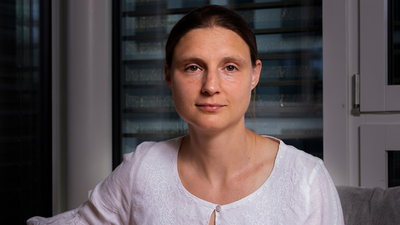
Imagine trying to stack oranges as tightly as possible so that no space is wasted. Simple enough in a grocery store. Now imagine doing it in a world with eight dimensions, a space that exists not in physical reality but in the abstract architecture of mathematics, and proving, beyond any doubt, that you have found the single most perfect arrangement possible.
For over 400 years, the greatest mathematical minds on earth could not do it. In 2016, a quietly determined Ukrainian mathematician named Maryna Viazovska did. She was 31 years old and working alone in Berlin. What she produced wasn’t just a solution, it was a masterpiece.
The 400-year-old problem solved by Maryna Viazovska
The sphere packing problem sounds deceptively simple: what is the most efficient way to arrange identical spheres so they fill space with as little wasted gap as possible? In three dimensions, the answer is intuitive, a pyramid shape, the way fruit is stacked at a market.
Johannes Kepler proposed this arrangement as optimal back in 1611, but it took until 1998 for a formal mathematical proof to be completed, and even that proof required lengthy, controversial computer calculations running to hundreds of pages.Move beyond three dimensions, however, and the problem becomes an entirely different beast. In four dimensions, five, six, seven, mathematicians had almost nothing. As Henry Cohn of MIT described it after Viazovska’s breakthrough: “It’s this horrific gap in our knowledge, almost embarrassing for humanity.”
Among all higher dimensions, eight was special. Mathematicians had long suspected that the answer lay in a structure called the E8 lattice, an arrangement of extraordinary symmetry that exists only in eight-dimensional space. More than a decade before Viazovska’s proof, Cohn and mathematician Noam Elkies had calculated that the E8 lattice was accurate to within one billionth of a percent of the theoretical optimum.
They could almost touch the answer. But they couldn’t prove it. Nobody could.
The proof that stunned the world in just 23 pages
Viazovska had been circling this problem for years. The key insight came from an unexpected direction: her doctoral work on modular forms, a type of highly symmetrical mathematical function that typically lives in the world of number theory, seemingly far removed from geometry. She had studied them under the legendary mathematician Don Zagier at the Max Planck Institute for Mathematics in Bonn, where she completed her PhD in 2013.Her breakthrough was in constructing a special “magic function” using tools from Fourier analysis and modular forms that could serve as an exact upper bound, a mathematical ceiling for how densely spheres could possibly be packed. When she compared that ceiling to the E8 lattice, they matched perfectly. An exact match of this kind is extraordinarily rare. In mathematics, it is the equivalent of cutting a key in the dark and finding it opens the lock.
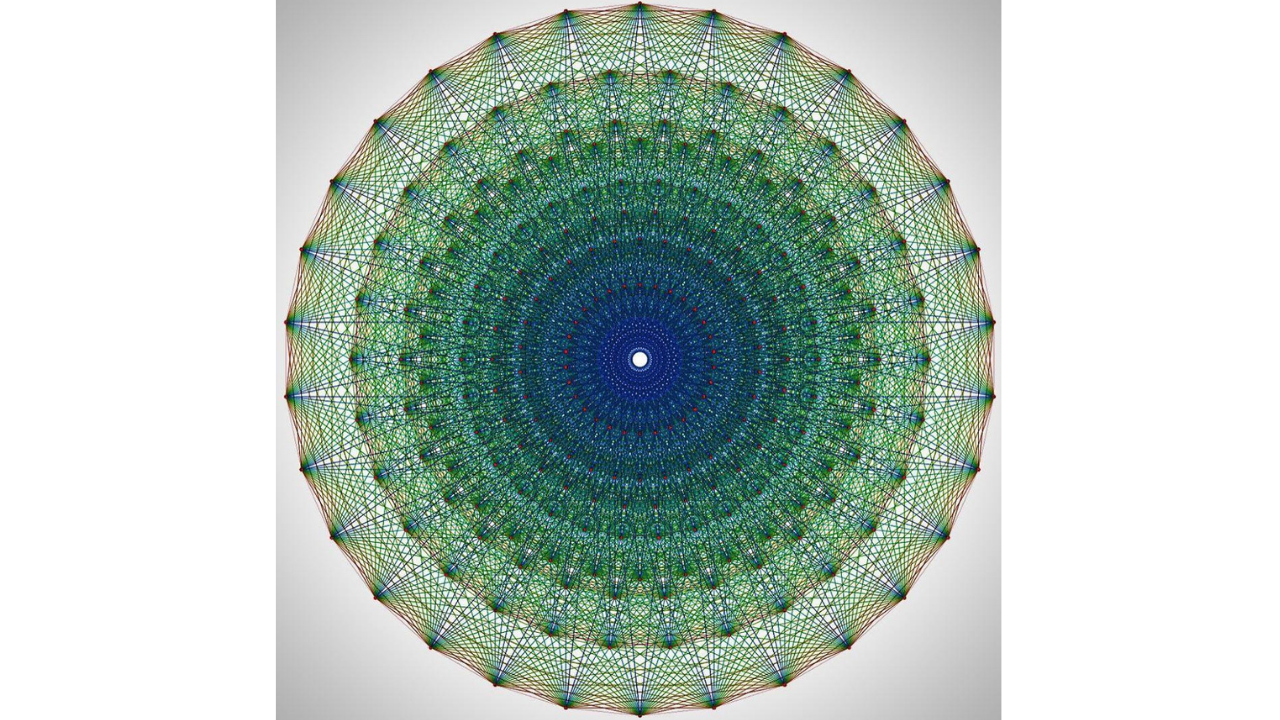
Visualisation of the E8 lattice, the highly symmetrical structure that solves sphere packing in eight dimensions.
The proof was uploaded to the academic preprint server in March 2016. It was 23 pages long. Earlier attempts at related problems had stretched into hundreds of pages. The mathematical community was stunned, not just by the solution, but by its elegance. Experts described it as “stunningly simple” and praised its clarity and originality. Within a week of its publication, Viazovska had teamed up with four collaborators to extend the same approach to 24-dimensional space, solving that version of the problem using a structure called the Leech lattice.
Two monumental problems, both cracked within days.
Why any of this matters beyond pure mathematics
It would be easy to dismiss this as beautiful but impractical mathematics conducted in a rarefied universe that ordinary life never touches. That would be a mistake.Sphere packing in higher dimensions is deeply connected to error correcting codes, the technology that allows information to be transmitted accurately across noisy channels. Every time you stream a video, make a phone call, or receive a file without corruption, error correcting codes are quietly working in the background.
The mathematical structures that govern optimal sphere packing are the same structures that underpin how information is efficiently encoded and decoded.
Viazovska’s work didn’t just satisfy centuries of curiosity, it expanded the theoretical foundations that applied mathematicians and engineers draw upon.Her results have also opened new doors in theoretical physics and cryptography, areas where the geometry of high-dimensional space has direct and practical consequences.
The woman behind the mathematics
Viazovska was born in Kyiv in 1984, the oldest of three sisters, and showed an early passion for mathematics through school competitions and Olympiads. She earned her bachelor’s degree at Taras Shevchenko National University of Kyiv, her master’s at the University of Kaiserslautern in Germany, and her doctorate at the University of Bonn. She is now a full professor and Chair of Number Theory at the École Polytechnique Fédérale de Lausanne in Switzerland.
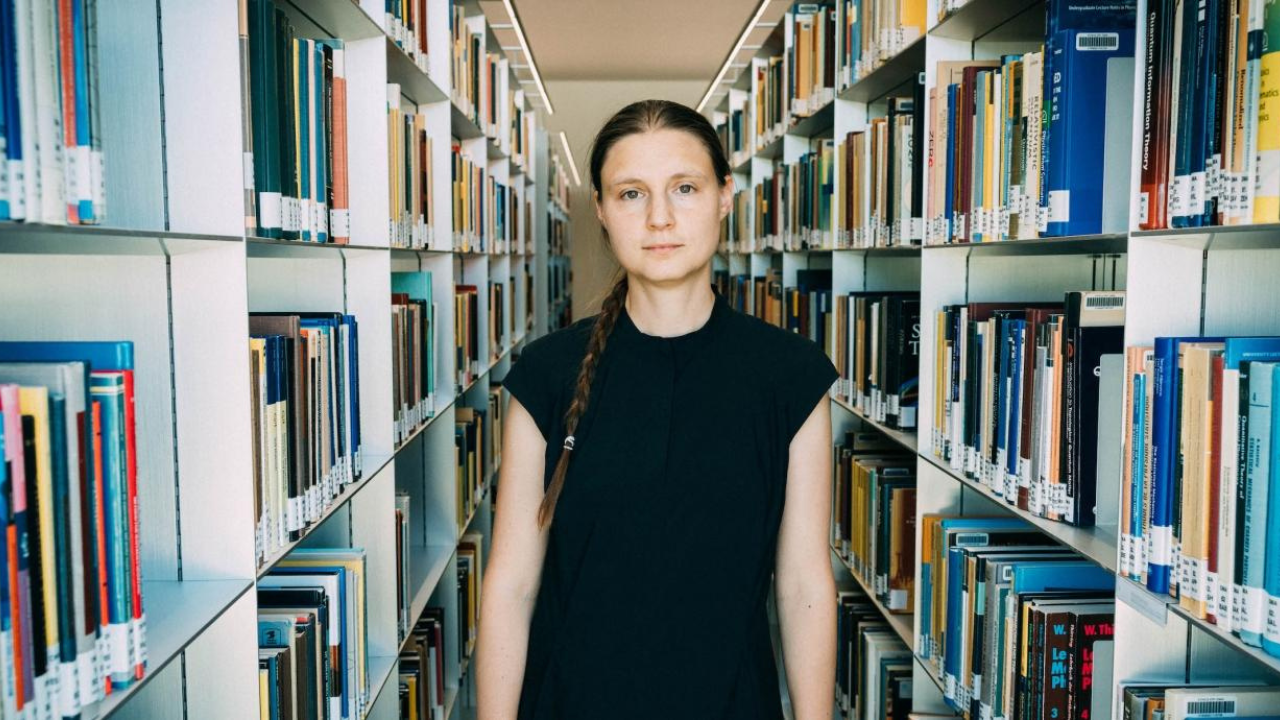
Her son Michael, a teenager, once recalled being the last child picked up from kindergarten in Berlin while his mother was absorbed in working on the E8 proof. When he later learned about the Fields Medal, he reportedly said: “Now I understand why she worked so much.”In July 2022, Viazovska was awarded the Fields Medal, widely regarded as the Nobel Prize of mathematics and restricted to mathematicians under 40. She became only the second woman in the prize’s 86-year history to receive it, after Iranian mathematician Maryam Mirzakhani in 2014.
The award was announced just weeks after Russia’s full scale invasion of Ukraine had begun. In interviews, Viazovska spoke quietly but with steel about her country: “Tyrants cannot stop us from doing mathematics.
There is at least something they cannot take away from us.”More than four centuries after Kepler first posed the question, the answer in eight dimensions arrived not through brute computational force, but through one woman’s creative intuition and a set of tools borrowed from a seemingly unrelated corner of mathematics. That is what makes Maryna Viazovska’s story so remarkable and so worth remembering.