
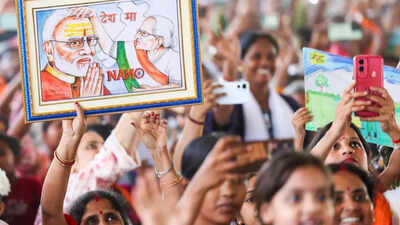
West Bengal polls (Image/ANI)
“Apnake bole ki hobe, kichu hole apni dekhben?”, ( What is the point of speaking to you? Will you bear the consequences if something happens?) A visibly agitated shopkeeper says to this reporter when asked for a sound bite on the upcoming elections.
It is not a one-off incident. Across South Bengal, this has become the default response of many ordinary people, especially from the middle class, when approached by the media.It is not just journalists. Even pollsters seem to face the same predicament. Pradeep Gupta of Axis My India recently told a news channel that in Bengal, over 60% of voters his teams approached were unwilling to reveal their voting preference.Gone are the days when roadside adda at a tea stall would see people bonding even with strangers over why Didi was the best, why no one could match the aura of Jyoti Basu, or how CPI(M) supporters were basically East Bengal and Argentina fans. Football and politics still mix, though not always with favourable outcomes, as the Messi fiasco showed. But politics in Bengal has moved far away from the days of bhadralok courtesies and healthy debates.
It is now shaped far more by cut-throat contests, muscle power and money power. That, many political observers believe, has deepened the disenchantment of ordinary people with politics.That probably explains the deafening silence of the voter.However, silent voters will have to make a decisive choice on April 29, when 142 seats go to the polls. Of these, 108 are in the Presidency Division, Kolkata, Howrah, Nadia, North 24 Parganas and South 24 Parganas where the TMC won 93 seats in 2021. Add nearby Hooghly, and the party had won 107 of these 126 seats in the last Assembly election. The TMC also retained a strong advantage across much of this belt in the 2024 Lok Sabha election, though the BJP remained competitive in several Matua-heavy and urban pockets.
How many seats the BJP can win here may well determine the fate of this election.Beyond the claims and counter-claims of the BJP and TMC, it is no secret that the first phase covered areas where the BJP has done well over the last 10 years and would hope to repeat that performance. But to win Bengal, it needs to breach the TMC’s fortress in Kolkata and its adjoining areas.What may help the BJP is the natural anti-incumbency any party faces after 15 years in power.
The TMC’s problem is further exacerbated by growing allegations of petty corruption in local-level governance. These are no longer reported as aberrations, but as a constant refrain across South Bengal. Words like cut-money and syndicate raj have become part of popular lexicon. Cutting across social strata, many complain, even on camera, that money has to be paid even for small construction work.This, along with the public spectacle of senior TMC leaders being hauled up in scams from SSC to ration and coal, has only reinforced that perception.
The lack of big industries and the consequent mass migration of citizens for both blue- and white-collar jobs are also issues that repeatedly come up in conversations. The Delhi-NCR domestic-help disruption during the election season has only sharpened that debate, and even some TMC workers and supporters grudgingly acknowledge the problem.However, that does not make the BJP’s path easy, apart from being the de facto vehicle for anti-establishment votes.
In fact, the party faces several structural challenges in South Bengal.
Mamata vs who?
One of the BJP’s bigger predicaments in South Bengal is finding someone who can match the clout of “ghorer meye” Mamata Banerjee. While the TMC’s credibility has slowly waned because of anti-incumbency and the string of scams that have rocked the party, Mamata Banerjee’s personal credibility remains unmatched.Fielding Suvendu Adhikari from Bhabanipur is perhaps a way of enforcing the binary that there is someone who can match the Chief Minister in her own pocket borough.
But it has also meant that Suvendu has largely been confined to Nandigram in Phase 1 and Bhabanipur in Phase 2.That has left Prime Minister Narendra Modi and Union home minister Amit Shah to do much of the heavy lifting. But they do not have the support of the kind of robust organisation that is crucial to bringing voters to the booth. In densely populated belts, the difference between winning and losing often comes down to micro-management.The BJP, though, believes it has learnt its lessons from previous drubbings. Speaking to TOI, state president Samik Bhattacharya exuded confidence and cited how the TMC managed to outsmart the Left in 2011 despite having fewer boots on the ground.
Left ‘rejuvenated’
The Left’s fortunes have gone sharply south over the last few elections, but it has cultivated a group of young leaders who are immensely popular on social media.From young faces like Afreen in Ballygunge, Kalatan Dasgupta in Panihati, Dipsita Dhar in North Dum Dum and Minakshi Mukherjee in Uttarpara, to veterans like Bikash Ranjan Bhattacharya and Manas Mukherjee, Left candidates are drawing large crowds and trying to redefine the language of organised protest and social justice for the downtrodden.
There is now an entire generation of voters that has not experienced 34 years of Left rule.
Many among them feel emboldened by the new grammar of politics brought in by these young leaders.In a first-past-the-post system, many of these candidates may not have enough legs to reach the finishing line first. But they may draw enough votes to puncture the BJP’s fortunes. Even if the TMC loses 5% of its vote share, but that vote gets divided between the Left and the BJP, the ruling party may still remain in a comfortable position.Ironically, the Left may end up providing a buffer to its bitter rival, the TMC, in its bid to retain power.
The 3-M factor
Muslims, Matuas and Mahila may well hold the key to South Bengal.With SIR becoming one of the defining anxieties of this election, studies by the Kolkata-based SABAR Institute have alleged disproportionate impact on Muslim voters in several constituencies. Sentiments on the ground also echo that premise, with minorities among the few groups openly vocal about supporting the TMC.
This phase includes areas with a considerable Muslim population, with South 24 Parganas having a Muslim share of 35.57% as per Census 2011 data.
The ISF factor, however, will keep the ruling party on edge in parts of South 24 Parganas, especially Bhangar and Canning Purba. Haroa, too, will be watched closely. Other anti-BJP parties, however, are not yet giving up on Muslim votes. Rahul Gandhi’s aggressive campaign in places like Metiaburuz points to the Congress looking to tap into wider anti-incumbency against the TMC.
The Left, too, has tried its best, especially through renewed outreach in slum areas.
But these overtures may have come too late to make any meaningful impact in the polls.The Matuas, Namasudra Dalit Hindus with roots in present-day Bangladesh, have felt deep anxiety over deletions in the SIR process. Namasudras account for about 17.4% of West Bengal’s Scheduled Caste population, making them the second-largest SC group in the state after Rajbanshis.
They have influence on around 50-70 assembly seats. In the last few elections, the Matuas have staunchly supported the BJP, largely buoyed by its promise of citizenship.
That trust is now under severe stress after the SIR controversy. Even Subrata Thakur, BJP MLA and a member of the Matua first family, acknowledged the discomfort while speaking to TOI, equating it with the unintended consequences of house-cleaning.On the ground, anger and despair among people whose names have been deleted is palpable. The slow pace of the CAA process has only added to the unease. With Amit Shah and Narendra Modi making campaign stops in Matua strongholds of Ranaghat and Thakurnagar, respectively, the latter being the centre of Matua politics, BJP would be breathing slightly easier. But whether Matua families whose names have been deleted will continue to steadfastly back the BJP remains a billion-dollar question.But perhaps the TMC’s biggest shield against anti-incumbency is its stable support among women voters.Schemes like Lakshmir Bhandar, Kanyashree and Rupashree have generated unprecedented goodwill for the TMC among women, and a sense of independence particularly among the financially disadvantaged. The delivery system has worked well, something even BJP and Left supporters acknowledge.In many constituencies, the gap between voting patterns of men and women may become considerable and decisive.
The BJP has sought to offset the TMC’s advantage by promising Rs 3,000 per month to women and by giving a nomination to Ratna Debnath, the mother of the RG Kar victim, from Panihati. The protests after the RG Kar incident on August 9, 2024, were among the most spontaneous outbursts of emotion, led largely by women, that West Bengal has seen in recent years.
They were raw, visceral and a culmination of frustration, all crystallised into one fireball of rage against the ruling party.
However, some believe the BJP’s decision to politically foreground the victim’s parents may have ensured that the issue loses some of its edge beyond Panihati.In 2011, the yearning for change was palpable. The contours of a tectonic shift were visible even before the first vote was cast. It was largely to Mamata Banerjee’s credit that she gave voice to that anger, dismantling the CPI(M)’s impressive party machinery.This time, voters are largely silent.Is that a sign of calm over the Hooghly, or merely the pause before the Kalbaisakhi, the nor’wester so common in this part of the world strikes and creates havoc? The answer, perhaps, is blowing in the wind.
Elections 2026 mark a pivotal year for democratic processes across various regions in India and globally. This includes key state assembly elections, local body polls, and by-elections that could significantly impact national-level politics. Get real-time updates, important dates, voting procedures, and verified news — all in one place. Whether you’re tracking results or exploring candidate profiles, this is your go-to hub for Elections 2026.