
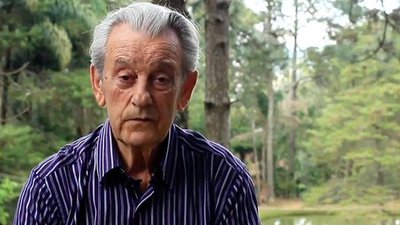
In a region where forests were once cleared to make way for agriculture, one man chose a different path. In the early 1970s, Brazilian environmentalist Antonio Vicente bought a stretch of degraded cattle pasture outside Sao Paulo, at a time when government policies were encouraging land clearing for farming.
What followed was a quiet, decades-long transformation. Instead of expanding agriculture, Vicente began restoring the land, planting trees one by one. Over the next 40 years, his persistence reshaped the landscape, turning barren ground into a thriving forest and creating a powerful example of long-term ecological restoration in a country still grappling with deforestation.
How one man turned degraded land into a 31-hectare forest
During the 1970s, Brazil’s development policies promoted agricultural expansion, often encouraging landowners to clear forests for economic use.
Vicente worked within this broader environment, yet chose a different direction. Rather than using his land for grazing or cultivation, he committed to reforestation, a decision that at the time appeared uncertain and unconventional.His motivation was rooted in personal experience. Growing up on a farm, he had seen forests cut down for charcoal production and cattle grazing, only for water sources to disappear over time.
That memory shaped his belief that forests were essential for maintaining water systems.The land he purchased had already been heavily degraded. Years of use as cattle pasture had left the soil compacted and low in nutrients. Water sources had nearly dried up, and vegetation was sparse. Restoring such an ecosystem required sustained effort, as natural regeneration alone would have taken far longer.Vicente began with basic tools, working with a small team and even using donkeys to help manage the terrain.
What started as a part-time effort gradually became his life’s work.He planted trees manually over more than four decades, eventually growing tens of thousands of native trees. The process was slow and physically demanding, with each sapling requiring careful placement and time to establish in weakened soil.In the early years, his efforts were met with scepticism. Neighbours told him planting trees was a waste of productive land and doubted the long-term value of his work.
The slow pace made results difficult to see at first, yet he continued steadily.
The return of water and wildlife
As the forest gradually took shape, the ecological impact became visible. The soil began to recover, retaining more moisture and supporting plant life. Springs that had once nearly disappeared started to flow again.Over time, the land developed into a richer ecosystem, with native vegetation creating a habitat for birds, small mammals and insects.
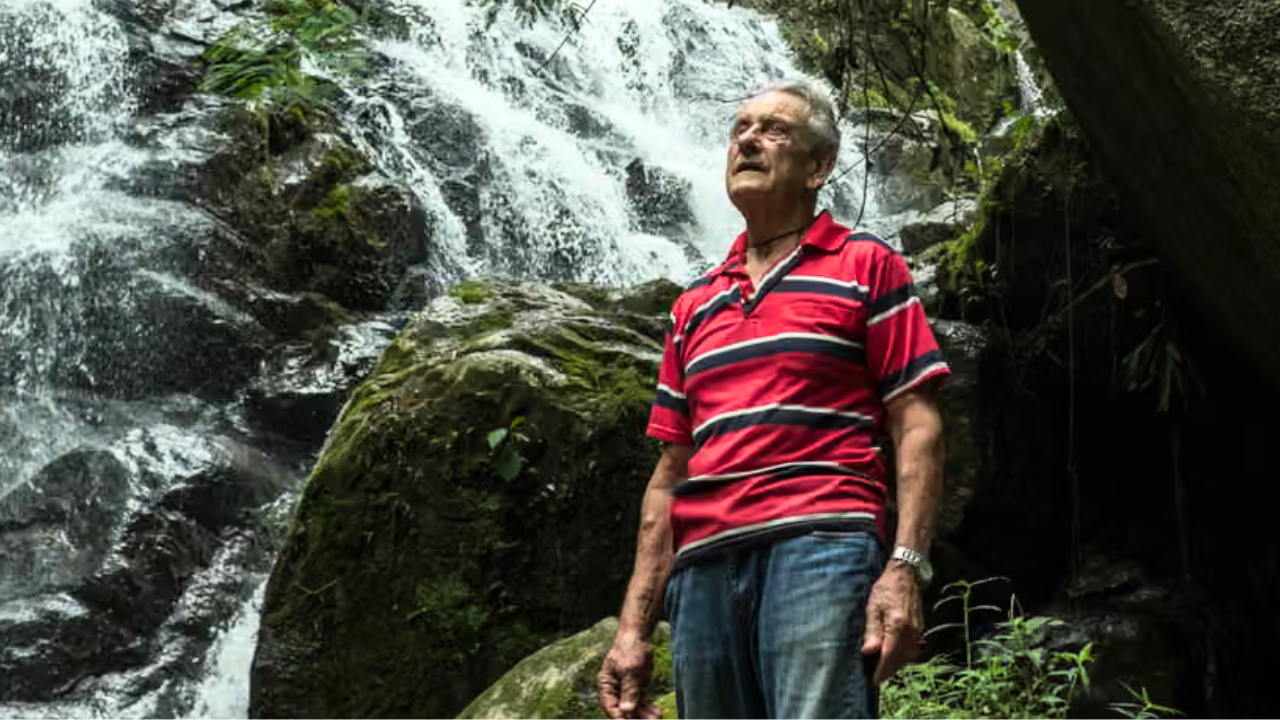
Vicente’s property now includes multiple natural water sources, including several small waterfalls, reflecting the restoration of the local water cycle.
A rare example in a changing country
Brazil continues to face large-scale deforestation, particularly in regions under pressure from agriculture and development. In São Paulo state, much of the original Atlantic Forest has already been lost, with only a small portion remaining.Against this backdrop, Vicente’s work stands out as an example of what sustained, long-term restoration can achieve.
While the scale of 31 hectares is modest compared to national deforestation figures, the project demonstrates the impact of persistence over time.Efforts like his are increasingly seen as important, as much of the land available for restoration lies on private property. Engaging individual landowners is considered key to broader environmental recovery goals.
A forest shaped by patience
Vicente later reflected that his motivation was simple. He responded to the condition of the land and worked to restore it gradually.
His effort was guided by patience rather than immediate results.He has described the forest in deeply personal terms, seeing each tree as part of something he helped create over decades.The forest he created now exists as a living system, one that continues to grow and evolve with minimal intervention. The story of Antonio Vicente proves what steady, long-term effort can achieve. In an era where environmental challenges often seem overwhelming, his work offers a grounded example of restoration built over decades.His 31-hectare forest does not change global deforestation trends, yet it shows that recovery is possible, even on land that once appeared beyond repair.

